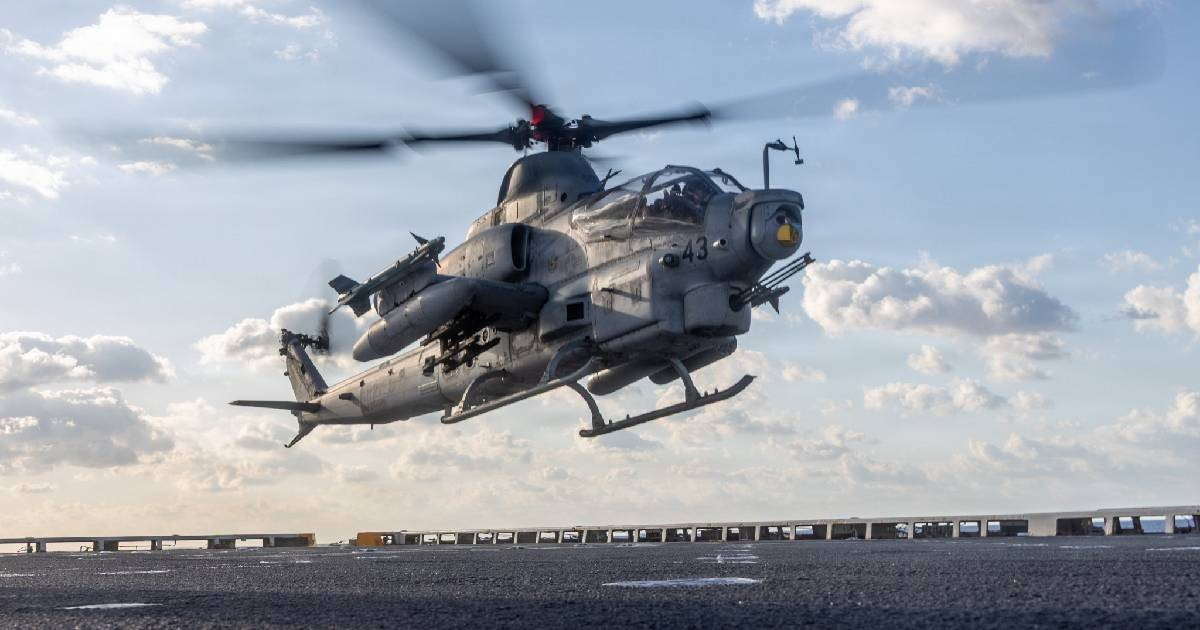
The U.S. Southern Command recently shared a striking image of an AH-1Z Viper attack helicopter from the 22nd Marine Expeditionary Unit taking off from the amphibious ship USS Fort Lauderdale in the Caribbean Sea. This is part of Operation Southern Spear, amid escalating tensions between Washington and Havana.
The photo, which was captured on May 4, 2026, was released with a message emphasizing that military forces in the Southern Command's area of responsibility are actively supporting Operation Southern Spear. These operations, led by the Department of Defense and prioritized by the president, aim to disrupt illegal drug trafficking and safeguard the homeland.
On the same day, Southern Command carried out a lethal kinetic strike in the Caribbean against a vessel operated by groups designated as terrorists, resulting in three fatalities. This release coincides with an unprecedented diplomatic and military escalation.
Earlier that week, Politico reported that Southern Command had initiated a "planning series" for potential military contingency scenarios against Cuba, although it clarified that no decision or imminent action has been confirmed. A White House official indicated that the Pentagon's role is to provide the president with a comprehensive range of options.
On Wednesday, the Miami Herald disclosed that the Trump administration was "building a case" for possible military intervention in Cuba if diplomacy and sanctions do not yield changes. Secretary of State Marco Rubio hinted on Fox News that Cuba would be given an opportunity, yet expressed skepticism about the regime's ability to alter its course.
Amid rising tensions, Southern Command's leader met with Defense Secretary Pete Hegseth on Thursday, while Russia accused the United States of preparing for military intervention, and Cuban Foreign Minister Bruno Rodríguez accused Rubio of provoking aggression against the island.
Coinciding with Cuba's Independence Day, Southern Command announced the arrival of the USS Nimitz carrier strike group in the Caribbean as part of the Southern Seas 2026 exercise. The deployment of the USS Fort Lauderdale and the 22nd Marine Expeditionary Unit in the Caribbean aligns with a continuous presence pattern since August 2025, which marked the beginning of sustained amphibious forces in the region.
Operation Southern Spear, officially launched between September and November 2025, aims to "detect, disrupt, and degrade transnational and illicit maritime criminal networks." By early May 2026, it had resulted in at least 190 deaths from numerous kinetic strikes.
Simultaneously, the Trump administration has imposed over 240 sanctions against Cuba since January 2026, intercepted at least seven oil tankers bound for the island, and signed an executive order on May 1 expanding restrictions on energy, defense, mining, and financial services. Reports suggest these actions have reduced Cuban energy imports by 80% to 90%, leading to power outages lasting up to 25 hours daily in more than 55% of the Cuban territory.
The Southern Command's publication this Friday, showcasing activity from May 4, arrives at a time of heightened pressure on the regime, giving it a strategic signaling dimension that extends beyond its declared operational purpose against drug trafficking.
Key Questions About U.S. Southern Command's Activities in the Caribbean
What is Operation Southern Spear?
Operation Southern Spear is a mission conducted by U.S. Southern Command aimed at disrupting illegal drug trafficking and protecting national security through various military operations in the Caribbean.
Why is the U.S. Southern Command active in the Caribbean now?
The U.S. Southern Command's recent activities in the Caribbean coincide with increased diplomatic and military tensions between the U.S. and Cuba, aiming to apply pressure on the Cuban regime while combating illicit activities in the region.
What are the implications of the sanctions imposed by the Trump administration on Cuba?
The sanctions have severely impacted Cuba's energy imports, reducing them by 80% to 90%, which has led to widespread power outages across the island, further exacerbating the country's economic difficulties.