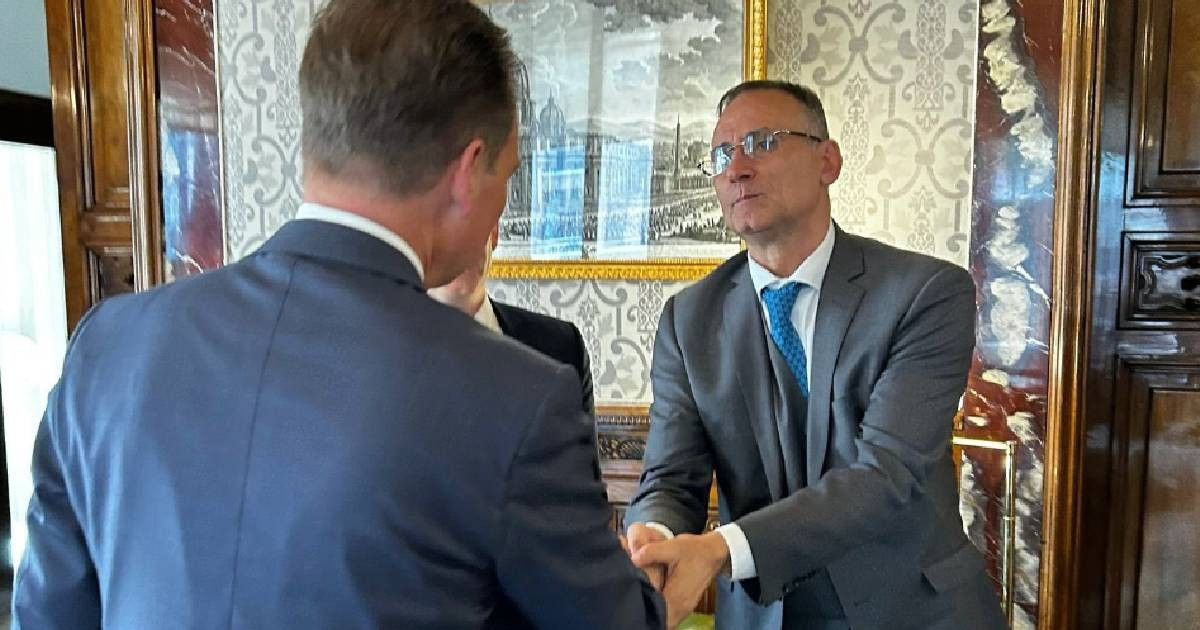
The U.S. Embassy to the Vatican hosted José Daniel Ferrer, the leader of the Patriotic Union of Cuba (UNPACU), this past Friday. The meeting is part of the Cuban dissident's extensive tour across Europe which began in early May.
The American diplomatic mission shared the details of the encounter on their official X account, portraying Ferrer as "a Cuban pro-democracy leader who has personally endured the oppressive nature of the Cuban regime" and "a man of deep faith, a courageous Cuban dissident forced into exile for demanding basic freedoms."
This gathering carries significant symbolic weight, as the Vatican played a pivotal role in Ferrer's release from prison in January 2025. At that time, an agreement brokered by the Holy See alongside Washington led to the release of 553 Cuban political prisoners.
Nonetheless, Ferrer refused to sign the conditional release document, deeming it illegitimate. In April of that year, the regime retracted his release and sent him back to Mar Verde prison in Santiago de Cuba.
Ferrer ultimately went into exile in October 2025, relocating to Miami with his family, an act described by his supporters as a forced exile.
His European tour, organized in collaboration with Prisoners Defenders and its president Javier Larrondo, commenced in Madrid on May 2 and spans more than ten countries.
On May 5, Ferrer appeared before the European Parliament in Brussels, highlighting the Cuban crisis and calling for Magnitsky sanctions against regime officials.
Amidst the tour, Poland offered its democratic transition experience to Cuba, and Santiago Abascal, the leader of Vox, met with Ferrer, pledging to support the "Cuba Liberation Agreement."
This agreement, signed in Miami on March 2 by over 30 exile organizations, is the central political document Ferrer advocates for throughout his journey. His visit to the U.S. diplomatic mission at the Vatican took place under active diplomatic pressure; Secretary of State Marco Rubio traveled to the Vatican this month to discuss Cuba with Pope Leo XIV.
Parallel to the meeting, Ferrer published a comprehensive text titled "The Vatican, the European Union, and Latin America in the Face of the Cuban People's Tragedy," urging these institutions to abandon diplomatic ambiguity. "The Cuban tragedy has reached a point where international silence can no longer be presented as diplomatic prudence," Ferrer stated on his Facebook profile.
Ferrer demanded that humanitarian aid reach "directly to the needy population, bypassing the corrupt hands of the communist regime," and harshly criticized private dialogues between European governments and the dictatorship: "Privately urging the Castro-communist regime to account for its crimes is like quietly scolding Al Capone for his murders, extortions, and criminal networks without applying real pressure, sanctions, public denunciations, and without standing by the victims."
"There are moments when neutrality becomes a grave sin. There are circumstances where remaining silent in the face of grave injustices makes you complicit. Cuba is living one of those moments," Ferrer concluded.
Key Aspects of José Daniel Ferrer's European Tour
What is the significance of José Daniel Ferrer's meeting at the U.S. Embassy to the Vatican?
The meeting is significant because the Vatican had previously played a key role in Ferrer's release from prison, symbolizing continued international support for Cuban dissidents.
Why is Ferrer advocating for the "Cuba Liberation Agreement" during his tour?
The "Cuba Liberation Agreement," signed by numerous exile organizations, is a central political document aimed at promoting change in Cuba, which Ferrer is actively promoting during his European tour.
What stance does Ferrer take on international aid to Cuba?
Ferrer insists that international aid should directly reach the Cuban people, bypassing the regime's control to ensure it helps those in genuine need.