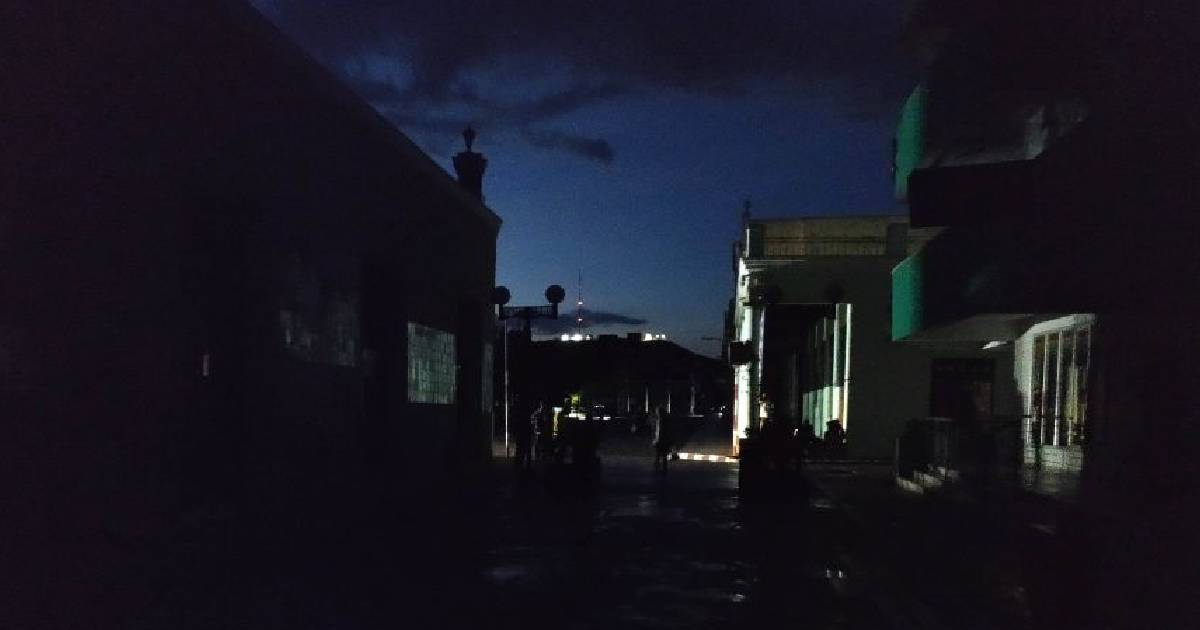
Davielquis Cortina Cobas, the director of the Territorial Dispatch Base in Holguín, has openly acknowledged this week that the province's current electricity strategy involves leaving entire municipalities without power to ensure critical circuits remain operational. These circuits supply electricity to hospitals, communication centers, water supply facilities, the Communist Party headquarters, the provincial government, and the electric company itself.
Appearing on Telecristal's program "En Primer Plano," Cortina provided a technical breakdown, explaining that circuits 2 and 12 in Holguín city focus on all essential facilities in the province. These include the Clínico Quirúrgico, Pediatric, Military, and Vladimir I. Lenin hospitals, the State Major, the Communist Party, the Government, potable water wells, Etecsa, and central banks.
According to Cortina, just 10 to 15 megawatts allocated to these two circuits ensure this critical hub remains functional, permitting the remainder of the available capacity to be rotated among the other circuits in the province.
The most telling revelation came when he attempted to justify why some circuits in Holguín city receive power more frequently than the rest of the province. He admitted that keeping circuit 2 closed during the day is a decision based on efficiency, not an accidental emergency.
"For us as a company, as a dispatch center, it's not profitable; it's more economical, and more efficient to keep circuit 2 closed and use those 10 megawatts to reduce the impact on other circuits," he acknowledged.
Cortina also highlighted the human cost of this strategy. The circuits in Banes 4, Banes 5, and the Urbano Noris municipality were without electricity for 13 to 14 hours at the time of the interview, despite being eligible for service starting from 3 PM.
The backdrop of this admission is grim. Cuba is currently facing an anticipated shortfall of between 1,840 and 1,915 megawatts during peak night hours, with only 1,300 megawatts available against a demand of 3,200 MW.
The official further confirmed that Cuba's electricity generation relies solely on domestic crude oil and associated gas. "We are not receiving any international support or fuel imports," he stated.
Public reaction in the comments on the company’s Facebook video reveals widespread frustration that transcends technical explanations.
"Come to Mayarí and you'll see an entire municipality without connection," wrote Hector Fuentes Rabaina.
Yanelis Guerrero from Buenaventura, in Calixto García municipality, reported having "only two hours of power and up to 40 hours without."
Naleynis Batancourt from Pueblo Nuevo subdivision in the provincial capital was more direct: "I've never seen any improvement, here we only get three hours of electricity a day, and during the night, today we've been over thirty hours without power."
Several residents also questioned the truthfulness of the official explanation. Daite García Almaguer remarked: "Please stop lying, the circuits that consume the most in Holguín, 2 and 12, are now the least consuming ones, where all the private businesses are located."
Another resident, Tania Aguilera, warned that the situation could become unsustainable even for hospitals. "If they don't regulate the number of residential areas included in the prioritized circuits, there will come a time when there isn't even enough for the hospitals," she warned.
The electricity crisis has sparked protests across several Cuban cities, with the Cuban Observatory of Conflicts recording 1,133 protests in April 2026, marking a 29.5% increase compared to the same month the previous year.
FAQs on Holguín's Electricity Crisis
Why are entire municipalities in Holguín left without electricity?
The strategy prioritizes keeping critical circuits powered, which supply electricity to essential services and government facilities, over providing continuous service to all areas.
What is the impact of the electricity strategy on local residents?
Residents experience prolonged power outages, sometimes lasting over 30 hours, causing significant disruption to daily life.
How is Cuba addressing its electricity generation needs?
Cuba relies solely on domestic crude oil and associated gas for power generation, with no international fuel imports.