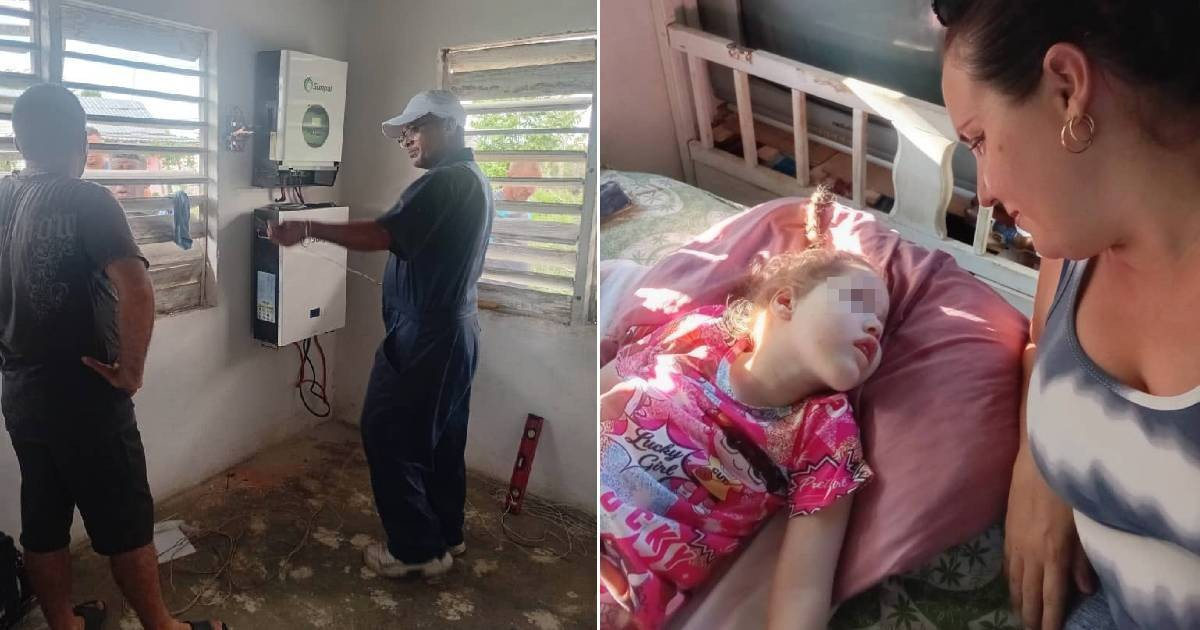
Milena Acosta, a six-year-old Cuban girl suffering from Lennox-Gastaut syndrome, has finally returned home thanks to the generosity of countless Cubans who contributed to install a solar power system. This system is the only backup that ensures her survival during the frequent power outages that plague the island.
Her father, Baysel Acosta Moreno, shared the joyful news on Facebook, expressing deep gratitude: "I will be eternally grateful to Carla and Mónica for their dedication and support to our cause. For their encouraging words and for being compassionate individuals who empathize with our struggles. To Verónica for her initiative, her consistent effort to address every problem, find solutions, and attend to every detail to make this project stronger."
The "Manos a la Obra" initiative, led by Verónica C. Barrios, facilitated the installation in the Acosta family home. It includes a Sunpal brand inverter and storage battery, a rooftop solar panel, and an 18,000 BTU air conditioner, all of which ensure the continuous operation of the medical equipment Milena needs to survive.
Verónica C. Barrios confirmed Milena's homecoming with a concise yet powerful message: "Milenita is home. Milena Acosta, the third of the girls for whom a GoFundMe campaign was launched through Mónica Baró Sánchez and Carla Gloria Colomé Santiago, is now back home, far from a hospital ward."
Milena's situation was part of a GoFundMe campaign initiated in January 2026 by Cuban journalist Mónica Baró Sánchez and Carla Gloria Colomé Santiago. The campaign aimed to raise $12,500 for three critically ill girls: Valentina Ramos, a one-year-nine-month-old who had never lived outside a hospital; Yeilín, a two-year-old with type one spinal muscular atrophy, dependent on a mechanical ventilator 24/7; and Milena.
The fundraising progressed slowly: by January 22, it had only reached $715; by January 25, $1,853; and by February 17, $4,292, still far from the goal. Eventually, the campaign succeeded, and Milena became the third of the three girls to return home.
The plight of these families highlights the harsh reality in Cuba: frequent power outages, which in provinces like Pinar del Río have lasted up to 30 consecutive hours, force children reliant on medical equipment to remain hospitalized indefinitely, as a power cut at home could be fatal.
The Cuban government fails to provide any energy backup for such cases, leaving the survival of the most vulnerable to the compassion of the diaspora and civil organizations.
In April 2026, a critically ill two-month-old faced worsening conditions due to power outages lasting up to twenty hours daily, while the healthcare system operated with only 30% of essential medications and 11,193 children awaited surgical procedures.
Baysel Acosta Moreno had encapsulated this suffering in January with a phrase that touched thousands: "If you see me crying, it doesn't matter, each tear carries all the love in the world." Today, that same voice is filled with gratitude.
Cuban Power Outages and Their Impact on Health
How did Milena Acosta return home?
Milena Acosta returned home thanks to the donations made by many Cubans, which helped install a solar power system that ensures the operation of her essential medical equipment during power outages.
What is the "Manos a la Obra" project?
"Manos a la Obra" is an initiative led by Verónica C. Barrios that facilitated the installation of solar power equipment in Milena Acosta's home to help her survive the frequent blackouts in Cuba.
Why are power outages a significant issue for Cuban families?
Power outages in Cuba pose a severe risk to families with members who rely on medical equipment, as a lack of electricity can be life-threatening without a backup power source.