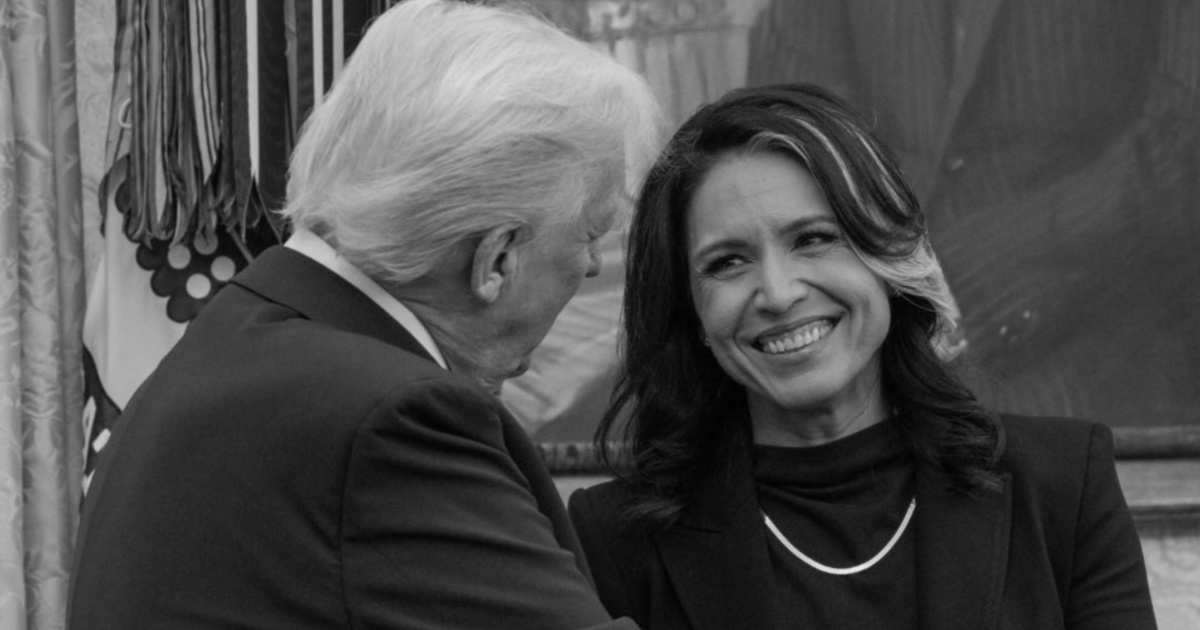
On Friday, Tulsi Gabbard announced her resignation as the Director of National Intelligence of the United States, as first reported by Fox News following a meeting in the Oval Office with President Donald Trump.
Gabbard personally informed Trump of her decision during their meeting, with her resignation set to take effect on June 30, 2026, according to the resignation letter she handed to the President.
The reason for her departure is strictly personal and family-related: Gabbard's husband, Abraham Williams, has been diagnosed with an extremely rare form of bone cancer, prompting her to step down to support him through the treatment of this serious illness.
"Regrettably, I must submit my resignation, which will become effective on June 30, 2026," Gabbard wrote in her resignation letter, as detailed by Fox News.
As the Director of National Intelligence, Gabbard oversaw the coordination of 18 intelligence agencies across the country, holding the highest-ranking position within the entire U.S. intelligence community.
The Senate had confirmed her appointment on February 12, 2025, with a narrow vote of 52 to 48, with nearly the entire Republican bloc in favor, except for a single dissenting vote from Senator Mitch McConnell, who had voiced concerns over her profile.
Her appointment was seen as unconventional from the outset. A former Democrat and congresswoman from Hawaii between 2013 and 2021, Gabbard had run for the Democratic presidential nomination in 2020 and supported Bernie Sanders in 2016, breaking from her party's official stance. She left the Democratic Party in 2022 and gradually aligned herself with Trump.
Her confirmation sparked resistance both within and outside the Republican Party due to her comments perceived as favorable to Russia, her meeting with Syrian President Bashar al-Assad, and her public defense of Edward Snowden, the former National Security Agency contractor who leaked classified documents.
Before her political career, Gabbard served in the Hawaii National Guard and was deployed to Iraq and Kuwait, a background her supporters touted as credentials for the position.
During her tenure leading the intelligence community, Gabbard was involved in several significant episodes, including the declassification of documents related to Trump's impeachment process in 2019, where she claimed there were irregularities based on hearsay and sources with potential political biases.
She was also evacuated along with Marco Rubio and Pete Hegseth during the shooting at the White House Correspondents' Dinner in Washington on April 26, an incident that sparked debate over security protocols for high-ranking officials.
Gabbard married Abraham Williams in April 2015. The couple has not made any additional public statements regarding the medical diagnosis beyond what was mentioned in the resignation letter.
Her departure raises questions about who will lead the U.S. intelligence community at a time of heightened geopolitical tension, with ongoing negotiations with Iran, active conflicts on multiple international fronts, and the intelligence community undergoing restructuring under the Trump administration.
Key Questions About Tulsi Gabbard's Resignation
Why did Tulsi Gabbard resign as Director of National Intelligence?
Tulsi Gabbard resigned to support her husband, Abraham Williams, who was diagnosed with a rare form of bone cancer, through his treatment.
When will Tulsi Gabbard's resignation take effect?
Her resignation is set to become effective on June 30, 2026.
What role did Tulsi Gabbard have before her resignation?
Tulsi Gabbard served as the Director of National Intelligence, overseeing the coordination of 18 intelligence agencies in the United States.