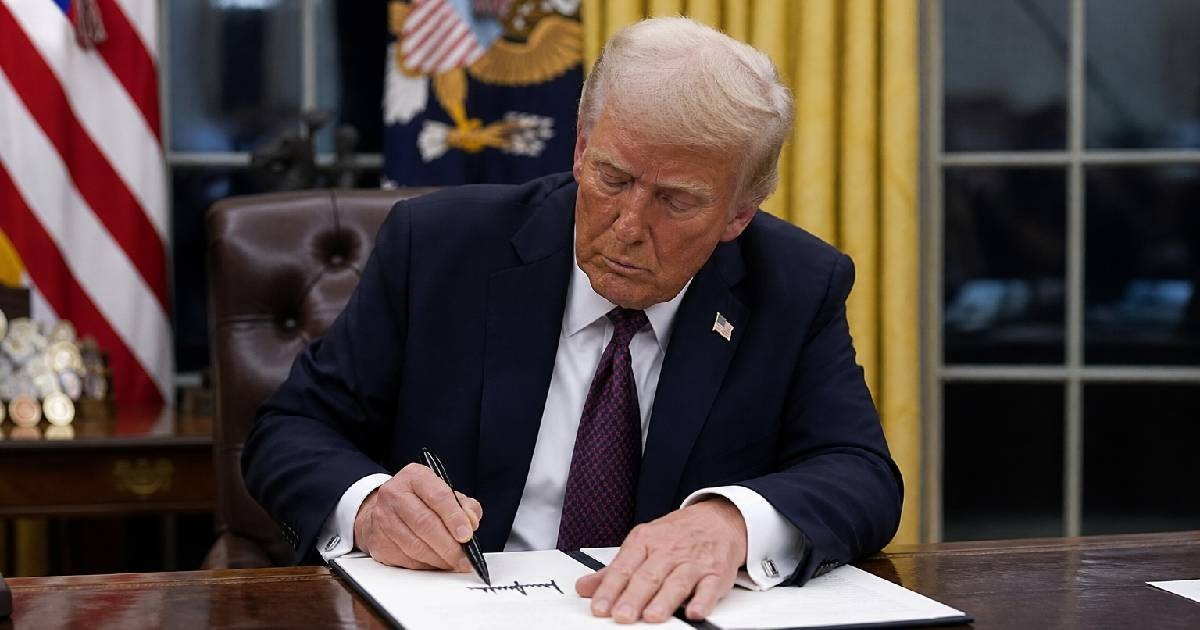
On Thursday, the Trump administration unveiled a plan to loosen federal regulations that required supermarkets and air conditioning companies to reduce their use of hydrofluorocarbons (HFCs). These greenhouse gases, commonly used in refrigeration, have been targeted in an effort to curb inflationary pressures impacting American families.
Trump, along with Lee Zeldin, the administrator of the Environmental Protection Agency (EPA), highlighted the initiative at the White House, promoting it as a direct economic relief for consumers. They estimated savings of "over $2.4 billion annually" for families and businesses.
Zeldin pointed out that the supermarket sector alone could see savings of $800 million, labeling HFCs as "detrimental" to food prices.
Greg Foran, CEO of the Kroger chain, supported the decision during the event, stating that delaying the regulation would prevent the company from having to "spend more capital quickly" to replace expensive refrigeration equipment.
Impact on Supermarkets and Refrigeration
The EPA's proposal would raise the allowable global warming potential threshold for cold storage and supermarket systems to 1,400, effective until 2032, after which stricter limits would be reinstated.
The rule being relaxed, known as the Technology Transitions Rule, was initially enacted under the Biden administration in October 2023. It set phased deadlines for various sectors to reduce their reliance on HFCs.
Criticism and Environmental Concerns
Critics point out that the AIM Act, which originally instigated these restrictions, was signed by Trump himself in 2020 to align the U.S. with the Kigali Amendment to the Montreal Protocol, which aims to eliminate these gases gradually.
Since December 2025, the EPA had already considered the enforcement of the January 2026 deadlines a "low priority," foreshadowing the formal relaxation announced this week.
Wider Deregulation Strategy Amid Economic Challenges
This move is part of a broader deregulatory strategy the administration has accelerated in recent weeks: on May 19, the Department of Energy announced the removal of 47 regulations deemed burdensome.
The economic backdrop underscores the political urgency: U.S. inflation reached 3.8% year-over-year in April 2026, the highest since May 2023, driven largely by an energy shock following U.S. and Israeli attacks on Iran in late February, which resulted in the blockade of the Strait of Hormuz.
Food prices rose 3.2% year-over-year, with grocery items increasing by 3.6%, while real wages turned negative for the first time since April 2023, as salaries grew 3.6% against an inflation rate of 3.8%.
However, experts and industry members question whether the relaxation of the HFC rule will lead to actual savings for consumers, warning that the measure could conflict with Congressional mandates and international commitments.
Environmentalists argue that the decision delays the technological transition to lower-impact refrigerants and extends reliance on gases with a global warming potential thousands of times greater than that of carbon dioxide.
"For consumers, this means the cost of living remains a challenge. For the Federal Reserve, it likely means interest rate cuts will be postponed into the future," cautioned Sung Won Sohn, an economist at Loyola Marymount University.
Key Questions on Trump's Climate Regulation Rollback
What are hydrofluorocarbons (HFCs) and why are they significant?
HFCs are potent greenhouse gases used in refrigeration and air conditioning. They have a high global warming potential, making them significant in discussions on climate change and environmental regulations.
How might the rollback of HFC regulations affect consumers?
While the administration claims it will lead to significant savings, experts argue that real consumer savings may not materialize, and it could conflict with existing mandates and international commitments.
What are the environmental concerns regarding the deregulation of HFCs?
Environmentalists worry that easing HFC regulations will hinder progress toward more climate-friendly refrigerants and prolong the use of gases with a high global warming potential.