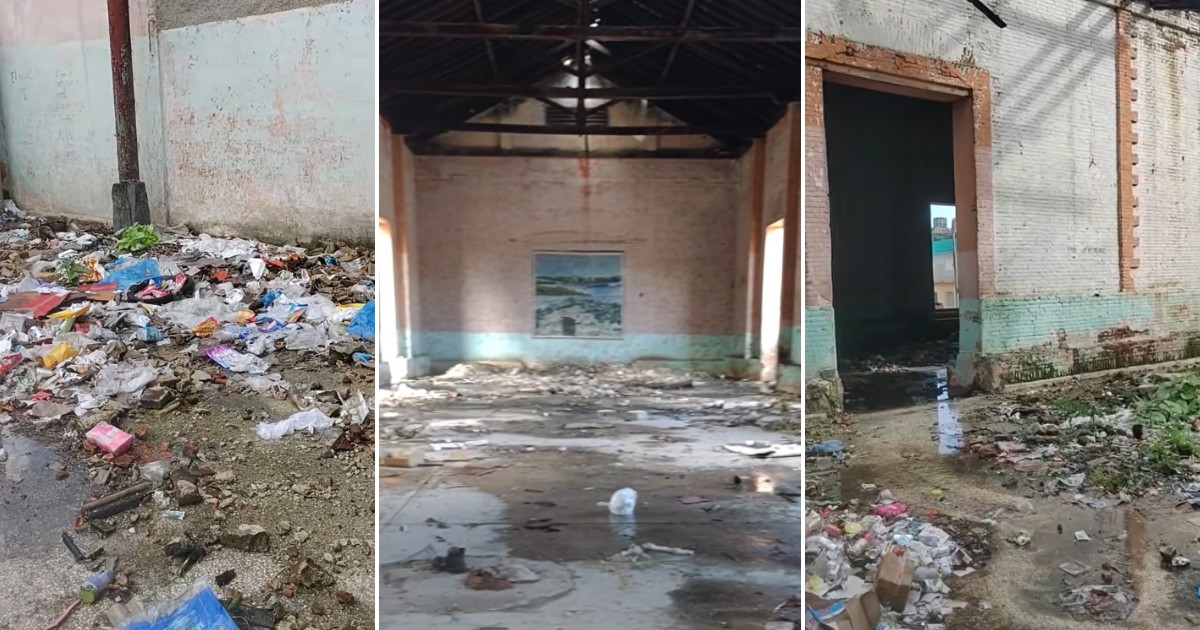
Once a bustling hub, the former Holguín-Gibara Railway Station, opened on April 4, 1893, in the Zayas district of Holguín, has now deteriorated into a dumping ground for debris, mosquitoes, and rats. A report by Cubanet features local residents who directly blame the authorities for this decay.
The colonial-style building, known for its prominent pediment, two large side corridors supported by wooden posts, and a gabled tile roof, served the community for 65 years until 1958. It was then rendered inactive due to sabotage during the armed struggle.
Following the railway's closure, the building found new life as a modeling and sculpture workshop before becoming an agricultural market called "Mercado Mambí," partially supplied by the Youth Labor Army, a productive branch of the Revolutionary Armed Forces.
Voices of Frustration and Irony
Today, the remnants of the façade stand in stark contrast to a government sign reading "The Revival of Mambí," complete with the Youth Labor Army's logo—an irony not lost on the locals.
"All we see is ruin and abandonment, what exactly was revived?" questions Luis López, a resident of Holguín, as he reads the sign.
"Leaving that sign amid these ruins is an insult to the memory of the mambises who fought and died for this country's freedom," López adds.
Community Outcry Over Official Neglect
Neighbor Félix Borrero criticizes the government's inaction: "With some of the revenue from the market, they could have repaired the station, preventing its current state."
"The authorities' neglect has cost us a piece of Holguín's history," Borrero laments.
This isn't the first time concerns have been raised about the building's condition. In April, another account of the station's deterioration stirred reactions on social media.
Health Risks Amid Historical Decay
Despite its mandate to "rescue, preserve, investigate, and disseminate the nation's cultural and natural heritage," the Provincial Center for Cultural Heritage of Holguín, established on April 1, 1990, has failed to act, according to the locals.
"Those in power don't care about heritage," declares Jorge Góngora, a resident who walks past the site daily. "Government talks a lot about culture and history, but lets historic sites fall apart," he adds.
The neglect also poses a direct health threat: the accumulation of garbage and stagnant rainwater under the crumbling roof creates a breeding ground for disease-carrying vectors, in a province that reported dengue and chikungunya cases in nearly all its 14 municipalities as of October 2025.
Wider Pattern of Negligence
This situation is not unique. The iconic sculpture on Holguín's boulevard collapsed on May 16 after six weeks without preventive action, and the former Los Caballitos children's park has turned into a vacant lot and dump with no plans for rehabilitation.
Isabel Pérez, a local resident, reflects on lost potential: "The site could have been a cultural center, a museum, something for the youth, but it was allowed to die, erasing history through neglect."
"We've grown accustomed to seeing this place as a dump, and that normalization is what worries me most," concludes Elena Torres, another resident demanding accountability: "What did the Provincial Center for Heritage and the Government do to prevent this?"
Understanding the Neglect of Cuban Heritage Sites
Why has the Holguín-Gibara Railway Station been neglected?
The neglect is attributed to the lack of action by local authorities and the Provincial Center for Cultural Heritage, despite its mandate to preserve historical sites. Residents cite official disinterest as a key factor.
What health risks does the abandoned station pose?
The accumulation of garbage and stagnant water has created conditions favorable for disease-carrying vectors, posing a health threat in a province already reporting dengue and chikungunya cases.
Have there been previous reports on the station's condition?
Yes, concerns about the station's deterioration were raised on social media as recently as April, highlighting ongoing community frustration with its neglected state.