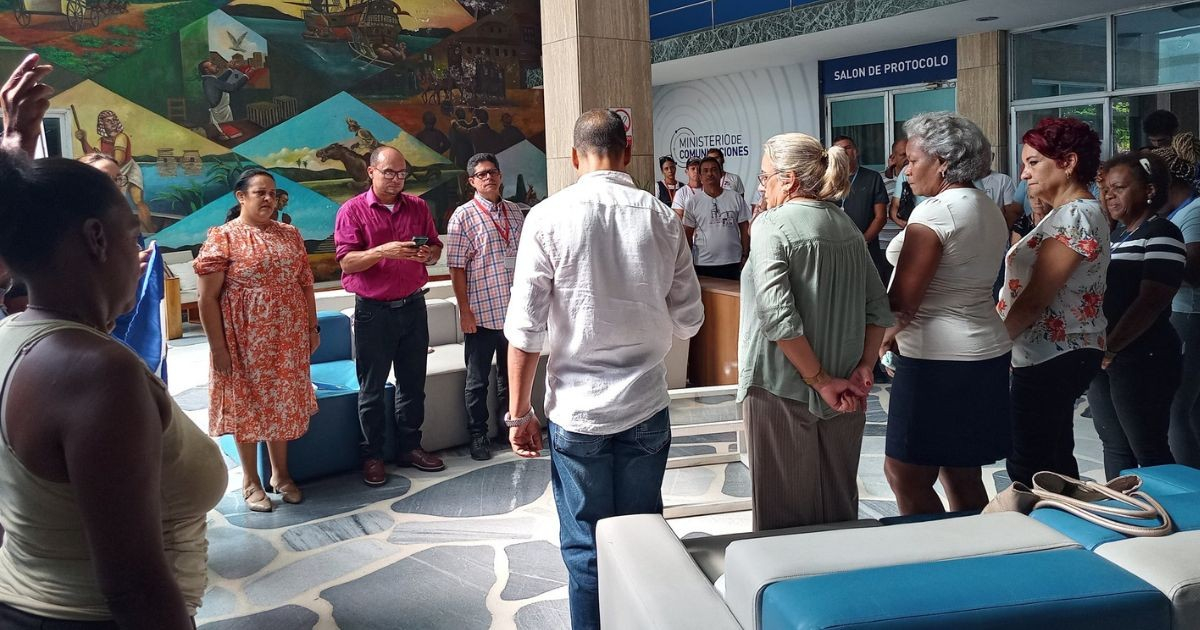
The Cuban government has initiated a campaign to mobilize employees from state-run enterprises nationwide, orchestrating demonstrations in support of Raúl Castro following the criminal charges filed against him by the U.S. Department of Justice on Wednesday.
A notable example comes from the Maritime Port Business Group (GEMAR), which is part of the Ministry of Transportation. Their official Facebook page showcased images on Thursday of workers gathered outside the ministry's headquarters in Havana, complete with sound equipment, a microphone podium, and a banner proclaiming "May."
GEMAR's official statement read: "The workers of GEMAR, together with the entire system of the Ministry of Transportation of the Republic of Cuba, reject the unfounded and illegitimate measures against Army General Raúl Castro Ruz and reaffirm our commitment and loyalty to the Leader of the Revolution."
This action is not isolated; similar scenes are unfolding across numerous state workplaces throughout the country, transforming work hours and spaces into political arenas serving the government’s agenda.
The charges that sparked these mobilizations were filed on May 20—Cuba's Independence Day—at Miami’s Freedom Tower by acting Attorney General Todd Blanche, who declared, "For nearly 30 years, the families of four murdered Americans have awaited justice."
The allegations against Castro include conspiracy to murder U.S. citizens, four counts of murder, and two counts of aircraft destruction, linked to the shooting down of two civilian planes from Brothers to the Rescue on February 24, 1996, which resulted in the deaths of Armando Alejandre Jr., Carlos Costa, Mario Manuel de la Peña, and Pablo Morales.
The prosecution's key evidence is a 1996 audio recording in which Castro orders, "Shoot them down at sea when they appear; and do not consult those with authority."
The regime's response was swift. Miguel Díaz-Canel escalated the rhetoric on Thursday, proclaiming, "The Army General is Cuba, and Cuba must be respected," adding, "You do not disrespect the nation's heroes, nor offend history and traditions without a response. Not in Cuba."
Simultaneously, the Union of Young Communists (UJC) called for a gathering at the José Martí Anti-Imperialist Tribune on Friday at 7:30 a.m. to "condemn the despicable and infamous act of the U.S. Department of Justice."
This pattern of political pressure in workplaces is not new. During the "My Signature for the Homeland" campaign in April and May of 2026, state enterprise managers were coerced to secure at least 80% of signatures from their workers under the threat of dismissal, with slogans like "Sign or resign."
Secretary of State Marco Rubio labeled Raúl Castro as a "fugitive from American justice" and, when questioned about a possible arrest, responded, "If there is an announcement, we will tell you afterward, not beforehand."
Key Questions on Raúl Castro's Charges
What charges has the U.S. Department of Justice filed against Raúl Castro?
Raúl Castro faces charges of conspiracy to murder U.S. citizens, four counts of murder, and two counts of aircraft destruction, linked to the 1996 shootdown of civilian planes from Brothers to the Rescue.
How has the Cuban government responded to the charges against Raúl Castro?
The Cuban government has organized demonstrations in support of Raúl Castro across state-run enterprises and political gatherings, denouncing the charges as illegitimate.
What evidence is central to the charges against Raúl Castro?
A key piece of evidence is a 1996 audio recording where Raúl Castro is heard ordering the shootdown of planes over the sea.