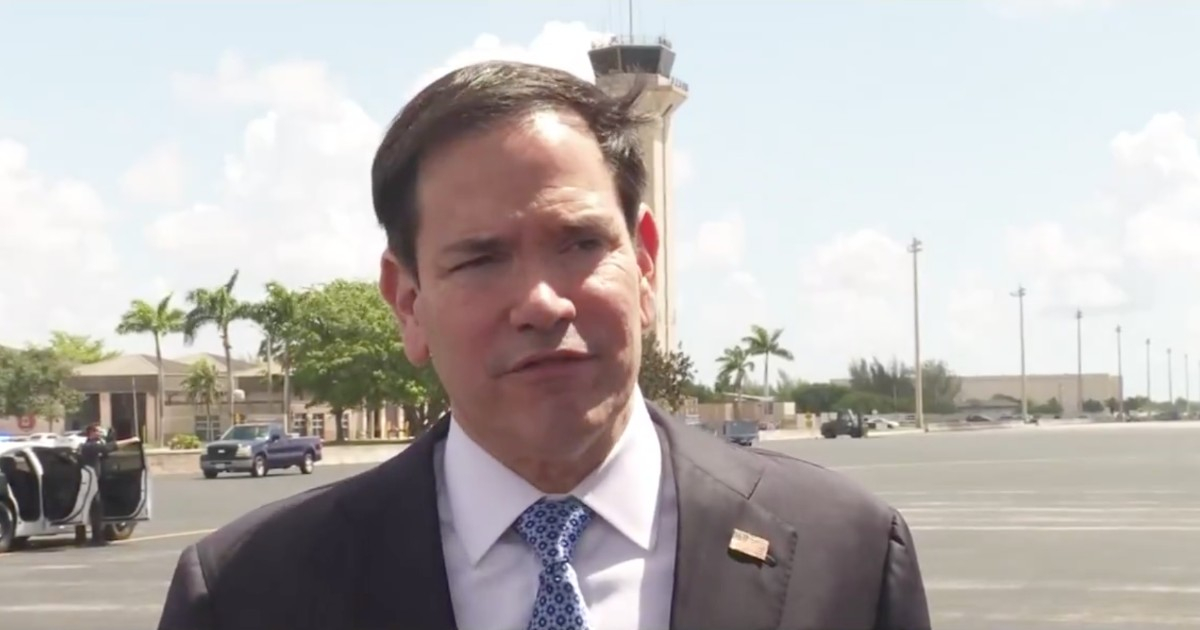
On Thursday, Secretary of State Marco Rubio described Cuba as a "failed state" and stated that negotiations with the regime are not progressing, as reported by C-SPAN during a press conference.
"Their system is dysfunctional. The economic framework is broken and cannot be fixed with the current political structure. They simply lack the understanding to make it work. It's a failed state," Rubio asserted with conviction.
This is not the first instance where the head of U.S. diplomacy has used such a diagnosis. On May 5, he labeled the regime as "incompetent communists" during a White House press briefing, and on May 14, he reiterated on NBC that the situation in Cuba is "unacceptable" and poses a direct threat to the United States.
This time, however, Rubio was more explicit about the state of diplomatic discussions: "I don't see much progress. At the end of the day, they need to make a decision."
Rubio acknowledged that Washington maintains open channels with Havana: ambassadors have recently met, the CIA director visited Cuba weeks ago, and the State Department holds regular communications. But he cautioned that these contacts have not yielded tangible outcomes.
"The president's preference is always a negotiated and peaceful agreement. That remains our preference. But honestly, with the current leaders in Cuba, the likelihood of that happening is low," he remarked.
This stance contrasts with the tone he used the previous day, when Rubio offered the Cuban people a "new relationship" with Washington, contingent on democratic and economic reforms, including $100 million in food and medicine distributed by the Catholic Church rather than GAESA.
Rubio targeted the military-business conglomerate GAESA as the core of the issue: "They have a private military company called GAESA, with $18 billion in assets, and not a penny goes to the state budget or to help the Cuban people."
The secretary highlighted Cuba's regional context to emphasize the system's contradictions: "Cuba is surrounded by places where people can start businesses, work independently, vote for their leaders or replace them. So, if that's possible around Cuba, why isn't it possible within Cuba?"
Rubio also dismissed the idea that Washington's pressure policy constitutes interference: "This isn't 'nation building.' We are addressing something directly tied to U.S. national security."
The central argument is both geographical and strategic: systemic collapse in Cuba, just 90 miles from the U.S. coast, would trigger a migration crisis and wave of violence impacting the United States directly.
Regarding the formal charge against Raúl Castro for the 1996 downing of the Brothers to the Rescue planes, Rubio was straightforward: "Raúl Castro openly admits and boasts about having ordered the shooting down of civilian aircraft." He did not disclose specific plans to bring him to justice but warned that by not surrendering, Castro becomes "a fugitive from U.S. justice."
"If they change their attitude, we'll be here. Meanwhile, we'll continue doing what needs to be done," Rubio concluded.
Understanding the U.S.-Cuba Relations
What does Marco Rubio mean by "failed state" in reference to Cuba?
Marco Rubio refers to Cuba as a "failed state" to highlight the dysfunctionality and inefficiency of its current political and economic systems, which he believes cannot be repaired under the existing governmental structure.
Why does Rubio believe negotiations with the current Cuban regime are ineffective?
Rubio suggests that negotiations are ineffective due to the regime's unwillingness or inability to make necessary changes, as well as a lack of significant progress in diplomatic discussions.
What role does GAESA play in Rubio's criticism of Cuba?
Rubio criticizes GAESA, a military-business conglomerate, for accumulating vast resources without contributing to the state budget or aiding the Cuban people, thus representing a core issue in Cuba's systemic problems.