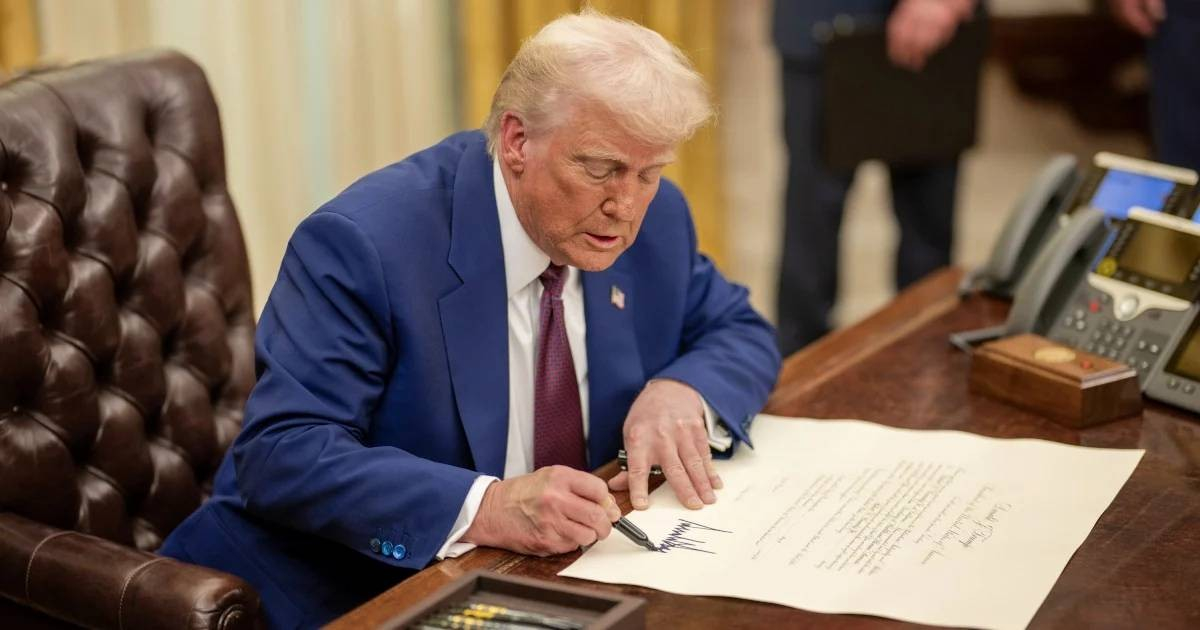
President Donald Trump has signed an executive order mandating federal banking regulators to assess and address what is being termed as "immigration-related credit risk." This is part of a broader strategy by his administration to increase pressure on individuals residing in the United States without legal authorization.
The directive, named "Restoring Integrity to America's Financial System," instructs the Department of the Treasury, the Federal Reserve, the FDIC, and the OCC to issue formal guidelines within 60 days. These guidelines are intended to help banks identify warning signs in accounts, loans, and credit cards held by individuals without legal immigration status.
The White House argues that lending to people who may face deportation poses a fundamental risk to the financial system, as these debtors could potentially lose income or leave the country, resulting in defaults.
In a statement, the White House emphasized that it would not "allow risks to our financial system stemming from the extension of credit or financial services to inadmissible foreign nationals subject to deportation."
Despite initial concerns in the banking sector, the order is less stringent than feared, as it does not explicitly mandate banks to collect citizenship proof from all clients.
The banking industry had lobbied vigorously against any measure requiring mandatory collection of such information, citing potential high costs and extensive paperwork.
Treasury Secretary Scott Bessent highlighted the issue in April, advocating for "stricter rules" for opening bank accounts and questioned, "Why can foreigners of unknown nationality come and open a bank account?"
Bessent further inquired, "How do you know your customer if you are unaware of their legal status, whether they are a U.S. citizen or a green card holder?"
The order specifically references the use of the Individual Taxpayer Identification Number (ITIN) for obtaining credit products or opening accounts when the applicant's immigration status is unverified.
Research from the Urban Institute estimates that between 5,000 and 6,000 mortgages have been issued to customers with ITINs, and banks are notably reluctant to lend to individuals using this type of documentation.
Immigrant rights advocates caution that this measure could drive unauthorized immigrants out of the formal financial system, pushing them towards a cash economy and unregulated services, which carry a higher risk of fraud and exploitation.
This is not the first indication of the Trump administration moving in this direction. Since December 2025, Cubans in the United States have started receiving alerts from Bank of America warning of potential account closures if they do not update their immigration information.
In November 2025, the Treasury Department also announced the reclassification of certain refundable tax credits as "federal public benefits," which prevents some immigrant taxpayers, including DACA and Temporary Protected Status (TPS) recipients, from receiving them.
Banking regulators now have a 60-day deadline to issue the formal guidelines that will detail how banks should identify and manage accounts of clients without verified immigration status.
FAQs on Trump's Executive Order on Immigration and Banking
What is the purpose of Trump's executive order regarding banks and immigration status?
The executive order aims to mitigate immigration-related credit risks by requiring federal banking regulators to develop guidelines for identifying financial accounts held by individuals without legal immigration status in the U.S.
How will this order affect banks and their clients?
Banks will need to follow new guidelines to identify and manage accounts of individuals without verified immigration status, potentially affecting clients who use ITINs or lack citizenship documentation.
Are banks required to collect proof of citizenship from all clients under this order?
No, the order does not mandate banks to collect citizenship proof from all clients, easing some concerns within the banking industry about the potential burden of such requirements.
What are the potential risks for immigrants due to this order?
The order could push immigrants without legal status out of the formal financial system, forcing them into cash economies and unregulated financial services, which can increase the risk of fraud and exploitation.