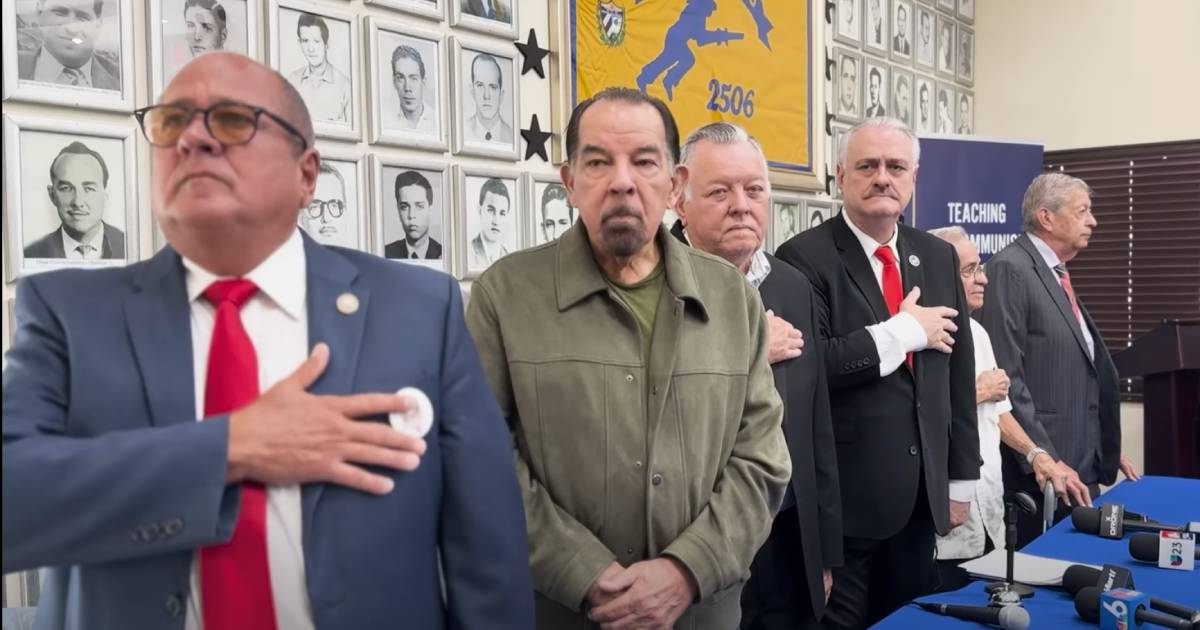
On the anniversary of the founding of the Republic of Cuba, the Assault Brigade 2506 released a solemn statement this Wednesday, declaring the U.S. Department of Justice's formal charges against Raúl Castro as "merely the initial step" towards justice. The brigade called for a complete overhaul of the communist regime on the island.
The event took place at the organization's headquarters in Miami, where historical leaders of the Cuban exile community expressed their support for the charges brought by the Justice Department that very day. These charges were against Castro and five Cuban military officers for the downing of the Brothers to the Rescue aircraft on February 24, 1996, which resulted in the deaths of four Cuban Americans: Armando Alejandre Jr., Carlos Costa, Mario de la Peña, and Pablo Morales, according to Martí Noticias.
Urgency for Change in Cuba
In its May 20 declaration, Brigade 2506 delivered a stark message: "The Cuban people are enduring one of the most painful and desperate periods in their history. The pervasive poverty, lack of food and medicine, constant power outages, political repression, and complete absence of freedoms underscore yet again the utter failure of the communist system imposed by the Castro dictatorship."
The organization dismissed any solution that does not involve a total break from the existing system: "The national crisis in Cuba cannot be resolved with superficial reforms, false openings, or successions controlled by the same regime. Cuba's future demands a complete, definitive, and urgent transformation."
International Concerns and Demands
The Brigade advocated for a transition grounded in the Helms-Burton Act and the 1940 Cuban Constitution, condemning the presence of espionage bases from China, Russia, Iran, and narcoterrorist organizations in Cuba as a direct threat to hemispheric security.
They made a direct appeal to President Donald Trump and Secretary of State Marco Rubio to continue supporting the Cuban people's struggle for democracy and human rights.
Voices from the Exile Community
Among those present at the event was former Florida State House Speaker Paul Renner, who emphasized the significance of the charges against Raúl Castro, which included seven counts, four of which were for murder: "At least finally, after all this time, we are at the beginning of justice for the families of Brothers to the Rescue."
Luis González Vega of Municipalities of Cuba in Exile described the indictment as a pressure tool: "It's a card that the United States now holds against Cuba, moving justice against that villain Raúl Castro, who ordered the murder of the four young men from Brothers to the Rescue."
Fernando Caula, president of the Orthodox People's Party of Cuba, warned that responsibility extends beyond a single individual: "It's not just Raúl Castro; there are many names within the government of this Cuban terrorist narco-republic that have kept all Cubans in exile for over 67 years."
The Regime's Response
The Cuban regime, on the other hand, dismissed the Department of Justice's charges as a "political action without legal basis," while Díaz-Canel defended Raúl Castro and justified the shooting down of the aircraft.
Given the absence of an extradition treaty between Cuba and the United States and the fact that Castro, now 94, has never set foot on U.S. soil, the charges hold primarily symbolic, political, and legal significance for the victims' families and the Cuban exile community.
Brigade 2506 concluded its statement with a warning that encapsulates decades of struggle: "There will be no true peace in Cuba and the Hemisphere as long as a dictatorship exists in the heart of the Americas, denying freedom to the Cuban people and threatening the peace and security of its neighbors. We will never abandon our homeland!"
Frequently Asked Questions About Raúl Castro's Indictment
What charges has Raúl Castro faced?
Raúl Castro has been charged by the U.S. Department of Justice for the downing of the Brothers to the Rescue aircraft, resulting in the deaths of four Cuban Americans in 1996.
Why is the indictment considered symbolic?
The indictment is symbolic because there is no extradition treaty between Cuba and the United States, and Raúl Castro has not been to the U.S., making it unlikely that he will face trial.
What does Brigade 2506 advocate for?
Brigade 2506 calls for a complete and urgent transformation of Cuba's political system, rejecting superficial reforms and advocating for a transition based on the Helms-Burton Act and the 1940 Constitution.