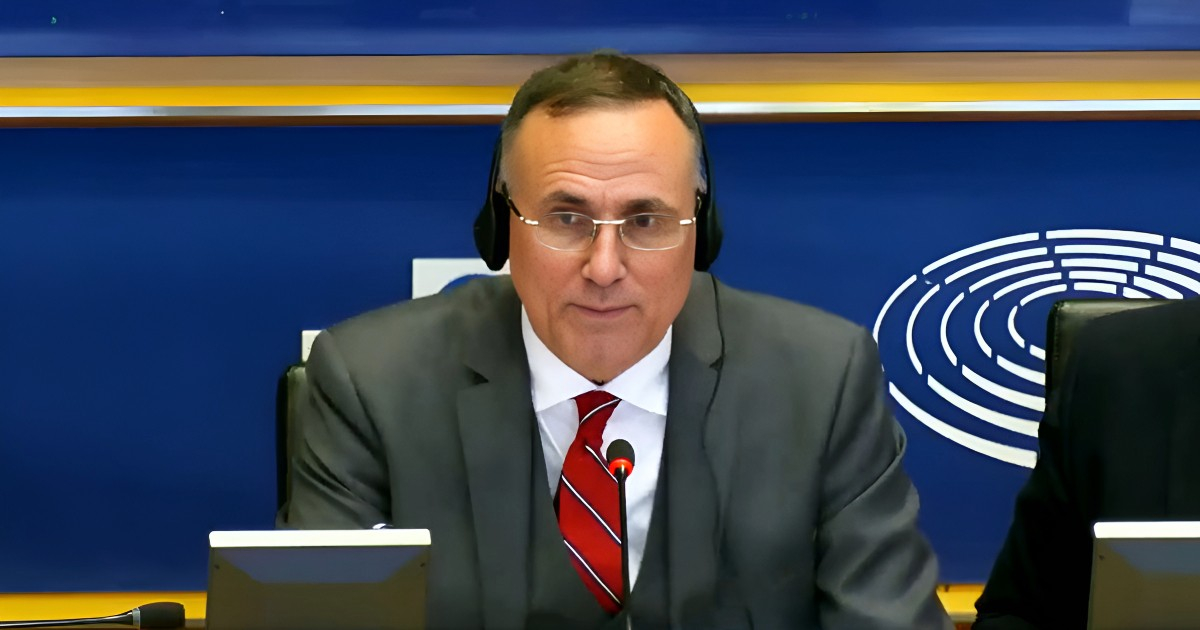
Cuban opposition leader José Daniel Ferrer expressed his gratitude on Wednesday for the overwhelming support he received from members of the European Parliament during his recent European tour. He observed that out of roughly fifty parliamentarians he met two weeks ago, only one supported the Political Dialogue and Cooperation Agreement (PDCA) between the European Union and Cuba.
"Thanks to all the MEPs standing in solidarity with the Cuban people. Out of about fifty we met, only one supports the highly negative PDCA," Ferrer shared on his social media account X.
As the coordinator of the Patriotic Union of Cuba (UNPACU) and a four-time political prisoner currently residing in Miami since October 13, 2025, Ferrer was clear in his assessment of the agreement: "Most are aware that with the criminal Castro-communist dictatorship, only condemnation and pressure work. The current Agreement solely benefits the communist regime."
Ferrer also highlighted the harm the PDCA inflicts on the European Union itself, noting that the agreement "even financially supports a regime allied with Russia, backing Putin's invasion of Ukraine," making it, in his view, a detrimental tool for both the Cuban people and political prisoners, as well as European interests.
His remarks come a day after the European Parliament in Strasbourg debated the political repression and humanitarian crisis in Cuba. During the session, EU High Representative Kaja Kallas acknowledged that the PDCA "has not yielded the expected results" after nearly a decade, yet defended its continuation as a dialogue mechanism.
Ferrer’s statement is a direct outcome of an intensive European tour initiated in early May, spearheaded by Prisoners Defenders and its president Javier Larrondo.
On May 5, Ferrer addressed the European Parliament's Foreign Affairs Committee in Brussels, describing Cuba as experiencing "the worst crisis in its modern history" and called for Magnitsky sanctions against the regime.
On May 11, MEP Hermann Tertsch announced that his group would propose a resolution to immediately suspend the EU's agreements with Cuba, with a vote expected during the June 2026 plenary session.
The pressure from Cuban civil society on European institutions is not new. In April 2026, activists Carolina Barrero and Amelia Calzadilla traveled to Brussels, meeting with European Parliament Vice President Esteban González Pons to gather support for an internal review process of the PDCA by the EU.
In January 2026, the European Parliament approved an amendment with 331 votes in favor and 241 against, calling for a review and suspension of cooperation with Cuba, also linked to the presence of more than 1,076 Cuban fighters in Ukraine and the use of European funds in repressive structures.
The PDCA was signed in 2016 and came into force in 2017; it includes a human rights clause that allows for its suspension in cases of serious violations, a mechanism that had not been formally activated until 2026.
The final vote on the agreement's future is scheduled for the European Parliament's plenary session in June 2026.
Key Discussions on EU-Cuba Relations
What is the Political Dialogue and Cooperation Agreement (PDCA)?
The PDCA is an agreement signed in 2016 between the European Union and Cuba, designed to facilitate political dialogue and cooperation. It includes a human rights clause that allows for suspension in the event of serious violations.
Why is José Daniel Ferrer critical of the PDCA?
Ferrer criticizes the PDCA because he believes it only benefits the Cuban communist regime and harms both the Cuban people and European interests. He argues that the agreement supports a regime allied with Russia, which endorses actions such as Putin's invasion of Ukraine.
What actions have been proposed by the European Parliament regarding the PDCA?
The European Parliament has seen proposals to review and potentially suspend the PDCA, particularly due to concerns about human rights violations and the agreement's ineffectiveness. A resolution to suspend the PDCA is expected to be voted on in June 2026.