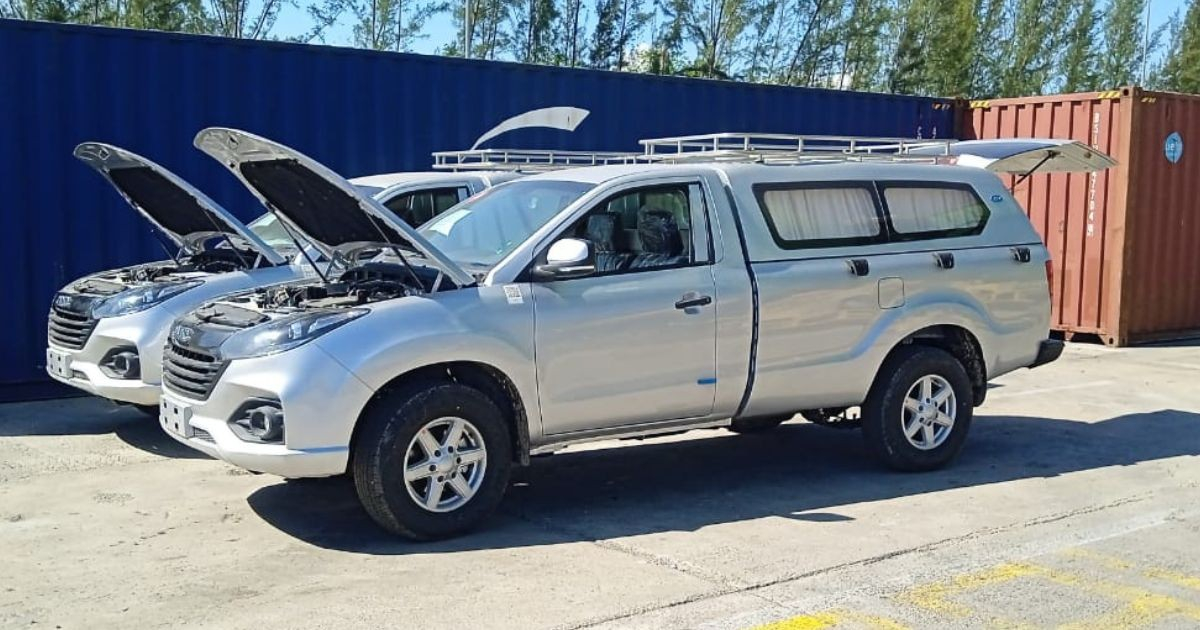
The Cuban state-run company, Transimport, announced on Tuesday the deployment of a fleet of funeral vehicles arriving at the Port of Mariel. These vehicles are intended to enhance necrological services across the nation, as revealed on the company's official Facebook page.
This operation was a collaborative effort between Transimport, the Ministry of Transport (MITRANS), and Cuban port authorities.
Photos released show a line of silver pickup trucks from the Chinese manufacturer JMC (Jiangling Motors Corporation), modified with canopies for funeral use, stationed at the Mariel Container Terminal.
This announcement emerges amidst a well-documented collapse of Cuba's funeral system, which has been deteriorating for years.
Back in December 2022, Mildrey Granadillo de la Torre, the Vice Minister of Economy and Planning, disclosed to the National Assembly that Cuba had only 233 operational funeral cars, out of the 615 required to meet national demand, leaving a shortfall of 382 units.
At that time, a three-year importation program was announced, sourcing vehicles from China.
By April 2023, an initial batch of Chinese funeral cars was distributed to provinces like Las Tunas and Holguín, yet the situation continued to worsen.
In Santiago de Cuba, March 2023, the Communal Services Company had a mere 10 funeral vehicles available for over a million residents.
In Ciego de Ávila, October 2025 saw only eight out of 19 funeral vehicles operational, necessitating transport coordination from other municipalities.
The municipalities of Jobabo and Manatí in Las Tunas faced periods without any functioning funeral vehicles of their own.
In December 2025, the government added 15 electric vehicles to Havana's necrological services, managed by the state-run microenterprise Servi Axess, promising free services for the public.
This latest announcement signifies the continuation of that plan, with a now stated reach throughout the entire national territory.
The energy context for these vehicles is dire: Energy and Mines Minister Vicente de la O Levy acknowledged last Wednesday that Cuba is devoid of "fuel, diesel," highlighting the significance of these new units for a state-monopolized service, as microenterprises are forbidden from operating funeral and necrological services.
Concurrently, the regime introduced 200 electric Dongfeng Box 01 vehicles on Tuesday for transporting dialysis patients across all provinces, amid a healthcare crisis that has left over 3,000 kidney patients without guaranteed transport since the beginning of the year.
Challenges and Solutions for Cuba's Funeral Services
Why is the Cuban funeral service system failing?
The Cuban funeral service system is failing due to a severe shortage of operational funeral vehicles, insufficient resources, and a centralized state monopoly that restricts private entities from providing services.
What measures has Cuba taken to improve funeral services?
Cuba has initiated an import program to acquire funeral vehicles from China, introduced electric vehicles for necrological services, and made efforts to enhance transport for kidney patients.
How does the current energy crisis affect funeral services in Cuba?
The energy crisis, marked by a lack of fuel and diesel, exacerbates the challenges in funeral services, making the introduction of new vehicles crucial for maintaining operations.