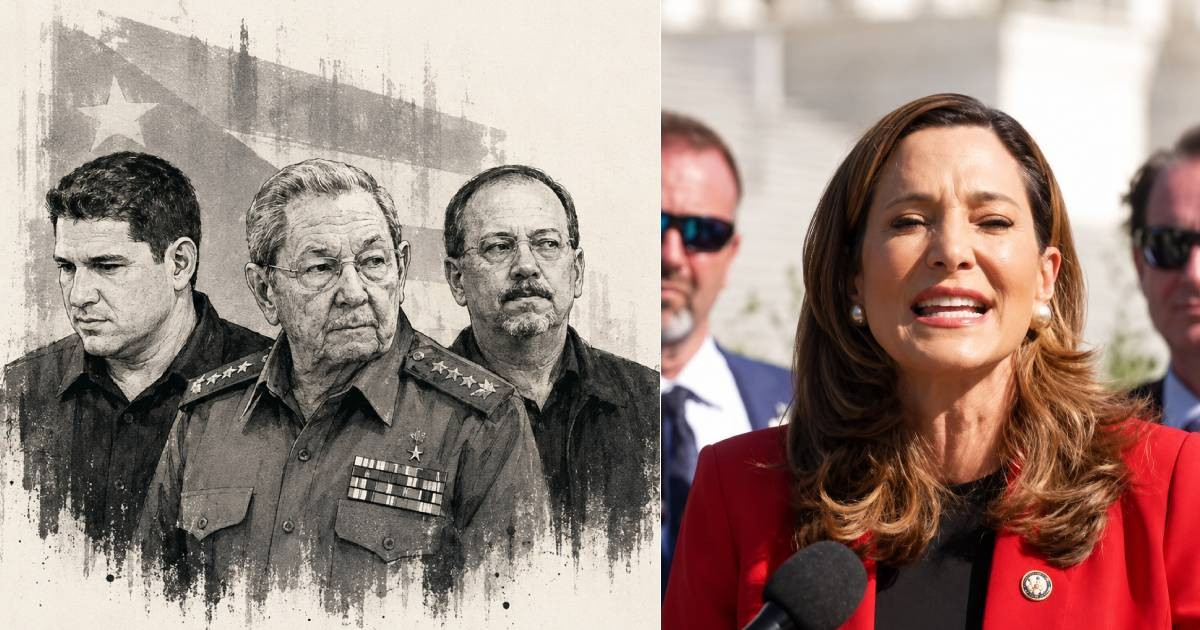
Republican Congresswoman María Elvira Salazar announced on Tuesday from the Capitol in Washington, D.C., that the era of Raúl Castro, his son, and grandson is over, urging them to step down. This statement comes ahead of an anticipated federal indictment against Raúl Castro for his involvement in the 1996 downing of Brothers to the Rescue planes.
The Department of Justice is set to unveil a formal charge tomorrow, Wednesday, May 20, issued by a federal grand jury at Miami's Freedom Tower. The date holds symbolic significance as it aligns with the anniversary of the founding of the Cuban Republic in 1902.
Speaking to Martí Noticias, Salazar was forthright: "Let's hope that tomorrow Raúl realizes it's time for him to leave as well."
Background on the Indictment
The charges pertain to the February 24, 1996, downing of two Cessna planes from Brothers to the Rescue over international waters in the Florida Straits, resulting in the deaths of four Cuban-Americans: Armando Alejandre Jr., Carlos Costa, Mario de la Peña, and Pablo Morales.
The International Civil Aviation Organization concluded that the planes were shot down outside Cuban territorial airspace, violating international law.
An audio recording from 1996, allegedly capturing Raúl Castro ordering the shootdown, is expected to be a pivotal element of the indictment.
The Delay in Justice
When asked why it took nearly 30 years for this judicial action, Salazar did not mince words: "Because Donald Trump is in the White House. Trump has acknowledged that the Western Hemisphere is crucial and that Cuba has long been the epicenter of hostility, the platform for all U.S. adversaries."
Salazar expanded the indictment's scope beyond the plane incident: "We're discussing training for Hezbollah, Hamas; Iran, Russia, China are all involved. The Castros have embraced everything anti-American. The game's over."
Comparisons and Warnings
Drawing parallels with Venezuela, Salazar warned that the Castros, being "shrewd," must have noted Nicolás Maduro's fate as a cautionary tale.
"At 95, Raúl won't want to spend his remaining years in a federal prison," the congresswoman stated.
Regarding potential negotiations with Raúl's grandson, Raúl Guillermo Rodríguez Castro, known as "El Cangrejo," and his son, Alejandro Castro Espín, Salazar was unequivocal: "I'm certain everything's on the table, because there's nothing left."
U.S. Moves and Future Prospects
This context unfolds just after Trump's declaration of his ability to "fix Cuba, regime change or not," and his openness to a diplomatic agreement with Havana. Additionally, Marco Rubio announced a second wave of sanctions targeting 11 regime elites and three organizations, including the DGI/G2, the Ministry of the Interior, and the National Revolutionary Police.
On May 14, CIA Director John Ratcliffe visited Havana and met with "El Cangrejo," marking the highest-level direct contact between the two nations on Cuban soil since 2016.
Salazar envisions a post-Castro Cuba transforming into "Cancún or Hong Kong" with Cuban-American and U.S. investments, though she acknowledges the transition will be challenging: "We're still on day one, and day one is for the Castros, who have ruined that island for 65 years, to finally leave."
Understanding the Implications of Raúl Castro's Indictment
What are the charges against Raúl Castro?
Raúl Castro faces charges related to the 1996 downing of Brothers to the Rescue planes, which led to the deaths of four Cuban-Americans. The indictment claims these actions violated international law.
Why is the indictment happening now?
The indictment is occurring now partly because of the Trump administration's focus on the Western Hemisphere and its recognition of Cuba's longstanding role as a base for anti-American activities.
How might this indictment impact Cuba's future?
The indictment could potentially hasten the end of the Castro era, paving the way for significant political and economic changes in Cuba, involving increased foreign investment and a shift in international relations.