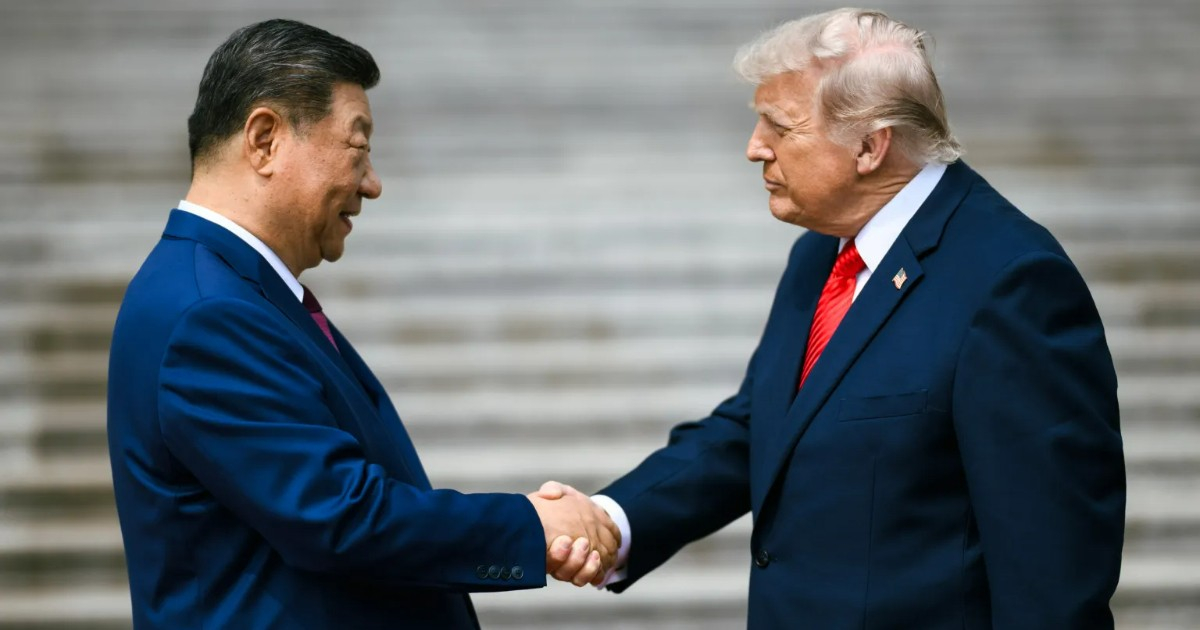
During a summit on May 14 in Beijing, Xi Jinping confided to Donald Trump that Vladimir Putin might end up regretting his decision to invade Ukraine, according to a report by the Financial Times on Tuesday, citing several sources familiar with the U.S. assessment of the meeting.
This remark by the Chinese leader marks a significant shift from previous discussions: a source familiar with meetings between Xi and former President Joe Biden noted that while those meetings were "frank and direct" regarding Russia and Ukraine, Xi had never before offered a personal assessment of Putin or the conflict.
Neither the White House nor the Chinese embassy in Washington responded to requests for comment. The official document released by the Trump administration on May 17 regarding the Beijing summit made no mention of discussions about Putin or the Ukrainian conflict.
The revelation comes on the day Putin arrived in China for a two-day visit, just four days after Xi hosted Trump in Beijing, marking the first state visit by a U.S. president in nearly nine years.
Strategic Proposals and Military Context
During the same summit, Trump proposed that the United States, China, and Russia collaborate to counter the International Criminal Court, arguing that the interests of the three nations were aligned. The Trump administration has consistently opposed the court, accusing it of politicization and disregarding U.S. national sovereignty.
The military context is crucial to understanding Xi's comment. According to the Institute for the Study of War (ISW), the pace of Russian advances has significantly slowed: from 14.92 km² per day between October 2024 and March 2025, to just 5.16 km² per day in the first quarter of 2026. During this period, Ukraine has regained over 400 km² in the Oleksandrivka and Hulyaipole directions.
This stalled front coincides with increased Ukrainian drone attacks. On May 16 and 17, Ukraine launched one of its largest assaults on the Moscow region; Mayor Sobyanin confirmed that Russian defenses shot down more than 120 drones.
Ukrainian President Volodymyr Zelensky described these attacks as "completely justified" following a record number of Russian airstrikes on Kyiv the previous week.
Diplomatic and Geopolitical Implications
The attacks followed a three-day ceasefire brokered by Trump that allowed Putin to celebrate the Victory Day parade without fear of Ukrainian reprisals.
Democratic Congressman Brendan Boyle, a delegate to the NATO Parliamentary Assembly, summed up the new battlefield reality: "The courageous Ukrainians have reinvented warfare in the same way World War I reinvented war for the 21st century. Drone warfare has become the norm and is revolutionizing how we fight."
Anton Gerashchenko, a former adviser to Ukraine's Interior Ministry, described Putin's visit to Beijing as an unmistakable sign of Russia's growing dependency: "Russia has lost its position as a relatively autonomous geopolitical pole and is sinking deeper into reliance on China."
Regarding Putin's statements about a "mutual understanding and trust" atmosphere with Beijing, Gerashchenko added: "It sounded like Putin was trying to convince himself that it is true."
Understanding the Current Ukraine-Russia-China Dynamics
What did Xi Jinping allegedly tell Donald Trump about Putin?
Xi Jinping allegedly told Donald Trump that Vladimir Putin might eventually regret his decision to invade Ukraine.
How has the pace of Russian military advances changed?
The pace of Russian military advances has slowed significantly, from 14.92 km² per day between October 2024 and March 2025, to just 5.16 km² per day in the first quarter of 2026.
What was Trump's proposal during the Beijing summit?
Trump proposed that the United States, China, and Russia work together to combat the International Criminal Court, arguing that the three countries' interests were aligned.