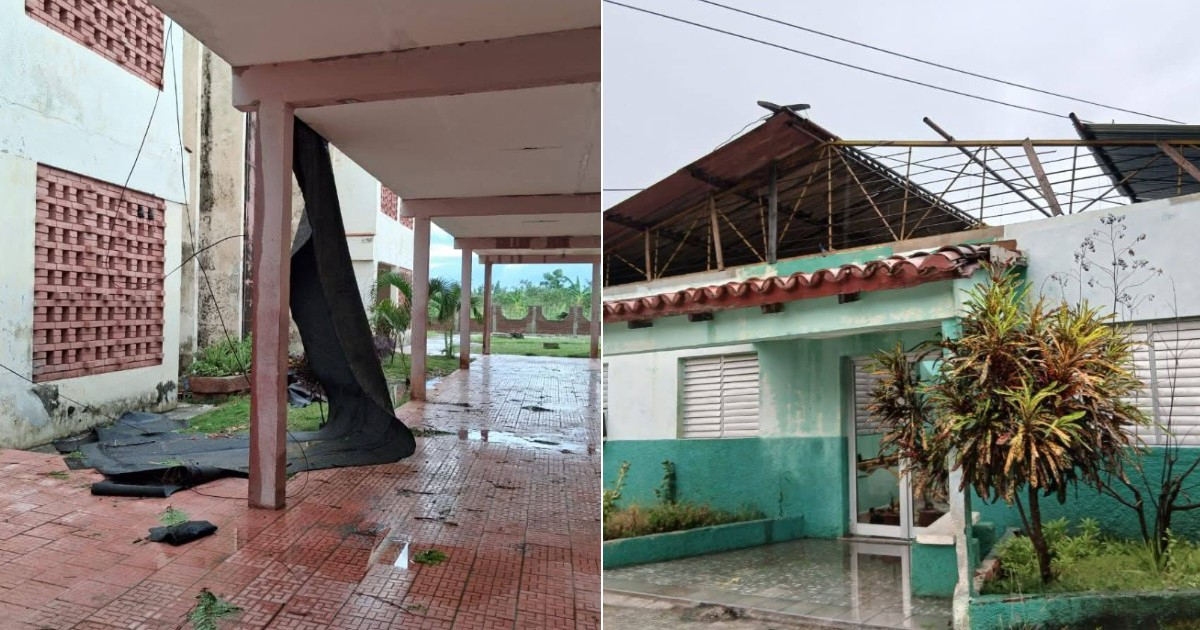
On Monday, a severe local storm swept through Bayamo, the capital of Granma province, causing preliminary damage to 85 homes and 19 state facilities, as assessed by the Communist Party and provincial government officials during the evening.
The storm struck in the afternoon, bringing winds exceeding 100 kilometers per hour, hailstones the size of peas or chickpeas, and a downpour of 81.5 millimeters of rain in just one hour, according to data from the Provincial Meteorological Center.
In addition to the damage to homes and state facilities, the storm also caused disruptions to the electrical and telephone infrastructure and uprooted dozens of trees across various neighborhoods in the Granma capital.
Affected sites include the Mártires de Barbados Stadium, the Guajiro Natural Cultural Recreation Center, and the Fernández de Castro Park.
Yudelkis Ortiz Barceló, the provincial Party's first secretary, and Governor Yanetsy Terry Gutiérrez, accompanied by municipal teams, toured the affected areas to assess damages and coordinate an immediate response.
Michel Carlos Santiesteban, the first Party secretary in Bayamo, confirmed that teams of linemen and ETECSA crews were organized to begin recovery operations early Tuesday morning.
Authorities have activated defense zones and called on young people, workers, and the general populace to participate in cleanup efforts. "Tomorrow will be a day of strong combat and popular participation," Ortiz Barceló remarked.
Despite the storm's intensity, authorities confirmed there were no reported human casualties.
This event was not isolated; on the same day, a storm destroyed nine of the twelve solar panels at the Nuestra Señora del Rosario Parish in Palma Soriano, Santiago de Cuba.
Bayamo has a recent history of similar incidents. In August 2025, hailstones the size of golf balls fell on the city during another severe local storm, and in July 2020, a storm left 36 homes damaged, with two completely collapsed and 13 roofs entirely lost.
Both of Monday's events occurred at the onset of the 2026 rainy season, which spans from May to October. The Meteorology Institute had predicted that May would bring temperatures above historical averages throughout the country, a condition conducive to atmospheric instability and the development of intense convective storms.
The storm's impact is worsened by Granma's deteriorating electrical infrastructure: the National Electric System had a capacity of only 1,070 MW against a demand of 2,545 MW, with a projected deficit of more than 2,000 MW during peak hours.
Key Questions about the Bayamo Storm Impact
What was the extent of damage caused by the storm in Bayamo?
The storm resulted in damage to 85 homes and 19 state facilities in Bayamo.
How did the authorities respond to the storm in Bayamo?
Authorities organized teams for recovery efforts, activated defense zones, and encouraged public participation in cleanup activities.
What other regions were affected by similar weather on the same day?
In Palma Soriano, Santiago de Cuba, a storm destroyed nine of twelve solar panels at a local parish.