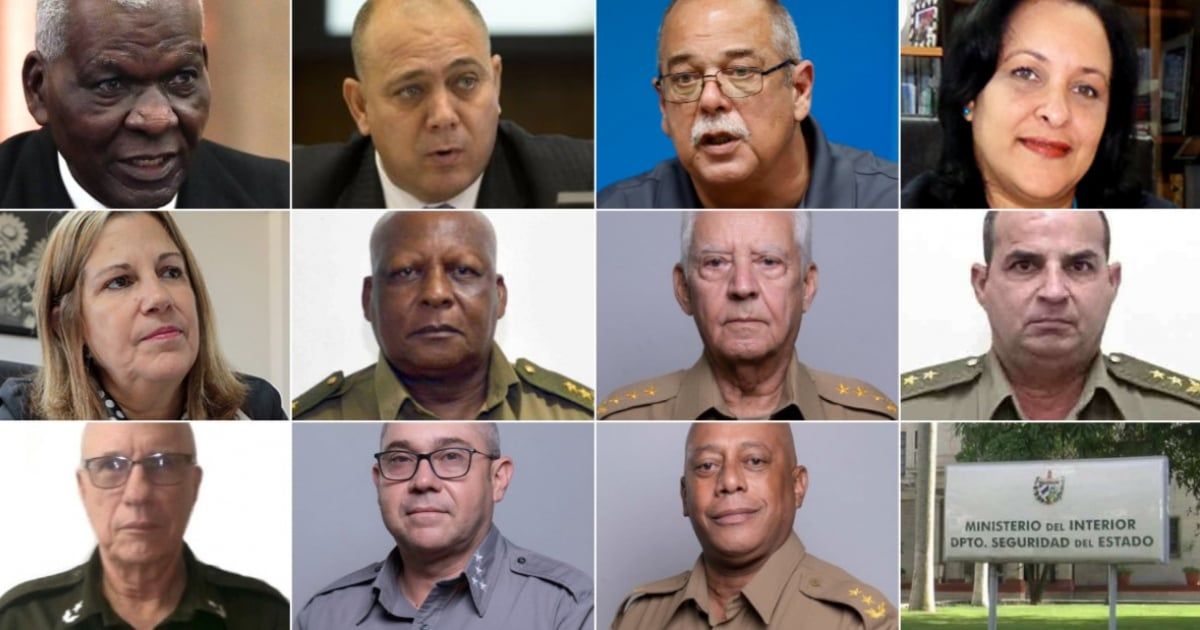
The U.S. Treasury Department announced on Monday the imposition of sanctions on nine senior officials of the Cuban regime, as well as the Cuban Intelligence Directorate (DGI/G2). This marks the second wave of actions under Executive Order 14404, signed by Donald Trump on May 1, 2026.
Secretary of State Marco Rubio warned that "additional sanctions are expected in the coming days and weeks," labeling those targeted as accountable for "the suffering of the Cuban people, the collapse of the Cuban economy, and the exploitation of Cuba for foreign intelligence, military, and terrorist activities."
Profiles of the Sanctioned Leaders
Roberto Morales Ojeda, born June 15, 1967, in Cienfuegos, serves as Secretary of Organization for the Communist Party of Cuba's Central Committee and is a member of the Politburo, wielding significant influence within the regime. Just three days prior to his sanctioning, he publicly boasted about the Cuban government's "transparency" following a meeting between the CIA and MININT in Havana.
Juan Esteban Lazo Hernández, born February 26, 1944, in Jovellanos, Matanzas, has been the President of the National Assembly of People's Power since April 2018, with a reelection in October 2019. A deputy since 1981, he is one of the enduring figures of the Cuban political landscape.
Mayra Arevich Marín, born in 1966 in Havana, has been the Minister of Communications since April 2021, previously serving as the executive president of ETECSA, the state telecommunications company. In May 2025, she defended the increased rates of ETECSA, claiming they were "necessary for the sustainability of telecommunications infrastructure."
Vicente De la O Levy, born April 25, 1962, has been the Minister of Energy and Mines since October 17, 2022. Last Wednesday, he acknowledged Cuba's lack of fuel oil and diesel reserves for electricity generation, though he added, "We recognize the discontent over the blackouts."
Rosabel Gamón Verde, born February 9, 1973, in Havana, assumed the role of Minister of Justice at the end of 2025, appointed through National Assembly Agreement X-155. She previously served as the first deputy minister of the same ministry.
Joaquín Quintas Solá, born in 1938 in Santiago de Cuba, is an Army Corps General and Deputy Minister of the Revolutionary Armed Forces (FAR). As the oldest sanctioned individual, he participated in a military visit to Algeria in October 2024 as a FAR deputy minister.
José Miguel Gómez del Vallín, born August 6, 1960, in Las Tunas, is a Division General and Chief of Military Counterintelligence at the Ministry of the Revolutionary Armed Forces (MINFAR). A law graduate, he completed an internationalist mission in Angola and is a member of the PCC Central Committee.
Eugenio Armando Rabilero Aguilera, born November 6, 1964, is a Division General and Chief of Cuba's Eastern Army, one of the three major territorial commands of the FAR.
Raúl Villar Kessell, born August 4, 1965, in Bahía Honda, Artemisa, is a Division General and Chief of the Central Army. Promoted to this position in November 2024, he is a member of the PCC Central Committee and has undergone military training in Chinese academies.
In addition to these nine individuals, the Office of Foreign Assets Control (OFAC) has designated the DGI/G2 as a blocked entity and updated previous sanctions on MININT and the National Revolutionary Police, incorporating them under the CUBA-EO14404 program along with their directors Oscar Alejandro Callejas Valcarce and Eddy Manuel Sierra Arias.
This second wave of sanctions follows less than two weeks after the initial measures under EO 14404 targeted GAESA, prompting major international shipping companies to halt operations to Cuba and Canadian mining company Sherritt International to suspend activities on the island.
Understanding U.S. Sanctions on Cuban Officials
What are the reasons behind the U.S. sanctions on Cuban leaders?
The U.S. has imposed sanctions on Cuban leaders to hold them accountable for the suffering of the Cuban people, the economic failure in Cuba, and the island's use in foreign intelligence, military, and terrorist operations.
Who are some of the key figures sanctioned by the U.S.?
Key figures sanctioned include Roberto Morales Ojeda, Juan Esteban Lazo Hernández, and Mayra Arevich Marín, among others, who hold significant positions within the Cuban government and military.
How do these sanctions affect Cuba's international relations?
These sanctions can strain Cuba's international relations, as they lead to halted operations by major shipping and mining companies, impacting the island's economy and foreign trade.