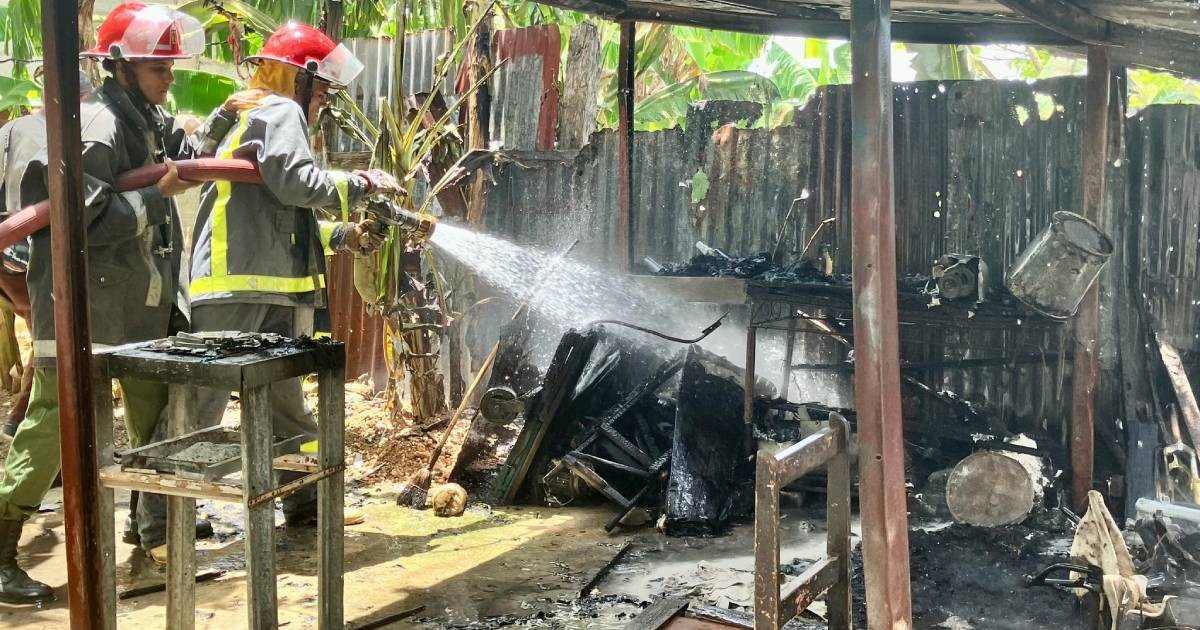
An electric scooter burst into flames on Tuesday afternoon in the yard of a home located on Cárdenas Avenue in Banes, Holguín province, sparking a fire that prompted a swift response from the local Fire Department, as reported by Radio Banes.
Alerted by concerned neighbors, firefighters arrived promptly and managed to bring the situation under control within minutes.
Fortunately, no injuries were reported, although the vehicle was completely destroyed.
Photographs of the aftermath reveal the scooter charred beyond recognition, with only the metal framework and front wheel identifiable. Firefighters, wearing uniforms marked with "BOMBEROS CUBA," were seen dousing the smoldering remains with water.
The explosion caused significant damage to the yard's structure, which had a metal sheet roof and corrugated walls, leaving it blackened and badly damaged by the flames.
Local authorities were present at the scene to offer assistance to those affected by the blaze.
Pattern of Electric Vehicle Fires in Cuba
This incident in Banes is part of a troubling trend of fires triggered by electric scooter explosions across Cuba. Just nine days earlier, a similar event occurred in Havana when a scooter caught fire while charging after a blackout, attributed to voltage fluctuations and thermal runaway in the battery.
From January to October 2025, Villa Clara reported 32 fires caused by electric scooters, resulting in material losses valued at 95 million Cuban pesos, according to the Fire Department data shared by the Cuban News Agency. Of these fires, 20 took place in homes, 10 on public roads, and two within state institutions.
Holguín itself experienced similar incidents in residences in July and October of 2025.
The most severe case nationally happened in Camagüey on July 30, 2025, where an explosion of scooter batteries during a power outage led to at least four fatalities and three injuries.
Identifying Risk Factors
The Cuban Fire Department has identified several risk factors, including prolonged battery charging exceeding seven or eight hours, voltage fluctuations following blackouts that lead to overcharges and thermal runaway in lithium batteries, the use of worn-out electrical extensions, informally repaired batteries, and uncertified equipment.
Cuba's ongoing electrical crisis, marked by frequent and extended blackouts, significantly exacerbates these risks: sudden power restorations can overload already weakened batteries, turning each scooter into a potential household hazard.
A Cuban firefighter warned in January 2025 that leaving batteries to charge overnight greatly increases the risk of overheating and fire, a widespread practice among scooter owners on the island.
Understanding the Risks of Electric Scooter Fires in Cuba
What caused the fire in Banes?
The fire in Banes was caused by an explosion of an electric scooter in the yard of a home, which ignited a fire controlled by the local Fire Department.
How frequent are electric scooter fires in Cuba?
Electric scooter fires have become alarmingly frequent in Cuba, with numerous incidents reported across different provinces, including Villa Clara and Holguín.
What are the primary risk factors for these fires?
Key risk factors include prolonged battery charging, voltage fluctuations after blackouts, and the use of uncertified equipment.
How does Cuba's electrical crisis contribute to these fires?
Frequent blackouts and abrupt power restorations can overload scooter batteries, significantly increasing the risk of fires.