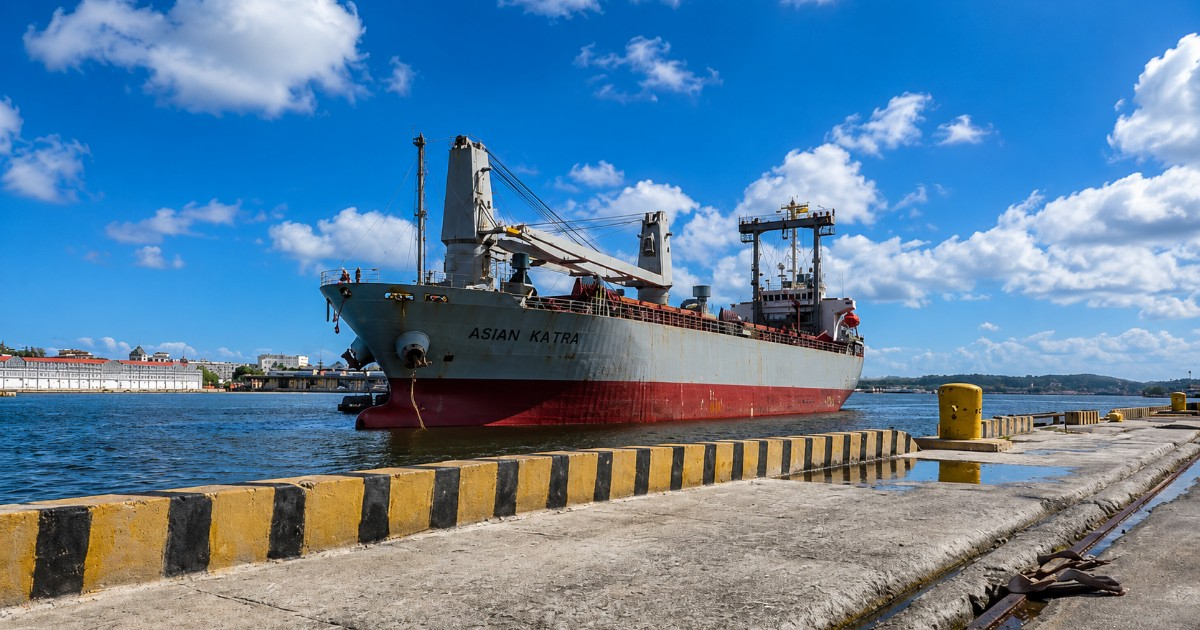
The cargo vessel Asian Katra, originating from Mexico, docked at the port of Havana this Monday, bringing with it 1,700 tons of essential provisions including rice, beans, and milk. This news was confirmed by Mexico's ambassador to Cuba through the Cuban state media.
The shipment, which also comprises contributions from the people of Uruguay, logistically coordinated with Mexico, was welcomed by the Minister of the Food Industry, Alberto López. López expressed deep gratitude to all crew members and officials involved in this humanitarian mission.
According to Cubavisión Internacional, this marks the eighth shipment from the Mexican government and civil associations, though the AFP agency reports it as the fifth, possibly due to differing counting methods.
The Asian Katra departed from Asipona Pajaritos in Coatzacoalcos, Veracruz, amidst a severe food and energy crisis gripping Cuba, where power outages last up to 24 hours daily across more than 55% of the country.
International Solidarity and Response
Uruguay's involvement was announced back in late March 2026, when Foreign Minister Mario Lubetkin characterized the action as "a gesture of solidarity." The Uruguayan aid includes approximately 20 tons of powdered milk transported from Mexican soil.
The dispatch of the Asian Katra was announced on May 11 by President Claudia Sheinbaum during her morning briefing, where she emphasized, “We will continue to send humanitarian aid to a nation in need.”
Mexico's Continued Support
Since February 2026, Mexico has shipped over 3,125 tons of humanitarian aid to Cuba, encompassing food, medicine, hygiene products, and solar panels.
The initial shipment departed on February 8 with two Mexican Navy vessels from Veracruz, arriving in Havana on February 28 with over 1,193 tons. Subsequent shipments took place in March, with two more Navy ships delivering food, cleaning supplies, and medical inputs.
Challenges of Oil Supply
Mexico ceased oil shipments to Cuba on January 27, 2026, following Trump's Executive Order 14380, which imposed secondary sanctions on countries supplying oil to the island. Sheinbaum decided against resuming these shipments, noting that Cuba "is receiving oil from Russia," and redirected support towards non-petroleum humanitarian aid.
The Dire Situation in Cuba
The food crisis in Cuba is severe: Minister López previously reported that over 117,000 children were not receiving their daily milk ration due to logistical and energy issues, and nearly 96,000 patients are awaiting surgery on the island.
The only significant energy relief came from Russia in March when the oil tanker Anatoly Kolodkin arrived in Matanzas with 100,000 metric tons of donated crude oil. However, in April, Russian Foreign Minister Serguéi Lavrov admitted that "this aid will likely last a couple of months," with no new shipments confirmed as of yet.
Key Insights into Cuba's Humanitarian Aid
What supplies did the Asian Katra bring to Cuba?
The Asian Katra delivered 1,700 tons of rice, beans, and milk to Cuba.
Who coordinated the aid shipment from Uruguay?
The aid shipment from Uruguay was coordinated logistically with Mexico.
Why did Mexico stop sending oil to Cuba?
Mexico halted oil shipments due to Trump's Executive Order 14380, which imposed sanctions on countries supplying oil to Cuba.
How has Russia contributed to Cuba's energy crisis?
Russia sent the oil tanker Anatoly Kolodkin with 100,000 metric tons of crude oil to help alleviate Cuba's energy crisis.