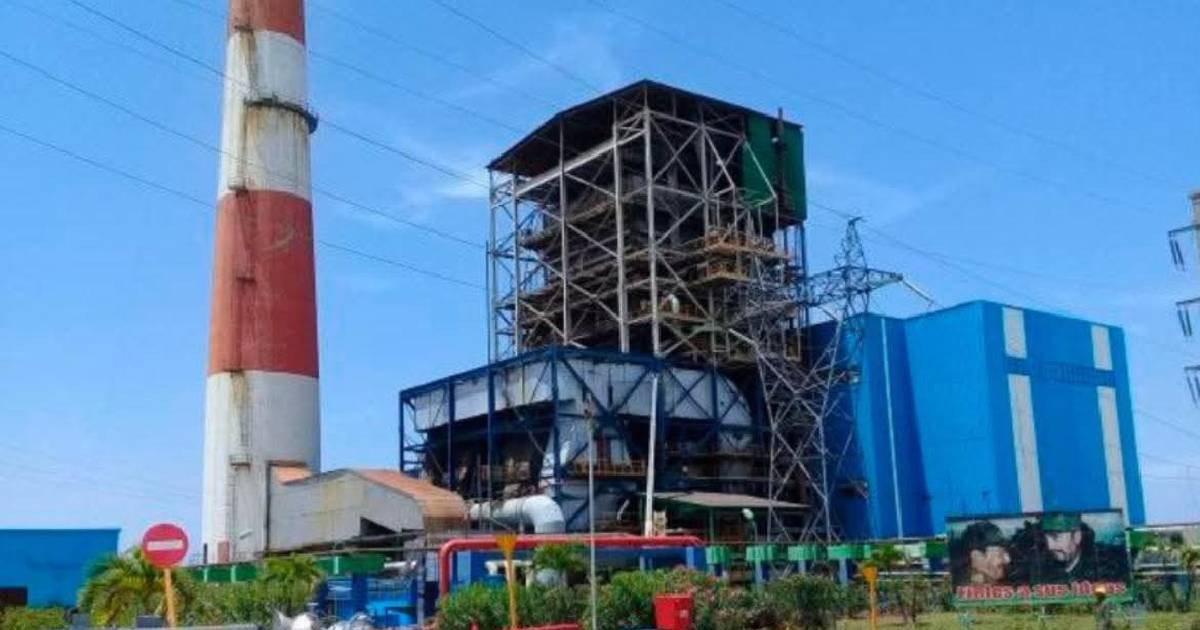
Roberto Morales Ojeda, the Secretary of Organization for the Central Committee of the Communist Party of Cuba, visited the Antonio Guiteras Thermoelectric Plant in Matanzas on Saturday. His visit aimed to oversee maintenance efforts on the country's largest power generation unit, which remains offline from the National Electric System (SEN) due to yet another breakdown.
This marks the ninth failure at the Guiteras plant in 2026 alone, occurring just five days after it was reconnected to the SEN on May 9, following a 90-hour repair involving nearly 300 corrective actions.
Morales Ojeda, accompanied by Mario Sabines Lorenzo, Matanzas' first PCC secretary, and Jorge Luis Broche Lorenzo, a member of the Central Committee's secretariat, toured the facility. He engaged with both management and workers amidst the nation's growing energy crisis, as reported by the official newspaper Girón.
The Tireless Efforts to Restore Power
General Director of the Guiteras plant, Engineer Román Pérez Castañeda, detailed that operations continue around the clock, split into two shifts, with adjustments being made to regenerative air heaters and maintenance performed on all burners.
"We're working in 24-hour shifts to ensure not a second is wasted in restoring the unit's contribution to the system," Pérez Castañeda stated.
The most optimistic scenario suggested a restart between Sunday afternoon and early Monday morning, assuming no new issues were found during hydraulic and radiographic tests—a level of uncertainty that has become common for the plant.
Political Praise Amidst an Energy Crisis
During his visit, Morales Ojeda praised the workers, with the official press framing his words as political recognition: “You are an inspiration.”
He linked the plant's recovery with the regime's ideological discourse and the centenary of Fidel Castro (1926-2016), saying, “Advancement in the province must continue, and you are an example. This is the best tribute we can give to the Commander in Chief in his centennial year.”
These words of encouragement sharply contrast with the severe energy crisis gripping Cuba. On Sunday, the Electric Union reported an availability of only 1,070 MW against a morning demand of 2,545 MW, forecasting a peak time deficit of 2,053 MW, leading to anticipated power outages exceeding 20 hours in several provinces.
Structural Decay of Cuba's Power System
The latest Guiteras breakdown underscores the structural decay of Cuba's electrical system, reliant on aging thermoelectric plants that undergo constant repairs yet fail to provide stability or reduce the extended power cuts affecting millions of Cubans daily.
The plant, inaugurated in 1988, has gone over 15 years without major maintenance, despite technical standards recommending a thorough overhaul every seven to eight years. Pérez Castañeda acknowledged that the plant needs at least 180 days of downtime for such maintenance, but "the country's situation still doesn't allow it."
Compounding the technical crisis is the fuel supply collapse. Energy and Mines Minister Vicente de la O Levy admitted last Wednesday that Cuba has "absolutely no fuel, no diesel, only accompanying gas" after a Russian donation of 100,000 tons of processed crude at the Cienfuegos refinery ran out in early May, with no alternative supply secured by the regime.
Understanding Cuba's Energy Challenges
What is the current status of the Antonio Guiteras Thermoelectric Plant?
The Antonio Guiteras Thermoelectric Plant is currently offline due to a recent breakdown, marking its ninth failure in 2026.
How severe is Cuba's energy crisis?
Cuba is experiencing a severe energy crisis with a significant deficit between electricity supply and demand, leading to power outages that can last over 20 hours in some provinces.
What are the main causes of the energy crisis in Cuba?
The energy crisis is primarily due to the aging infrastructure of thermoelectric plants, lack of major maintenance, and a collapse in fuel supply.