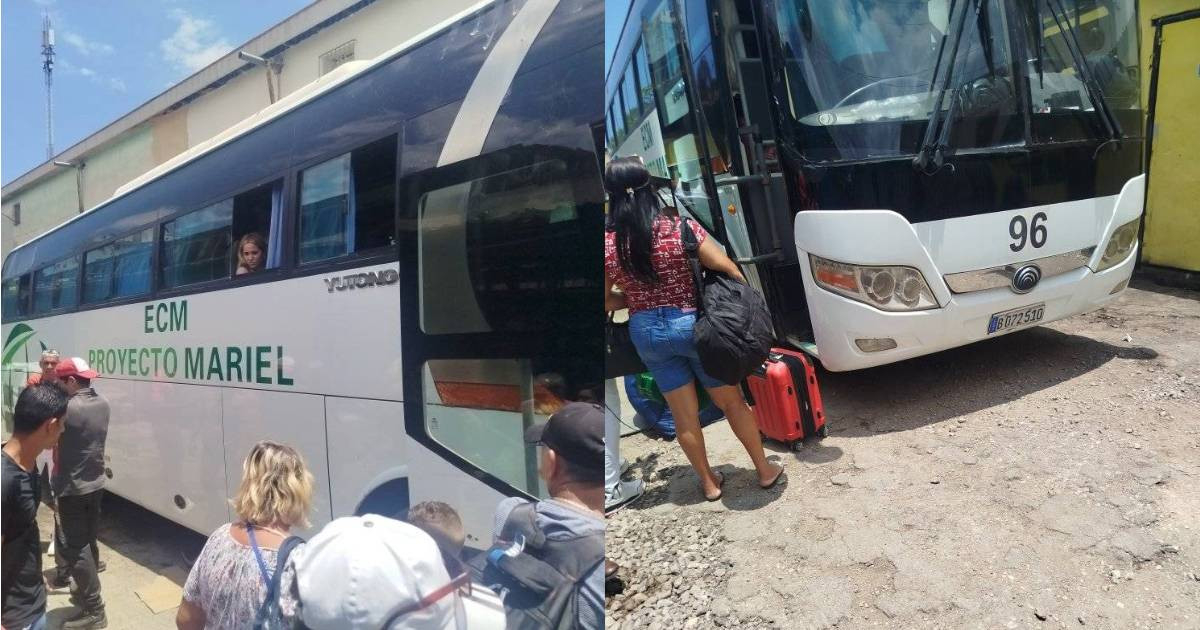
An individual identified on Facebook as Anubbis Inframundo publicly reported on Saturday the appalling conditions faced by their family members during a bus trip from Havana to Santiago de Cuba. The journey, characterized by over four-hour delays, unexpected fare hikes, and passengers crammed among boxes of goods, was nothing short of a nightmare.
The Facebook post, shared in the "rented buses" group, revealed that the bus service operates at the corner of Consejero Arango and Universidad in the Cerro municipality, near the Latinoamericano Stadium.
Originally scheduled to leave at 10:00 AM, the bus did not depart until 2:30 PM, without any explanation given to the waiting travelers. The complainant noted that the ticket price, initially set at 18,000 Cuban pesos, was increased to 20,000 pesos per person without notice.
Luggage areas were entirely packed with boxes of soda, cigarettes, and other goods, forcing passengers to keep their suitcases and belongings with them inside the bus, leading to severe overcrowding.
"There was no room even to place a foot. Poor conditions, mistreatment, and disrespect; I've never witnessed anything like this from an agency that charges so much for such poor service," the individual wrote in their complaint.
The post highlighted a particularly concerning aspect; the driver and coordinators reportedly instructed those transporting boxes to claim that the bus was for Mariel workers if stopped at a checkpoint.
A commenter named Luis Luis confirmed this account. "That bus doesn't belong to any agency; it's a worker transport from Mariel, and since even the boss gets involved, there's no one to complain to because it's not under the Ministry of Transportation, so the driver does whatever he wants."
Other users shared similar experiences on recent trips. Mailenis Corria recounted a comparable ordeal she endured with her husband and their one-year-old baby the previous week.
"The bus was supposed to leave at 3 PM but never showed up. When another bus finally arrived, it broke down, and passengers had to sleep in the broken bus," she recounted, adding that the bus didn't depart until almost night the following day.
Yaquelin Morales described a journey in late April that lasted nearly 24 hours, with aisles filled with luggage and a passenger with a 17,000-peso reservation being told to pay more or stand until reaching Sancti Spíritus.
Faced with the inability to file complaints, user Rosabel Ledesma summed up the collective frustration: "There's no one to answer to anything anymore, you can't complain because no one provides answers, not even the bus terminal managers, it's all a disrespect," she said.
Victoriano Suárez, familiar with the agency due to his family's travels, remarked, "Over time, they've become nothing but bandits operating outside the law, taking advantage of the high level of impunity and lack of real state oversight."
Mariela Alonso harshly summed up what many feel: "Even animals in the jungle don't treat each other this poorly."
The Broader Crisis in Cuba's Transportation
This complaint emerges amid the worst interprovincial transportation crisis in Cuba's recent history. The Ministry of Transportation announced drastic cuts to the frequency of National Buses, trains, and ferries starting June 18, reducing the Havana-Santiago route to just three weekly trips.
In December, out of a fleet of 558 interprovincial buses, only 219 were operational. The fuel shortage is the root of the problem, with Energy Minister Vicente de la O Levy admitting on May 13 that Cuba has "absolutely no" diesel or fuel oil.
This incident is not isolated. In March, a nearly 20-hour Santiago-Havana trip was documented, plagued by six mechanical breakdowns, and by February, interprovincial ticket prices ranged from 15,000 to 30,000 pesos, with private cars charging up to $400.
Understanding Cuba's Transportation Woes
What are the main issues facing Cuba's interprovincial transportation?
Cuba's interprovincial transportation is plagued by severe delays, overcrowding, and unexpected fare increases. The root causes are linked to a critical shortage of fuel and a lack of effective oversight and accountability within transportation agencies.
How often does the Havana to Santiago bus route operate now?
Due to drastic cuts announced by the Ministry of Transportation, the Havana to Santiago bus route now operates only three times a week.
What steps can passengers take to address these travel issues?
Passengers currently have limited options for addressing these issues due to the lack of accountability within the transportation system. Public complaints through social media and seeking alternative travel options are some of the few measures available.