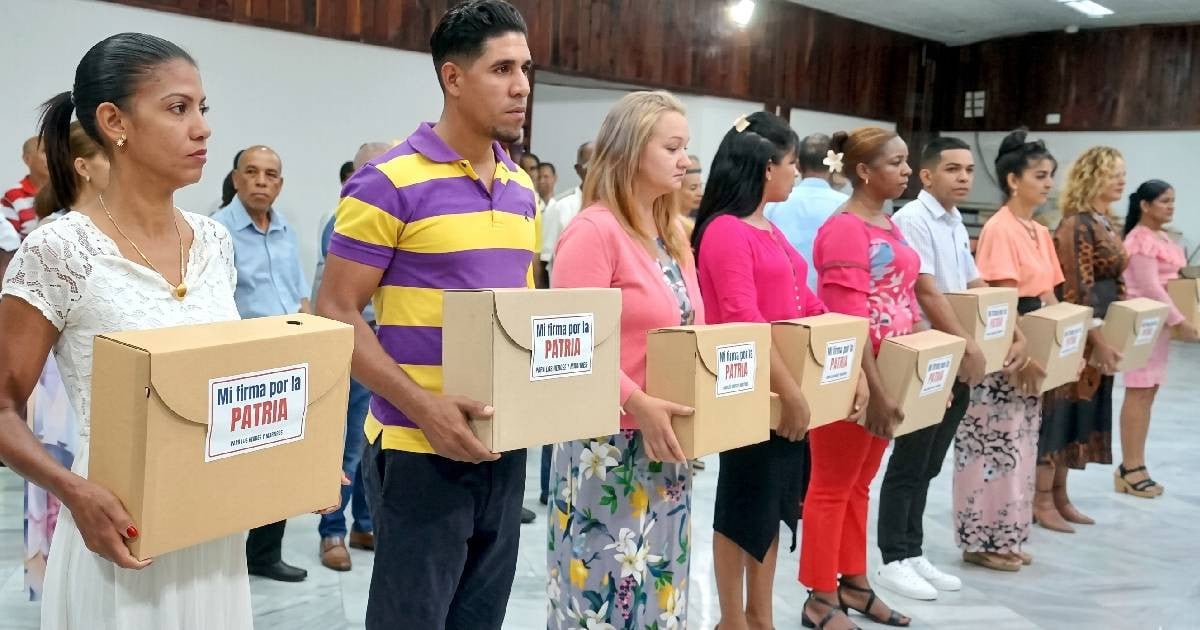
On Saturday, the Cuban regime hosted an official event in Santiago de Cuba's Antonio Maceo Grajales Revolution Square to present signatures collected throughout the province as part of the "My Signature for the Homeland" campaign. This initiative extended to remote areas like the Sierra Maestra mountains and was met with skepticism and mockery by Cubans on social media.
According to a report from the state-run Tele Turquino channel, the envelopes containing signatures from all nine municipalities of the province were delivered to key figures, including Beatriz Johnson Urrutia, the first secretary of the Communist Party in the province, Governor Manuel Falcón Hernández, and Martha del Carmen Mesa Valenciano, President of the National Assembly's Commission on Education, Culture, Science, Technology, and Environment.
The ceremony began with a floral tribute to the "Bronze Titan," followed by a speech from a representative of the so-called "civil society" recognized by the regime. This spokesperson claimed the movement demonstrated "the steadfast resolve of Cubans to preserve their independence and demand respect for their inalienable right to develop and live in peace without blockades or threats."
However, the public's reaction on social media sharply contrasted with the official narrative.
"When did that happen? I didn’t hear about it," commented Leydis Area Santana below the event announcement.
Others were equally candid. "As if the United States cares," noted Miloida Martinez, and Anays Matos sarcastically summarized the campaign: "They signed on behalf of the common people."
The campaign, launched by the Communist Party of Cuba on April 19 to coincide with the 65th anniversary of the Bay of Pigs invasion, was officially portrayed as a spontaneous civil society initiative.
The regime claimed to have collected over six million signatures nationwide, a figure symbolically presented to leader Miguel Díaz-Canel and former president Raúl Castro on May 1 at the José Martí Anti-Imperialist Tribune facing the U.S. Embassy in Havana's Malecón.
Historian Alina Bárbara López critically examined this number, noting that in 2002, the regime reported over eight million signatures with a larger population. She highlighted discrepancies like the identity card of Vice President Salvador Valdés Mesa appearing with only eight digits instead of the required eleven in the official registry, among other irregularities.
Leaked audio recordings also revealed the coercion involved in the initiative. A Revolutionary Armed Forces official threatened civilian workers of the state-run Cimex company, stating that those who disagreed should resign and not work anymore.
State enterprise managers were pressured to secure at least 80% of signatures from their employees under the threat of dismissal, and the Communist Party set up signing tables even at agricultural fairs and marketplaces across the country.
Cuban youth Alfredito Fominaya encapsulated the sentiment in a viral video, saying, "Signatures don't fill the bucket for a bath, nor do they drown out the cries of a child who can't sleep at 3 a.m.," highlighting Cuba's severe economic crisis marked by 24-hour blackouts and a GDP contraction of 23% since 2019.
Frequently Asked Questions about the Signature Campaign in Cuba
What was the purpose of the "My Signature for the Homeland" campaign?
The campaign aimed to collect signatures from Cubans nationwide to demonstrate support for the regime's narrative of independence and peace without foreign blockades or interference.
How many signatures were reportedly collected in the campaign?
The regime claimed to have collected over six million signatures across the country.
What irregularities were reported regarding the signature collection?
Irregularities included discrepancies in official records, coercion of state workers to participate, and setting up signing tables in various public locations to ensure participation.
How did the public react to the signature campaign?
The public reaction was largely skeptical and critical, with many Cubans mocking the initiative on social media and questioning its authenticity and impact.