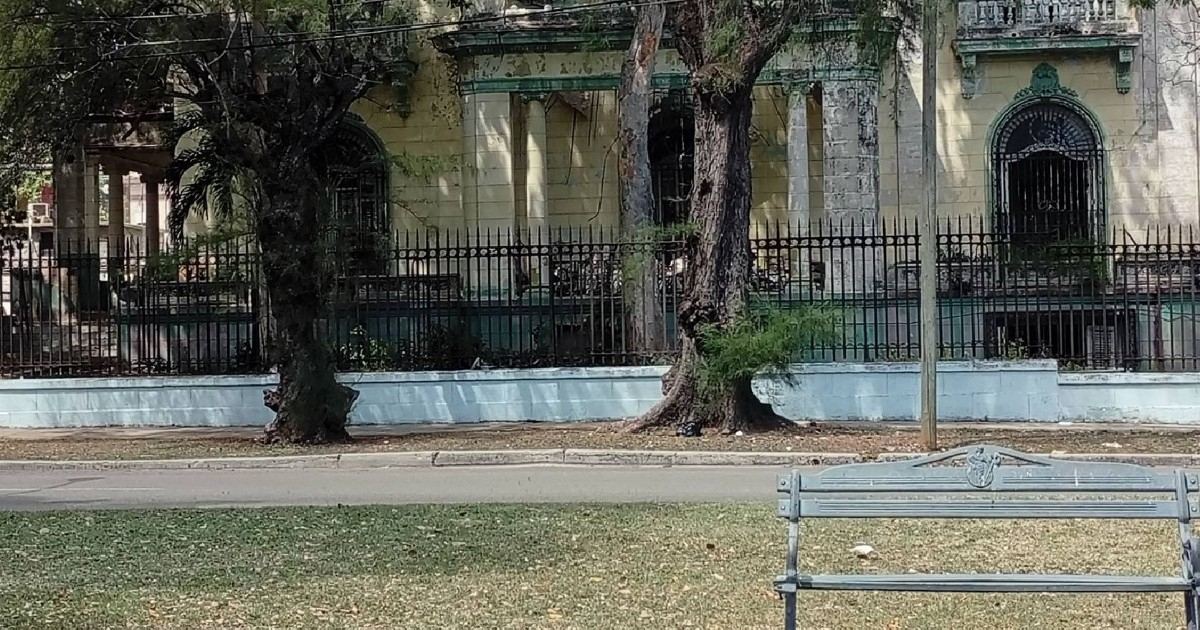
Perched on a bench at the corner of 21 and Paseo, overlooking a dilapidated mansion, Havana resident Yordy Battle contemplates the decay of Vedado, the neighborhood he has called home for 31 of his 41 years. In a post that skillfully blends nostalgia, humor, and sharp criticism, he shares his thoughts.
"If Vedado were a person, I'd imagine it as Dr. House—elegant, worn, intelligent, broken, and sarcastic," writes Battle. He portrays the neighborhood as "a sort of ailing, aristocratic sugar daddy."
The moment of reflection arose from a raw everyday experience: after leaving a fair at John Lennon Park and in search of a bottle of oil, Battle paused to take in the sight of the abandoned mansion.
This image—material scarcity alongside the crumbling beauty of architecture—forms the essence of his piece, which he refers to as "crying-out mea culpa."
Challenging the Official Narrative
In his musings, Battle openly challenges the official discourse on property and heritage: he would rather see the mansion restored by a foreign investor or the heirs of its former owners than watch it continue to decay.
"Was it ever going to be mine? No, that's true! But it's not mine now either, nor will it ever be, and just look at its ruin," he writes.
He bolsters his argument with the biblical parable of King Solomon's judgment: just as the true mother would rather give up her child than see him die, Battle prefers someone else to save the mansion rather than no one.
"I wouldn't mind if any foreign investor, or even the heirs of the former owners, took it back just to see it rise from the ashes like a Phoenix," he declares.
Years of Neglect
Battle's observations are not isolated. Vedado has suffered decades of neglect and institutional abandonment, with residents repeatedly alerting authorities about the structural dangers of buildings without receiving any official response.
In December 2025, a partial collapse in Vedado raised alarms about the neighborhood's condition again, and by March 2026, a building in Havana had to be demolished after years of deterioration and partial collapses.
In 2024, families lived in a building at risk of collapse in Vedado, with no solutions offered by any authorities.
From Modernity to Decline
The neighborhood developed between the late 19th and mid-20th centuries as a symbol of Havana's republican urban modernity, showcasing eclectic, art deco, and Cuban modernist architecture.
Following the nationalizations from 1959 to 1968, thousands of private properties were seized by the state. The original owners, many of whom went into exile, never reclaimed their assets, and the 2019 Constitution prohibits the concentration of property in private hands, with no mechanism for restitution.
Battle concludes his reflection with an image steeped in irony: "Even if 'Solomonically' I have to sit on this same bench, gazing from afar at 80 years old, with oil at 50 quilos a bottle, and say, 'How beautiful!'"
Understanding Vedado's Decline
What are the main causes of Vedado's deterioration?
Vedado's decay is largely due to decades of neglect and lack of maintenance, compounded by institutional abandonment and the absence of private investment to restore its structures.
Why can't original property owners reclaim their assets in Vedado?
After the nationalizations from 1959 to 1968, properties were seized by the state. The 2019 Constitution prohibits the concentration of property in private hands, leaving no legal pathway for restitution to the original owners.
How has the community responded to the structural dangers in Vedado?
Residents have repeatedly warned authorities about the structural dangers of buildings, but they have not received any substantial response or assistance to address these concerns.