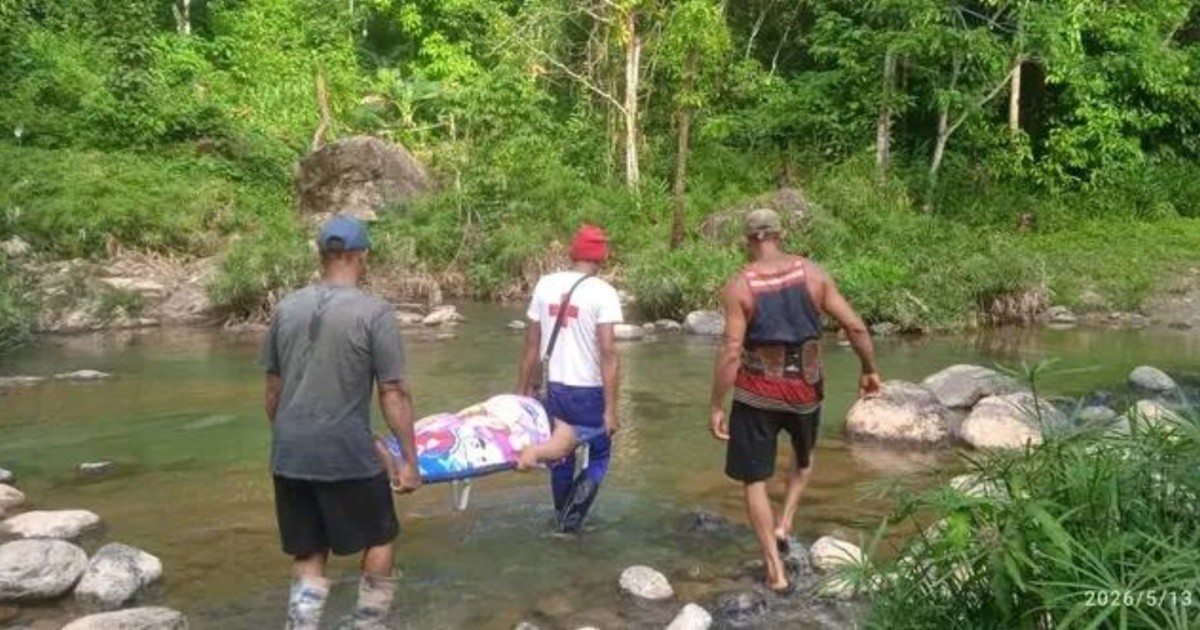
Last Wednesday, a postpartum mother and her three-year-old daughter were saved from a challenging situation in La Cueva, located in the Jobo Arriba area of Imías, Guantánamo. The rescue operation was a collaborative effort involving the Red Cross, the Municipal Relief Group, and health authorities. Due to the lack of vehicle access, rescuers had to navigate a rocky river to transport the patients.
Photos from the operation, taken on May 13 between 5:30 PM and 5:47 PM, reveal three men carrying the mother on a makeshift stretcher draped in vibrant fabric as they waded through the stone-laden river surrounded by lush tropical vegetation.
The three-year-old girl was transported across the same river on the back of a mule, accompanied by healthcare personnel and local community members who volunteered to assist.
A member of the Imías Red Cross, recognizable by his white vest with the iconic red cross, led part of the river crossing alongside medical staff equipped with emergency backpacks and wearing white coats.
The Imías Red Cross hailed the operation as a collective achievement, stating: “With helping hands, united wills, and coordinated efforts between the Municipal Relief Group, Health authorities, and the Provincial Red Cross, we managed to do what was essential... arrive on time.”
Approximately 10 to 15 people participated in the river crossing at various times over the 17-minute duration captured in the images.
The Challenges of Jobo Arriba: Navigating a Remote Terrain
Jobo Arriba is nestled within the Sierra del Purial, one of Guantánamo's most inaccessible regions. Any medical emergency in this area necessitates a well-coordinated response between institutions and the community due to the complete absence of roadways for vehicles.
The postpartum period is particularly perilous for mothers, making timely intervention crucial to their survival.
This rescue was not an isolated incident. Just two weeks prior, the Red Cross in Yateras evacuated an elderly man with a fractured hip from Palenque Arriba under similar conditions, involving a stretcher carry through rough terrain.
In April, two-year-old Gael de Jesús Leyva was found alive in Los Cerezo, within the Imías municipality, following a mobilization by the Municipal Operations and Relief Group, the Red Cross, and volunteer neighbors—a case cited by the Imías Red Cross as a testament to their commitment.
Historical Context: The Lasting Impact of Hurricane Oscar
The municipality of Imías continues to struggle with structural vulnerabilities worsened by Hurricane Oscar in October 2024, when severe flooding cut off Imías and San Antonio del Sur, leading to the evacuation of around 9,000 people. The alternate route via Moa-Baracoa took more than seven hours.
The Imías Red Cross encapsulated the essence of the rescue operation with a sentiment that reflects the reality of these communities: “This success isn’t credited to a single name. It belongs to every neighbor who carried, accompanied, and didn’t hesitate to help. Because when a community unites, no obstacle is insurmountable.”
Understanding the Humanitarian Efforts in Imías
What challenges do rescuers face in the region of Jobo Arriba?
Rescuers in Jobo Arriba encounter significant challenges due to the area's inaccessibility, which lacks proper roadways, thereby necessitating coordinated efforts for any medical emergencies.
How does the community contribute to rescue operations in Imías?
The community plays a vital role by volunteering to assist in transporting patients and providing support during medical emergencies, illustrating the power of collective action.
What was the impact of Hurricane Oscar on Imías?
Hurricane Oscar exacerbated the region's vulnerabilities by causing severe flooding that isolated communities, necessitating the evacuation of thousands and highlighting the area's infrastructural deficiencies.