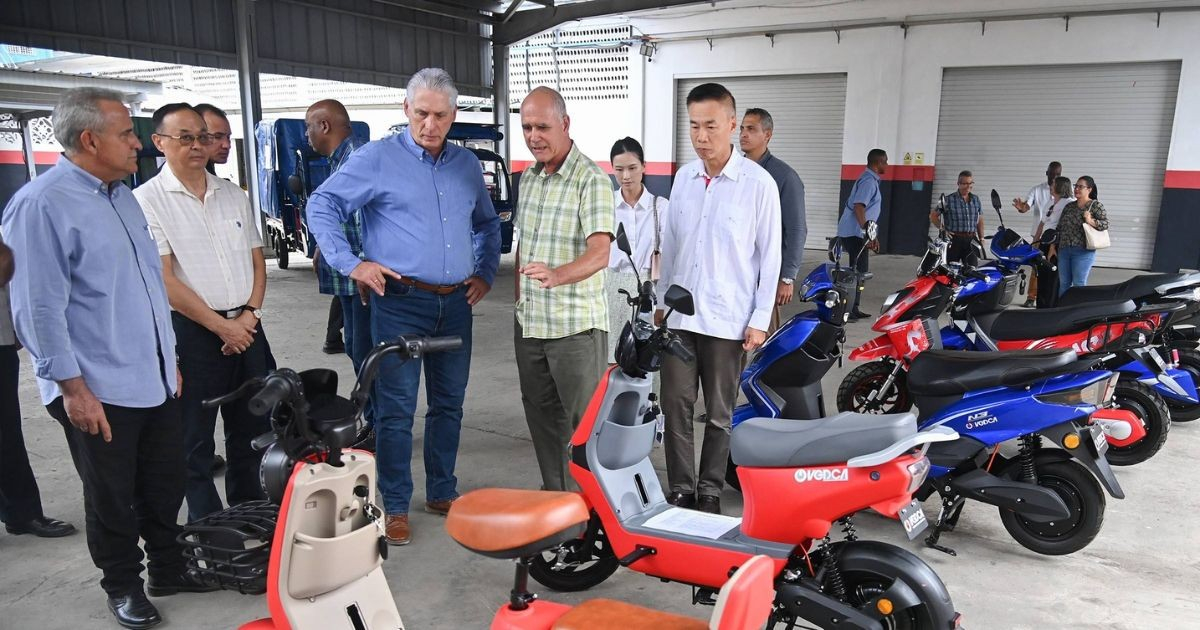
On Friday, Miguel Díaz-Canel visited the VEDCA (Caribbean Electric Vehicles) facility, a joint Chinese-Cuban venture located approximately 15 kilometers west of Havana. He described the plant as a "gem" to its executives, even as the nation experiences widespread power outages affecting over 70% of its territory.
The official Facebook page of Cuba's Presidency shared images from the visit under the slogan "Thinking Big," capturing the leader touring the assembly area and engaging with both Chinese technicians and local workers.
"You have a gem in your hands, and it must be protected," Díaz-Canel remarked to the director of VEDCA. The company currently assembles electric bicycles, motorcycles, and tricycles, with plans to begin manufacturing electric cars by August.
He praised VEDCA as a "fortress of cooperation with China" and a model of "energy transition, innovation, and socialist efficiency." Before concluding his tour, he remarked, "In such challenging times, development and resilience are palpable here."
However, he did not mention that these "challenging times" include power outages lasting up to 22 hours daily in some areas of Havana. Just two days prior to his visit, on May 14, Cuba set a new record for its electricity deficit, with 2,153 MW not being generated by 9:30 PM, plunging over 70% of the country into darkness.
The previous day, on May 13, the shortfall reached 2,113 MW, surpassing the previous record of 2,075 MW from March. Energy and Mines Minister Vicente de la O Levy openly acknowledged Cuba's dire situation, stating the country was "without fuel," neither oil nor diesel, relying solely on accompanying gas for electricity generation after no fuel shipments arrived between December 2025 and March 2026.
In this context, VEDCA's ambitious proposal for the factory to achieve "complete independence from the national electrical system" using photovoltaic panels seems more like a jest than an industrial strategy.
The numbers celebrated by the regime for VEDCA also don't hold up well under scrutiny: the company reportedly earned over $12 million in 2024, expanding from 1,000 to 10,000 units annually, according to the Presidency. For 2026, it aims to produce over 20,000 units and generate about $40 million, as reported by the official newspaper Trabajadores. In 2024, the plant operated far below capacity due to financial, logistical, and market challenges.
VEDCA's electric tricycles are sold in informal markets for over $3,000, while official stores price them between $1,300 and $2,550—in a country where the average state salary is less than $50 per month.
For those who can afford an electric tricycle, there's the issue of charging it, which requires electricity—a scarce resource the regime has failed to provide reliably for years. Installing a solar panel on the vehicle is an additional $800 cost.
Established in 2019, VEDCA is a partnership between China's Tianjin Dongxing Industrial Group Co. Ltd., holding 58% of the investment, and Cuba's Minerva. By January 2023, it had produced 2,500 electric motorcycles, 1,500 tricycles, and 1,000 children's electric cars, accumulating $6 million in profits.
While Díaz-Canel dreams big with electric bikes and solar panels, the National Electroenergetic System remains fragile: on May 15, the Electric Union announced a full restoration of service following record outages, though Cubans know well that this "restoration" is often short-lived until the next thermoelectric plant fails.
Understanding Cuba's Energy Crisis and VEDCA's Role
What is the significance of Díaz-Canel's visit to VEDCA?
Díaz-Canel's visit to VEDCA highlights the government's focus on electric vehicle production as part of Cuba's energy transition strategy, despite ongoing national power outages.
How is Cuba addressing its electricity shortages?
Cuba is currently facing severe electricity shortages, exacerbated by a lack of fuel and reliance on limited gas supplies, leading to widespread power outages.
What challenges does VEDCA face in its operations?
VEDCA encounters financial, logistical, and market challenges that affect its production capacity, despite government projections of significant growth and profitability.
Why are VEDCA's electric vehicles expensive for Cubans?
VEDCA's electric vehicles are costly, with prices far exceeding the average Cuban salary, making them inaccessible for most citizens without additional financial means or support.