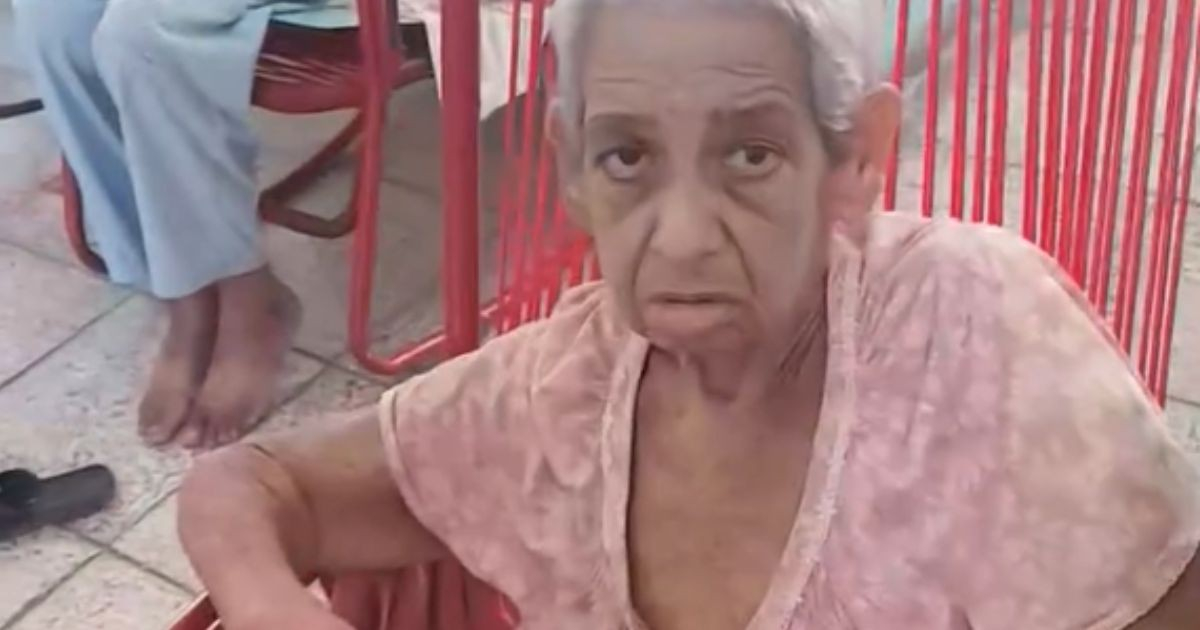
An individual from Havana, known as Alfonso Vera from the Los Ángeles neighborhood in the San Miguel del Padrón municipality, shared a video on Facebook highlighting the harsh conditions faced by his neighbor Luci, who resides in a senior care facility located at Beltrán Street and San Miguel Avenue in Jacomino, a district in the Cuban capital.
The footage reveals a stark reality where the elderly woman lacks personal cups and spoons. "Vaso y cuchara. Tengo que dejar que mamá quitarle cuchara para que otra gente," Vera narrates, illustrating how Luci has to wait for someone else to finish eating to use the utensils.
The situation with food is equally grim. Luci informed her neighbor that the standard meals at the facility consist of "pea water and boiled spaghetti." Vera expressed his disbelief with a single word of astonishment in his post.
To help alleviate these hardships, Vera brought Luci essentials like soap, underwear, cookies, house robes, and condensed milk, sent by her daughter from Spain through a niece living in Cuba. "Lucy is recovering," Vera stated in the video, though the surrounding conditions leave little room for optimism.
Vera also publicly appealed for assistance, suggesting that "with just 5 or 10 pesos, we could buy her a few more things and a decent meal." He provided his address and bank card number for donations intended for the elderly woman. The post quickly garnered attention, amassing over 9,300 views and hundreds of reactions.
The Broader Crisis of Elderly Care in Cuba
The situation at the Jacomino care home is not unique. Cuba holds the distinction of being the most aged country in Latin America and the Caribbean, with more than a quarter of its population aged 60 or older, according to the National Office of Statistics and Information (ONEI). This demographic reality clashes with a collapsing care system.
In September 2025, the Cuban Observatory for Human Rights (OCDH) reported that eight out of ten Cubans over 61 have had to skip breakfast, lunch, or dinner due to financial constraints or food shortages. The same report indicated that 14% of those over seventy continue to work after retirement because their pensions are insufficient to meet basic needs. A survey by the Independent Trade Union Association of Cuba found that 99% of Cuban retirees cannot cover basic necessities like food, housing, and medication.
The "Hunger in Cuba" report by the Food Monitor Program (2024) added that 96.9% of respondents have lost access to food due to inflation, and one in four Cubans goes to bed without dinner. Pensions, which do not exceed 4,000 Cuban pesos monthly, fall short of covering even the most basic expenses.
Similar scenes to those in Jacomino have been documented across other provinces. When Miguel Díaz-Canel visited a senior home in Manicaragua, Villa Clara, the images starkly contrasted with the reality of visibly malnourished residents. In Havana, an elderly woman in Boyeros summarized her plight with a devastating phrase: "The only thing I had to eat was a little bit of beans."
Government's Response and the Reality of Private Elder Care
Faced with overwhelming evidence of system collapse, the Cuban government authorized in February 2026, through Agreement 10249/2025, the opening of private senior residences by non-state actors. However, the first such facility reported, the Senior Residence of TaTamanía in El Vedado, charges from 1,080 dollars monthly for a shared room, a price far beyond the reach of most Cubans. The stark contrast between this cost and the reality of a care home where seniors share a spoon highlights, with brutal clarity, the dire state of elder care in today's Cuba.
Understanding Elder Care Challenges in Cuba
What are the primary issues faced by elderly care facilities in Cuba?
Elderly care facilities in Cuba often struggle with inadequate resources, including a lack of basic utensils and insufficient food supplies. These challenges are exacerbated by a collapsing care system and financial constraints.
How is the Cuban government addressing the problems in elderly care?
The Cuban government has allowed the establishment of private senior residences, but the costs are prohibitively high for most citizens, creating a gap between availability and affordability.
What impact does Cuba's aging population have on its care system?
With over a quarter of its population aged 60 or older, Cuba's aging demographic places significant pressure on an already strained care system, leading to widespread shortages and inadequate care for the elderly.