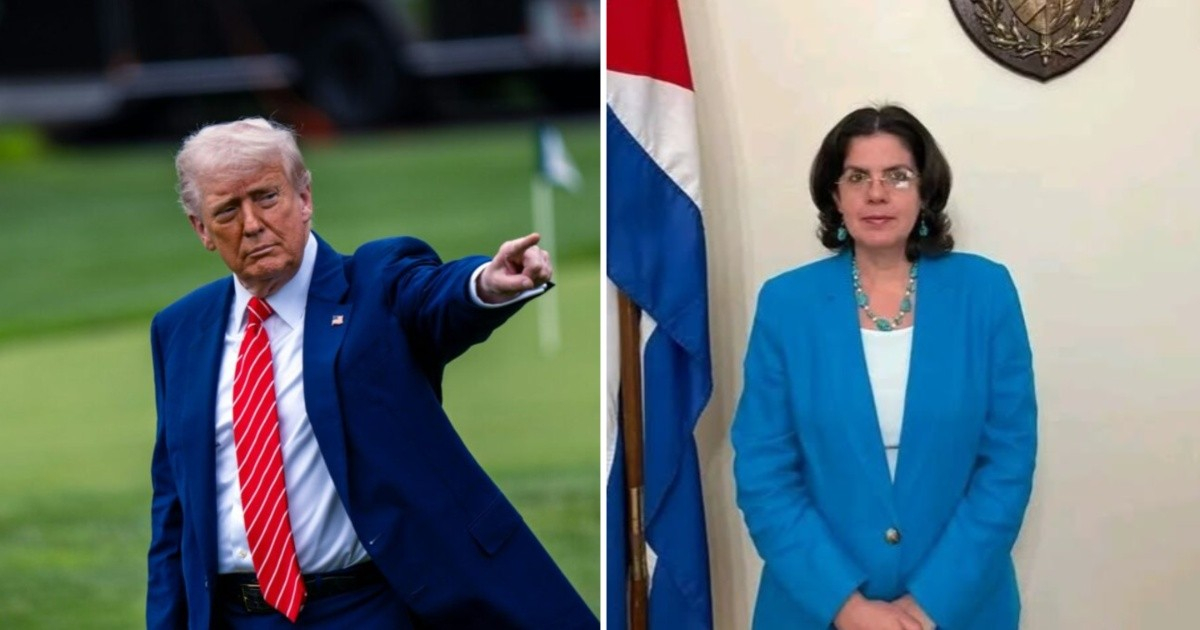
The primary Cuban diplomat in Washington, Lianys Torres Rivera, revealed on Friday that the island nation is gearing up for a potential invasion by the United States. She also noted a lack of progress in bilateral negotiations during an exclusive interview with The Hill, conducted at the Cuban Embassy in the U.S. capital.
This interview took place amidst one of the most tense periods in U.S.-Cuba relations. It followed Cuban Energy Minister Vicente de la O Levy's admission that the island is facing a severe fuel shortage, having "absolutely no fuel or diesel, only accompanying gas." He described the situation as "acute, critical, and extremely tense."
On that same night, Cuba's Electric Union recorded an unprecedented deficit of 2,153 MW, with only 1,230 MW available against a demand of 3,250 MW. This resulted in blackouts lasting up to 22 hours and sparked widespread protests across at least ten municipalities in Havana, with residents banging pots, lighting bonfires, and blocking streets.
While acknowledging the legitimacy of the Cuban people's grievances, Torres Rivera cautioned against misinterpreting these demonstrations. "When enduring 20-hour blackouts, people have complaints and express them," she stated. However, she warned that Washington should not mistake this as a sign that "the Cuban people will not defend their homeland against an invasion."
The Cuban Military Stance and Diplomatic Tensions
The diplomat was clear about the military preparations: "We are preparing for this. More so than ever before. We cannot afford to be naive. Our preparations are defensive. We are not planning to initiate actions against the U.S. territory or its citizens. That is not our intention. Our aim is self-defense."
Torres Rivera characterized the current situation as "one of the most difficult, if not the most difficult, in the bilateral relationship" between Cuba and the United States.
The backdrop to this interview also included a visit by CIA Director John Ratcliffe to Havana on Thursday, where he met with officials from Cuba's Ministry of the Interior.
Escalating Tensions and Economic Sanctions
The agency warned that the window for negotiations "will not remain open indefinitely" and that "Cubans should not harbor the illusion that the president will not enforce the red lines." The Cuban regime confirmed this meeting, claiming to have presented "evidence" that Cuba does not pose a threat to U.S. national security.
The U.S. State Department acknowledged publicly "numerous private offers" of $100 million in direct aid to the Cuban people, contingent on the regime allowing it.
The root of the escalation can be traced back to Executive Order 14380, signed by Trump on January 29, 2026, which cut between 80% and 90% of Cuban crude imports. On May 1, Trump signed a second executive order extending the national emergency and authorizing secondary sanctions.
On May 7, Secretary of State Marco Rubio announced direct sanctions against GAESA, the military conglomerate that controls 40% to 70% of Cuba's formal economy, with a deadline of June 5 for foreign financial institutions to cease operations.
Foreign Minister Bruno Rodríguez Parrilla warned in at least five public addresses in less than two weeks that a U.S. military action would "provoke a true humanitarian catastrophe, a bloodbath," claiming "Cuban and American lives would be lost."
President Miguel Díaz-Canel asserted in an NBC News interview that Cuba "will defend itself, and if we need to die, we will die," as the government declared 2026 the "Year of Defense Preparation" and intensified civilian military exercises involving rifles, drones, and anti-tank mines.
Frequently Asked Questions on U.S.-Cuba Relations
Why is Cuba preparing for a possible U.S. invasion?
Cuban officials, including Ambassador Torres Rivera, have cited recent tensions and lack of progress in negotiations with the U.S. as reasons for heightened military preparedness, emphasizing a defensive rather than offensive stance.
What sparked the current crisis in U.S.-Cuba relations?
The crisis escalated following Executive Orders by Trump that significantly reduced Cuban crude imports and imposed sanctions on Cuban entities, alongside increased diplomatic tensions.
How is the Cuban government responding to internal protests?
The Cuban government acknowledges the reasons for public discontent due to fuel shortages and blackouts but warns against interpreting protests as a lack of willingness to defend the nation against external threats.