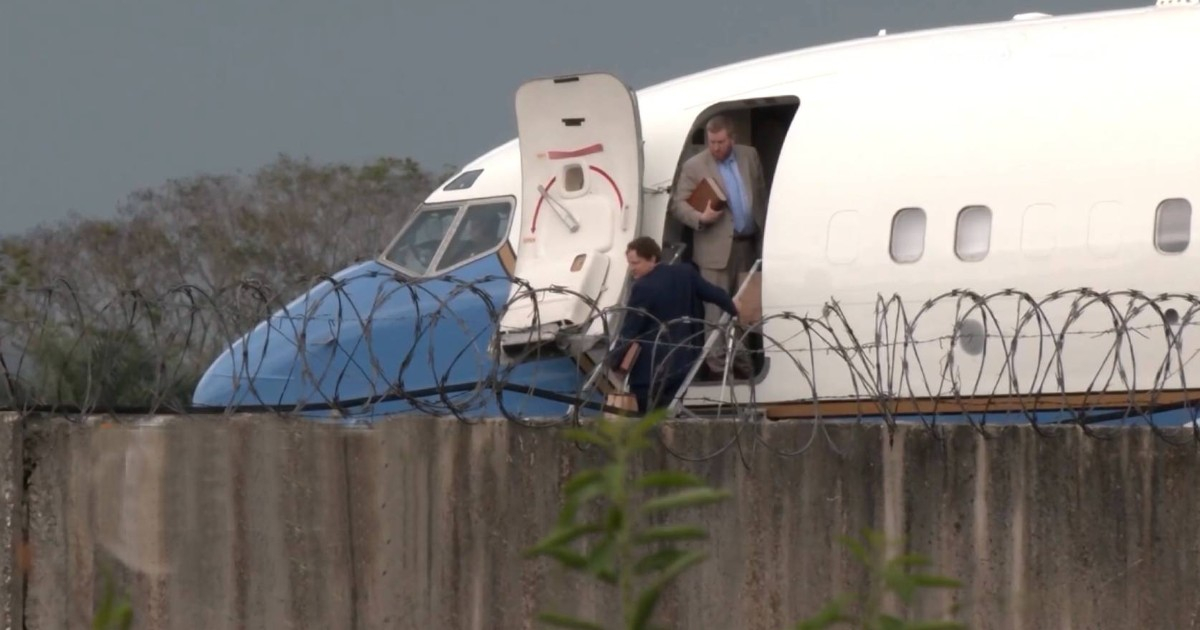
A team from the CIA, led by Director John Ratcliffe, made an official trip to Havana this Thursday, as captured on video by Reuters at the José Martí International Airport. The delegation arrived on a United States Air Force flight.
The flight, known as SAM554, was operated by a Boeing C-40B Clipper with tail number 01-0040. It departed from Joint Base Andrews, Washington, and touched down in Havana at around 13:00 UTC. Following the meeting in Havana, the aircraft flew to MacDill Air Force Base in Tampa, Florida.
The Cuban regime acknowledged the encounter in an official statement on the Communist Party of Cuba's website.
The statement indicated that the visit was initiated by a request from Washington and was approved by "the Directorate of the Revolution": "Following the request made by the United States government for a delegation led by CIA Director John Ratcliffe to be received in Havana, the Revolutionary Directorate approved this visit and the meeting with their counterparts from the Ministry of the Interior."
No specifics were provided regarding the subjects discussed during the meeting.
Unusual Diplomatic Signals and Historical Context
This visit occurs amidst a week marked by unusual diplomatic signals. Last Tuesday, Former President Donald Trump posted on Truth Social, "Cuba asks for help, and we're going to talk!" The following day, Cuban President Miguel Díaz-Canel expressed willingness for dialogue.
This is the second high-level contact between Washington and Havana in recent weeks. Previously, on April 10, a State Department delegation overseen by Marco Rubio held a secret meeting on the island — the first landing of a U.S. official aircraft in Cuba since 2016. Discussions included political prisoner releases, internet access via Starlink, and foreign group activities in the country.
The Cuban delegation included Deputy Foreign Affairs Ministers and Raúl Guillermo Rodríguez Castro, the grandson of the late Raúl Castro.
During that meeting, U.S. officials cautioned that Cuba had "a small window of opportunity" and "a limited timeframe" to enact reforms.
Strategic Implications of Ratcliffe's Visit
Ratcliffe's presence in Havana carries significant symbolic weight. In January 2026, he traveled to Caracas on a diplomatic mission that resulted in the capture of Nicolás Maduro, highlighting the strategic importance Washington places on the current process in Cuba.
The pressure on Cuba is substantial: since January 2026, the United States has imposed over 240 sanctions, intercepted at least seven tankers heading to the island, and conducted at least 25 military surveillance flights near its shores. Reports also suggest that the Trump administration directed the Pentagon to prepare for potential military operations against Cuba.
During the 2026 global threat briefing, Ratcliffe confirmed that Russia aims to expand its security and diplomatic ties with Cuba and Nicaragua, adding a geopolitical layer to ongoing negotiations.
Thursday's meeting represents the highest-level interaction between the two governments since the current phase of contacts began, raising questions about what concessions, if any, the Cuban regime might be willing to make to ease the pressure threatening its survival.
Key Insights into U.S.-Cuba Diplomatic Relations
What prompted the CIA delegation's visit to Havana?
The visit was requested by the U.S. government and approved by the Cuban Revolutionary Directorate, marking a significant diplomatic engagement.
What was the significance of John Ratcliffe's presence in Havana?
John Ratcliffe's presence symbolizes the strategic importance the U.S. places on its dealings with Cuba, especially given his past success in capturing Nicolás Maduro in Caracas.
How has the U.S. increased pressure on Cuba in recent years?
Since January 2026, the U.S. has imposed over 240 sanctions, intercepted multiple tankers, and conducted military surveillance near Cuba.