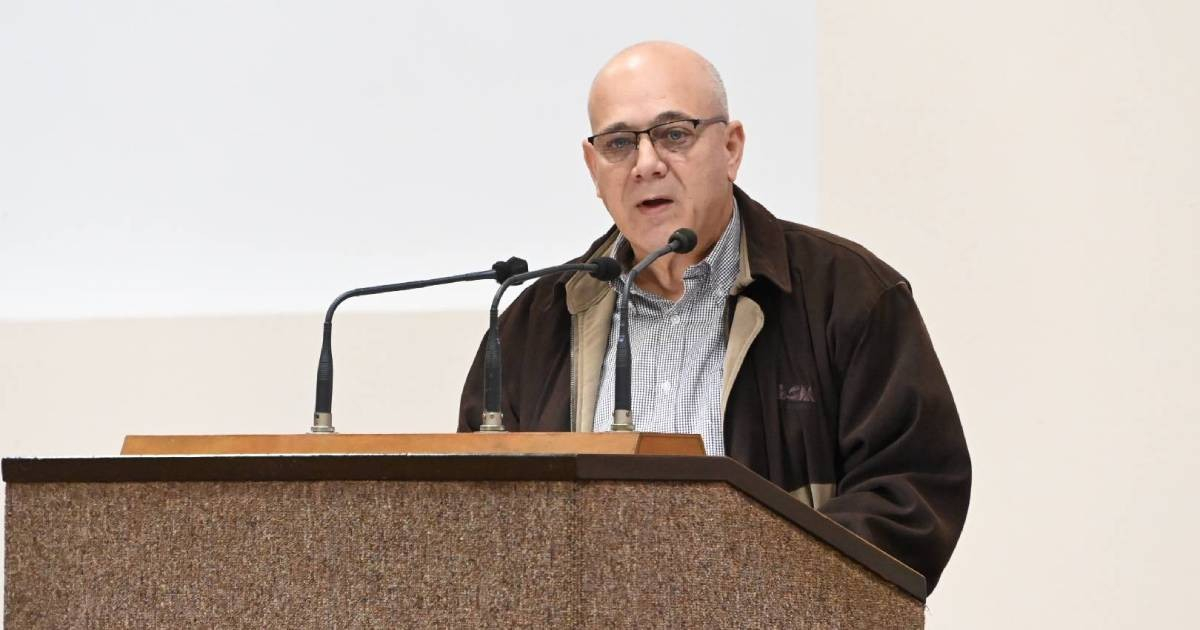
Roberto Morales Ojeda, a key figure within Cuba's Communist Party (PCC), took to social media to highlight the "openness" of the revolutionary government following a meeting in Havana between CIA Director John Ratcliffe and Cuban Ministry of the Interior (MININT) officials.
"With the transparency characteristic of the revolutionary government, details of today's exchange with a U.S. government delegation were shared. This meeting clearly demonstrated our strong arguments and Cuba's seriousness in discussing vital issues concerning both nations," Morales Ojeda posted on his @DrRobertoMOjeda account, concluding with the hashtag #CubaEstáFirme.
The irony of his statement was not lost: the regime labeled a previously secret meeting as "transparent," only confirming the event through an official PCC statement. According to this release, it was the U.S. government that sought the meeting, which was approved by "the leadership of the Revolution." This high-level dialogue, one of the most significant between Washington and Havana in decades, focused on Cuba's inclusion on the State Sponsors of Terrorism list, a designation reinstated by the Trump administration on January 20, 2025, shortly after his second term began.
The PCC statement insisted that the discussions "categorically proved that Cuba poses no threat to U.S. national security, nor are there legitimate reasons to list it among nations allegedly sponsoring terrorism."
The regime also firmly denied the presence of "foreign military or intelligence bases" on its soil, a claim countered by available intelligence. The Center for Strategic and International Studies (CSIS) has reported the existence of at least 12 Chinese signal intelligence facilities in Cuba, with key sites in Bejucal, El Wajay, Calabazar, and El Salao.
U.S. Secretary of Defense Pete Hegseth confirmed before Congress that Russian warships, including the submarine Kazan, have frequently docked in Cuban ports.
Morales Ojeda's tweet marks a notable shift in his rhetoric. In January, the PCC's Secretary of Organization had described armed intervention as an "imminent risk," asserting that "surrender is not an option." On May 7, he invoked Raúl Castro, emphasizing "the unity of the people as our main weapon" against the U.S. threat.
Ratcliffe's visit coincided with a week of significant diplomatic activity. On May 12, Trump announced on Truth Social, "Cuba asks for help, and we're going to talk!" On May 13, Díaz-Canel expressed a constant "willingness to dialogue." That same Thursday, Foreign Minister Bruno Rodríguez Parrilla reversed his stance on a $100 million humanitarian aid offer from Washington, stating Cuba was "open to hearing the details of the offer," just five days after dismissing it as a "fable" and "lie."
Preceding this visit was a covert meeting on April 10, where a U.S. State Department delegation made the first official American landing in Cuba since 2016, discussing political prisoners' release, internet access via Starlink, and the presence of foreign entities on the island.
Secretary of State Marco Rubio had warned on April 28, "We will not allow any foreign military, intelligence, or security apparatus to operate with impunity just 90 miles off the U.S. coast," directly addressing the Chinese and Russian installations in Cuba.
Frequently Asked Questions about U.S. and Cuba Diplomatic Relations
Why did the U.S. government request a meeting with Cuba?
The U.S. sought the meeting to discuss Cuba's designation on the State Sponsors of Terrorism list and address security concerns.
What was discussed in the meeting between the CIA and Cuban officials?
Discussions focused on security issues and Cuba's inclusion on the State Sponsors of Terrorism list.
How has Cuba responded to claims of foreign military bases on its territory?
Cuba has denied the presence of foreign military or intelligence bases, despite reports indicating otherwise.