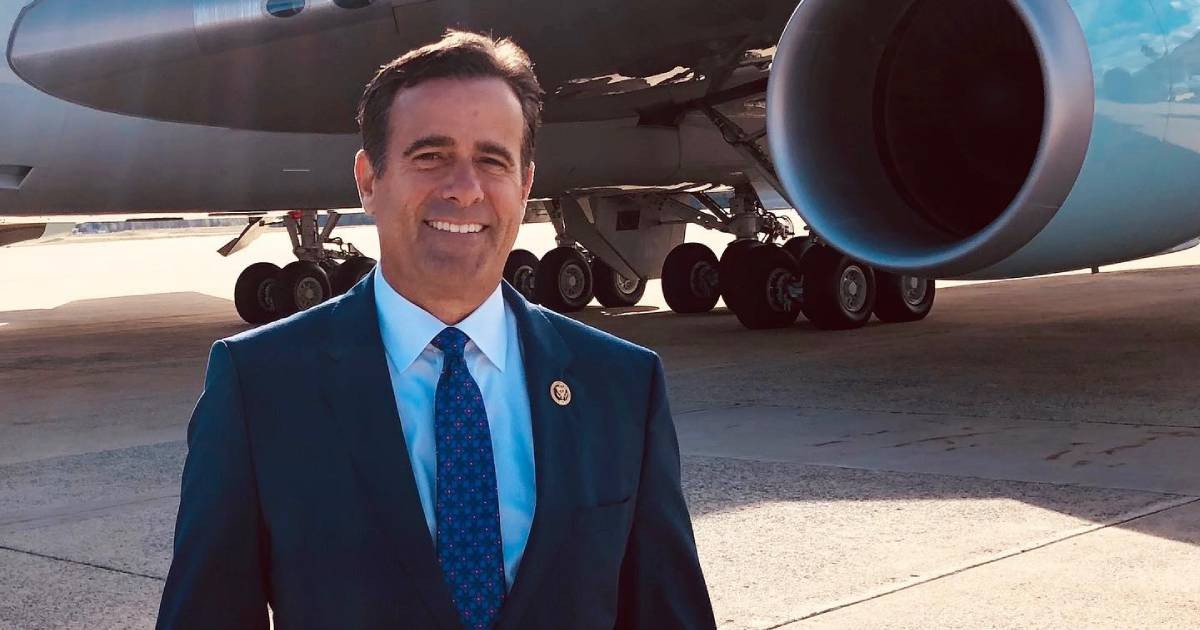
The Communist Party of Cuba (PCC) released an official statement this Thursday asserting that recent discussions with a delegation from the Central Intelligence Agency (CIA), led by its director, John Ratcliffe, unequivocally proved that Cuba is not a threat to U.S. national security. The statement further argued there are no legitimate grounds for Cuba's inclusion on the list of nations allegedly sponsoring terrorism.
The statement indicates that it was the U.S. government that requested the meeting, which was sanctioned by the so-called "Direction of the Revolution." The meeting took place between Ratcliffe's delegation and representatives from Cuba's Ministry of the Interior (MININT).
In the communiqué, the regime reiterated that the island "does not harbor, support, finance, or permit terrorist or extremist organizations." It emphasized that "there are no foreign military or intelligence bases on its territory," and that Cuba "has never supported any hostile activity against the United States nor will it allow such actions from its soil against any other nation."
This assertion stands in stark contrast to reports from the Center for Strategic and International Studies (CSIS), which have identified at least 12 Chinese intelligence facilities within Cuba, including sites in El Salao, Bejucal, Calabazar, and El Wajay, operational since at least 2019.
The CIA's arrival in Havana was tracked via flight SAM554, a Boeing C-40B Clipper originating from Joint Base Andrews in Washington, which landed at José Martí International Airport around 13:00 UTC. The SAM prefix, denoting Special Air Mission, is reserved exclusively for high-level U.S. government flights.
Both parties also expressed "interest in developing bilateral cooperation between law enforcement agencies for the security of both nations, regionally and internationally," according to the statement.
The Terrorism Sponsor List and Diplomatic Efforts
The main focus of the meeting was the list of State Sponsors of Terrorism. The Trump administration reinstated Cuba on this list on January 20, 2025, shortly after beginning its second term, reversing a decision made by Biden.
This visit takes place amidst a week of significant diplomatic activity. On Tuesday, Trump stated on Truth Social, "Cuba is asking for help, and we're going to talk!" The following day, Miguel Díaz-Canel expressed willingness for dialogue, while Foreign Minister Bruno Rodríguez Parrilla announced Cuba's openness to hearing the details of a $100 million humanitarian aid offer from Washington, a notable shift from their earlier stance on May 9, when they dismissed the proposal as a "fable."
Ratcliffe is known for his high-level diplomatic missions in the region. In January 2026, he traveled to Caracas to meet with Venezuelan officials following the capture of Nicolás Maduro, making his visit to Havana his second such mission in under four months.
The Trump administration has maintained a policy of maximum pressure on the Cuban regime, imposing over 240 sanctions since January 2026, intercepting at least seven tankers, and conducting at least 25 military surveillance flights near Cuban shores. The regime described the current situation as "complex" in its Thursday statement.
Key Questions Surrounding Cuba's Security Status
What was the purpose of the CIA Director's visit to Cuba?
The visit aimed to demonstrate that Cuba poses no threat to U.S. national security and to discuss potential bilateral cooperation on law enforcement.
How does the Cuban regime's statement contrast with reports from the CSIS?
While the regime claims no foreign intelligence bases exist in Cuba, CSIS reports identify multiple Chinese intelligence facilities operating on the island.
How has the Trump administration's policy affected Cuba?
The Trump administration has imposed over 240 sanctions, intercepted several tankers, and conducted numerous surveillance flights, increasing pressure on the Cuban regime.