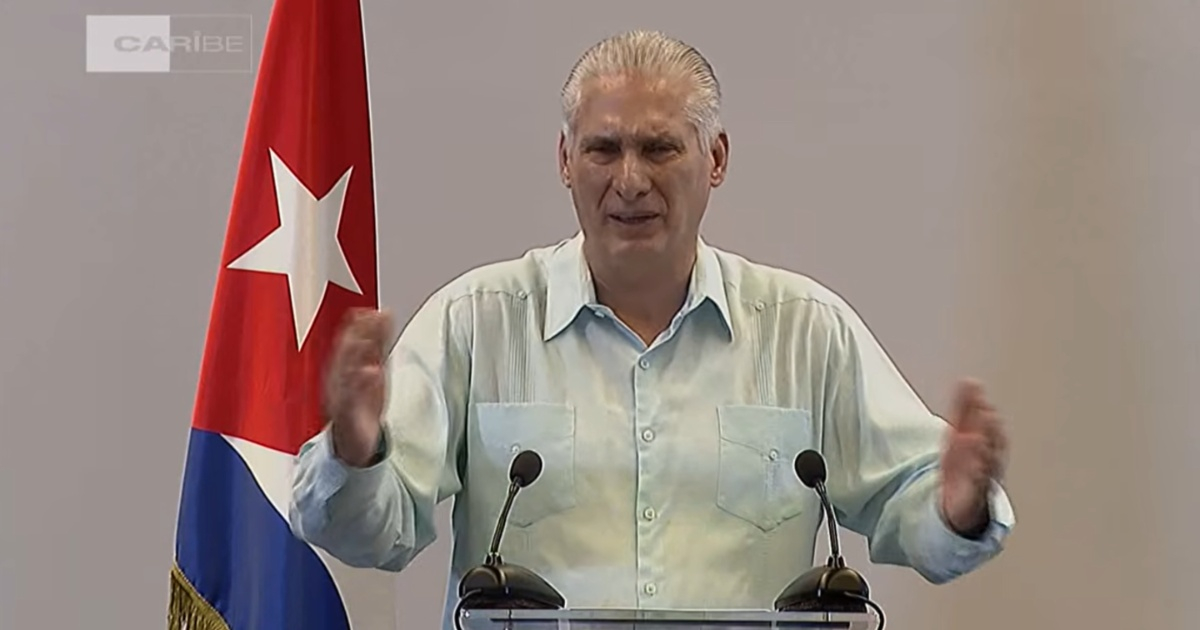
On Thursday, Miguel Díaz-Canel took to his X account to champion the Cuban government's relationship with the Catholic Church. This move seems to be an effort to position the regime as a legitimate partner following the U.S. announcement of a $100 million humanitarian aid package intended for the Cuban people.
The backdrop to this development is significant: The U.S. State Department has stipulated that the aid would be directed through the Catholic Church and independent humanitarian organizations, deliberately bypassing the Cuban government.
In his post, Díaz-Canel proclaimed that "our nation's experience in receiving international aid, including from the U.S., is vast and constructive." He concluded with a politically charged statement: "Our experience working with the Catholic Church is rich and productive."
He further set conditions for accepting the aid, emphasizing adherence to "universally recognized practices for humanitarian assistance." Díaz-Canel also took the opportunity to reiterate the regime's stance on the embargo, suggesting, "The harm could be alleviated more easily and quickly by lifting or easing the blockade, as the humanitarian situation is coldly calculated and induced."
Díaz-Canel's message marks a tactical shift by the regime within just 48 hours. Earlier, Foreign Minister Bruno Rodríguez Parrilla dismissed the aid offer as a "fable" and "lie," denying any formal proposal had been received.
However, on that same Thursday, Rodríguez softened his stance, expressing that Cuba "has no objections to working with the Catholic Church" and is willing to "hear the specifics of the offer."
Meanwhile, from Washington, Secretary of State Marco Rubio, speaking aboard Air Force One en route to China, stressed that "what is happening in Cuba is unacceptable," accusing the regime of rejecting the aid.
The State Department's official statement also disclosed that Washington had previously made "numerous private offers" to Havana, including support for free satellite internet, all of which were turned down.
On the ground, the situation contradicts the regime's narrative about its role in aid distribution. On May 8, Cáritas Cuba reported executing 82% of an initial $3 million donation, aiding approximately 8,800 families in Santiago de Cuba, Holguín, Las Tunas, Bayamo, and Guantánamo through parish networks and volunteers, without government interference.
This direct distribution was made possible by the model imposed by the U.S. from the outset: In April, five aid containers arrived at the Santiago port with over 1,300 food modules, 1,500 hygiene kits, and 720 household packages, all managed entirely by Cáritas, prioritizing single mothers, the elderly, the sick, and people with disabilities.
Rubio announced the $100 million aid offer on May 8, following a private 45-minute audience with Pope Leo XIV at the Vatican, where Cuba was a central topic. According to the State Department's statement, the decision to accept or reject the proposal "lies with the Cuban regime."
Key Questions About U.S. Aid to Cuba and Church Collaboration
Why is the U.S. aid offer significant for Cuba?
The U.S. aid offer is significant because it represents a substantial financial commitment intended to aid the Cuban people directly through trusted channels like the Catholic Church, bypassing the Cuban government.
How does the Cuban government view its collaboration with the Catholic Church?
The Cuban government, as expressed by Miguel Díaz-Canel, views its collaboration with the Catholic Church as "rich and productive," emphasizing their willingness to engage with the Church for humanitarian aid distribution.
What has been the response from the Cuban regime to previous U.S. aid offers?
Previous U.S. aid offers, including proposals for free satellite internet, have been rejected by the Cuban regime, according to the State Department.