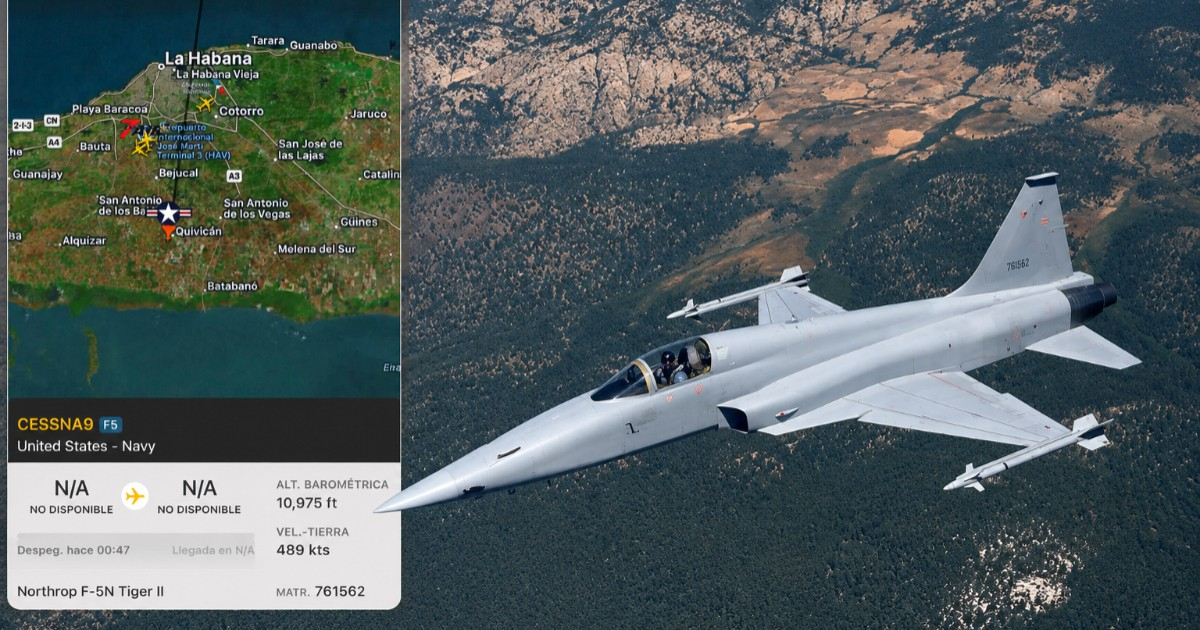
A U.S. Navy F-5N Tiger II jet made a flight over Havana on Thursday coinciding with the arrival of a special mission aircraft from the U.S. government at José Martí International Airport. This event was tracked by Flightradar24 and reported by military flight tracker @Flightwatcher1.
The jet, marked as CESSNA9 with registration number 761562, traversed the Cuban capital at an altitude of 10,975 feet and a speed of 489 knots (approximately 906 kilometers per hour). With no recorded origin or destination, the aircraft did not land and vanished from radar post-crossing, which suggests a potential escort or air cover role for flight SAM554. This flight, a Boeing C-40B Clipper used by high-ranking U.S. government officials, successfully landed in Havana after departing from Joint Base Andrews in Maryland.
The "SAM" prefix stands for "Special Air Mission," a designation for high-level U.S. government flights. The C-40B Clipper, a militarized version of the Boeing 737-700, transports Secretaries of State, top military leaders, and diplomatic delegations.
Surveillance Operations in the Region
Simultaneously, a Navy MQ-4C Triton surveillance drone, identified as BLKCAT6 with registration 169659, was operational south of Cuba and north of the Cayman Islands at 46,975 feet. It performed reconnaissance patterns typical of extended maritime intelligence missions. This unmanned aircraft took off from Jacksonville, Florida, at 9:32 AM local time and was tracked live by 1,509 users on Flightradar24.
While the F-5N Tiger II serves as an "adversary/aggressor" aircraft for tactical training and threat simulation, its appearance over Havana, coinciding with the VIP flight, is noteworthy given its lack of recorded origin or destination in public tracking systems.
This marks the second official U.S. flight to Cuban soil since 2016. The first occurred on April 10, when a State Department delegation, overseen by Marco Rubio, met with Cuban vice ministers in Havana to discuss political prisoner releases, internet access via Starlink, and the presence of foreign groups on the island.
Diplomatic Tensions and Aerial Presence
Thursday's aerial movements come at a time of heightened diplomatic activity. On the same day, the Cuban regime softened its stance regarding a $100 million humanitarian aid offer from Washington. Cuban Foreign Minister Bruno Rodríguez Parrilla, who previously dismissed the proposal as "fiction," stated that Cuba is "willing to hear the details of the offer and how it would be implemented."
U.S. military air presence near Cuba has escalated since February. The U.S. has carried out at least 25 documented surveillance flights close to the island since February 4, using aircraft such as the P-8A Poseidon, RC-135V Rivet Joint, and multiple MQ-4C Triton missions under Operation Southern Spear.
José Adán Gutiérrez, a former Navy commander with a specialty in intelligence, told the New York Times that the visible nature of these flights "essentially communicates a message," as intelligence operations typically occur without activating radars or announcing their presence.
U.S. Military Flight Activity and Diplomatic Relations with Cuba
Why did a U.S. Navy jet fly over Havana?
The U.S. Navy jet likely served as an escort or provided air coverage for a high-level government flight that landed in Havana.
What is the significance of the MQ-4C Triton drone's activity near Cuba?
The MQ-4C Triton drone conducts reconnaissance patterns typical of long-range maritime intelligence missions, reflecting increased U.S. surveillance in the region.
What was discussed during the U.S. delegation's visit to Cuba in April?
The U.S. delegation addressed the release of political prisoners, internet access via Starlink, and the presence of foreign groups on the island.