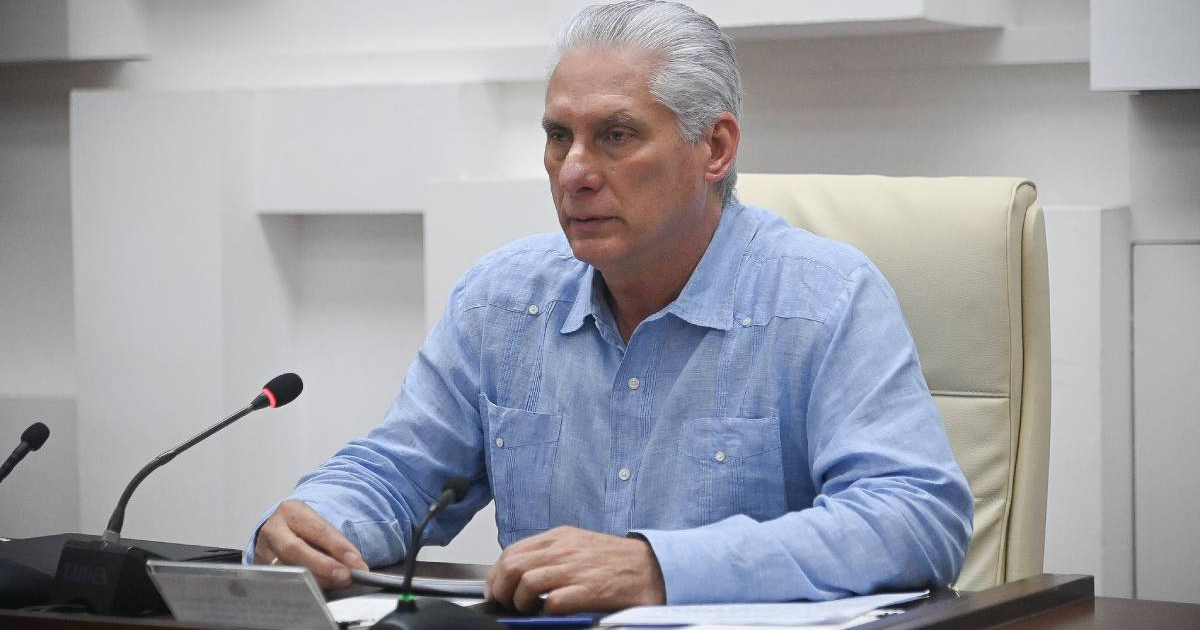
On Thursday, Miguel Díaz-Canel took to his X account to formally acknowledge the potential of accepting humanitarian aid from the United States, pinpointing fuel, food, and medicine as top priorities.
"The priorities are unmistakably clear: fuel, food, and medicine," he emphasized.
He further stated, "If the U.S. government is genuinely willing to provide the aid in the amounts they claim, and in full compliance with universally recognized humanitarian aid practices, Cuba will not present any obstacles or display ingratitude."
This statement follows the U.S. State Department's public offer of $100 million in humanitarian aid to the island, contingent upon its distribution through the Catholic Church and independent humanitarian organizations, avoiding any involvement from the Cuban government.
Shifting Attitudes in Havana
The response from Havana marks a significant shift: just two days earlier, Foreign Minister Bruno Rodríguez Parrilla had dismissed the proposal as a "$100 million lie," while Deputy Minister Carlos Fernández de Cossío described it as a "dirty political deal."
However, on Thursday, Rodríguez Parrilla softened his stance, acknowledging that Cuba "does not typically reject foreign aid" and is "open to hearing the specifics of the offer."
Energy Crisis Exacerbates Tensions
This change in rhetoric emerges amid an unprecedented energy crisis: on Wednesday, the available electricity was only 1,230 MW against a demand of 3,250 MW, with a maximum shortfall of 2,113 MW.
Díaz-Canel himself admitted the electrical system's situation was "particularly tense," attributing the shortfall of 1,100 MW to a lack of fuel.
The U.S. Offer: A Double-Edged Sword
In his message, Díaz-Canel described the U.S. offer as "inconsistent and paradoxical," asserting that the U.S. "collectively punishes" the Cuban people. He reiterated that alleviating the humanitarian crisis could be achieved more swiftly by lifting or easing the blockade, which he argues is a deliberately induced and calculated situation.
He also highlighted "rich and productive" previous collaborations with the Catholic Church, referencing the proposed distribution model for the $100 million aid package.
This model has a precedent: after Hurricane Melissa made landfall on October 29, 2025, impacting over 2.2 million people, the U.S. funneled $9 million through Caritas and the Catholic Church.
By May 8, 82% of the initial $3 million donation had been utilized, benefiting approximately 8,800 families across Santiago de Cuba, Holguín, Las Tunas, Granma, and Guantánamo.
The offer also includes free satellite internet via Starlink for Cuba, as confirmed by the State Department on Wednesday.
On Thursday, Secretary of State Marco Rubio stated in an NBC interview that "what is happening in Cuba is unacceptable" and that Washington has "over $100 million" in aid ready, accusing the regime of obstructing it.
Understanding the U.S. Humanitarian Aid Proposal to Cuba
What are the main priorities for the U.S. aid proposed to Cuba?
The main priorities for the U.S. aid proposal to Cuba include fuel, food, and medicine.
How does Cuba view the U.S. aid offer?
Cuba's initial response was dismissive, labeling it a "lie" and a "political deal." However, the stance has softened, with Cuba now expressing willingness to discuss the offer.
What is the condition for the U.S. aid distribution in Cuba?
The U.S. aid is conditionally offered to be distributed through the Catholic Church and independent humanitarian organizations, without the Cuban government's involvement.