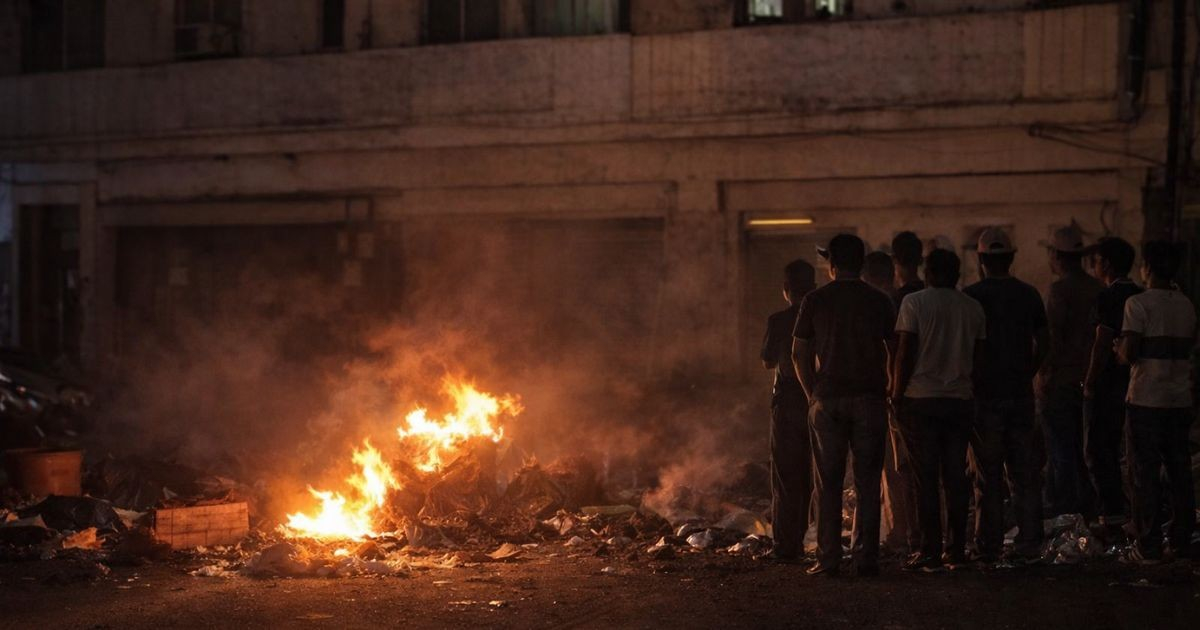
A Cuban mother named Zea Gisselle took to Facebook on Thursday to share a vivid account of the plight faced by countless families in Havana. Her son lay awake at 2 a.m. due to the oppressive heat and mosquitoes that accompanied the blackout, while flames from burning trash heaps lit up their neighborhood's night.
"The clanging of pots echoed through our neighborhood; we joined the chorus from our homes. The glow of the fire reflected off the hallway wall, smoke creeping in... Trash bins were set ablaze, it's a PROTEST," she recounted.
Zea Gisselle shared her story amidst a wave of demonstrations that swept through Havana on Wednesday night, where residents in at least nine municipalities, including Diez de Octubre, Playa, Marianao, and others, took to the streets.
Protest Strategies and Community Resilience
The protests featured pot-banging, street blockades, trash fires, and bonfires at street corners.
"A neighbor remarked that the fire at the corner resembled the burning of Bayamo... perhaps the sound of the pot-banging is the new cry of Yara," she wrote.
She explained to her child that "Cuba is at war, it's the defenseless people against the state," when he likened the flames to a conflict zone.
Zea Gisselle also denounced the power situation, noting that on Wednesday, they had only two hours of electricity all day. The previous week, power cuts forced her son to miss school on multiple days, despite teachers urging attendance as "this is here to stay" and "we must adapt."
Impact of Energy Crisis and Government Response
On the night of the protest, exhaustion and physical strain from sleepless nights left her and her neighbors unable to stay up long. "Sleep deprivation is a form of psychological torture, and those who (mis)govern know it."
"The fire crackles, pieces of fibrocement shingles bursting like projectiles. At the sound, someone shouts, 'The Yankees have arrived!' and we all laugh, because even in perpetual darkness, laughing together is an act of rebellion and defiance; it means we exist even though they are killing us," she described.
In San Miguel del Padrón, residents gathered in front of the municipal government building chanting "Power and food!"; while in Bahía, cries of "Down with the dictatorship!" accompanied the pot-banging.
In Nuevo Vedado, protests erupted after 24 hours without electricity; in Marianao, residents blocked streets after more than 20 hours without power.
Police resorted to violence against protesters in Playa, and mass internet outages were reported during the demonstrations.
Unprecedented Energy Deficit and Rising Tensions
The immediate trigger was an unprecedented energy crisis: the Electric Union recorded a generation deficit of 2,113 MW at 8:40 p.m. on Wednesday, with only 1,230 MW available against a demand of 3,250 MW.
Energy and Mines Minister Vicente de la O Levy acknowledged power outages lasting up to 22 hours daily in some Havana circuits, labeling the situation as "special."
The Cuban Conflict Observatory reported 1,133 protests in April 2026, a 29.5% increase from April 2025, and 1,245 in March, the highest monthly count since the 11J protests.
At least 14 people have been detained in Havana related to pot-banging protests since March 6, with 176 repressive acts documented in April alone.
Activists and protesters are eyeing May 20—the anniversary of the Cuban Republic's proclamation in 1902—as a potential date for another mass mobilization.
Zea Gisselle concluded her testimony with a poignant plea reflecting the exhaustion and resolve of those who took to the streets that early morning: "Let it be Freedom, and let it be soon... or we all perish."
Frequently Asked Questions About the Ongoing Protests in Cuba
What sparked the recent protests in Havana?
The protests were triggered by an unprecedented energy crisis, with severe power outages affecting daily life in Havana.
How have residents expressed their discontent during the protests?
Residents have engaged in pot-banging, street blockades, and setting trash ablaze as forms of protest.
What role has the government played in addressing the power crisis?
The government, through Energy and Mines Minister Vicente de la O Levy, acknowledged the severe power shortages but has yet to provide effective solutions.