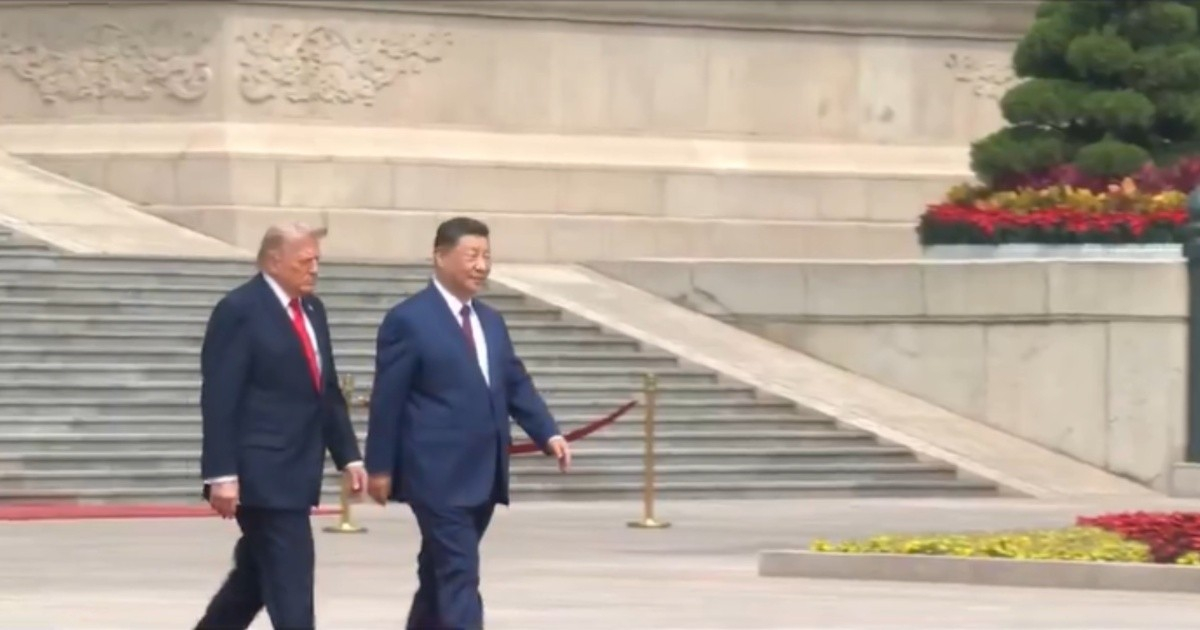
On Thursday, Donald Trump engaged in talks with Chinese President Xi Jinping at Beijing's Great Hall of the People, marking the highlight of his state visit to China. Trump expressed optimism, stating that the relationship between the two global powers "will be better than ever."
The summit commenced with a grand welcoming ceremony featuring military honors on the steps of the monumental building facing Tiananmen Square. Trump and Xi shared a prolonged handshake before acknowledging their respective delegations.
Trump lauded the meeting as "probably the greatest summit ever" and noted that in the United States, "people are not talking about anything else."
In his opening remarks, the U.S. President emphasized his personal connection with Xi: "You and I have known each other for a long time; indeed, it's the longest relationship between presidents of our two countries ever, and for me, that's an honor."
Trump also highlighted the robust direct communication channel between the two leaders: "We have a fantastic relationship. We get along well. When we've had difficulties, we've resolved them. You call me; I call you. And when we had a problem, we solved it quickly, which is why we will have a fantastic future together."
Xi Jinping's Vision for U.S.-China Cooperation
Chinese leader Xi Jinping, on his part, opened the meeting by urging Washington to "be partners, not rivals," outlining Beijing's roadmap: "Achieve success together, seek common prosperity, and forge the right path for great powers to interact in this new era."
Xi also asserted that "the common interests of China and the U.S. outweigh their differences" and congratulated Trump on the 250th anniversary of American independence, celebrated this year.
Significant Delegations and Preparations
This visit marks Trump's first trip to China in nine years; his previous visit was in 2017 during his initial term in office.
The American delegation included Secretary of State Marco Rubio, Defense Secretary Pete Hegseth, and Ambassador to China David Perdue, alongside a substantial business contingent: Elon Musk (Tesla), Tim Cook (Apple), Jensen Huang (Nvidia)—who joined at the last minute during the Air Force One stopover in Alaska—and representatives from Boeing, BlackRock, Visa, Mastercard, Meta, and Goldman Sachs.
In preparation for the summit, Treasury Secretary Scott Bessent and Chinese Vice Premier He Lifeng concluded negotiations in Seoul on Wednesday, described as "constructive" by China's state news agency Xinhua.
Key Issues on the Summit Agenda
The summit agenda focused on three major issues: bilateral trade, Taiwan, and Iran.
Regarding trade, the meeting aimed to solidify the truce agreed upon in Busan in October 2025, which halted a tariff escalation that had reached 145% by the U.S. and 125% by China.
Concerning Iran, Rubio mentioned that Washington expects Beijing to play a more active role with Tehran, given that approximately 45% of China's gas and oil imports pass through the Strait of Hormuz.
On the topic of Taiwan, Beijing urged Washington to "handle the issue prudently" and to cease arms shipments to the island, following Trump's announcement that he would address the matter directly with Xi.
Trump summed up his administration's approach: "It's an honor to be with you, it's an honor to be your friend, and the relationship between China and the U.S. will be better than ever."
Understanding the U.S.-China Summit
What was the main purpose of Trump's visit to China?
The main purpose of Trump's visit to China was to strengthen bilateral relations and address key issues such as trade, Taiwan, and Iran.
Who were the notable members of the U.S. delegation?
The U.S. delegation included Secretary of State Marco Rubio, Defense Secretary Pete Hegseth, and business leaders like Elon Musk, Tim Cook, and Jensen Huang.
How did Xi Jinping describe the relationship between China and the U.S.?
Xi Jinping described the relationship as one where the common interests outweigh the differences and called for partnership rather than rivalry.