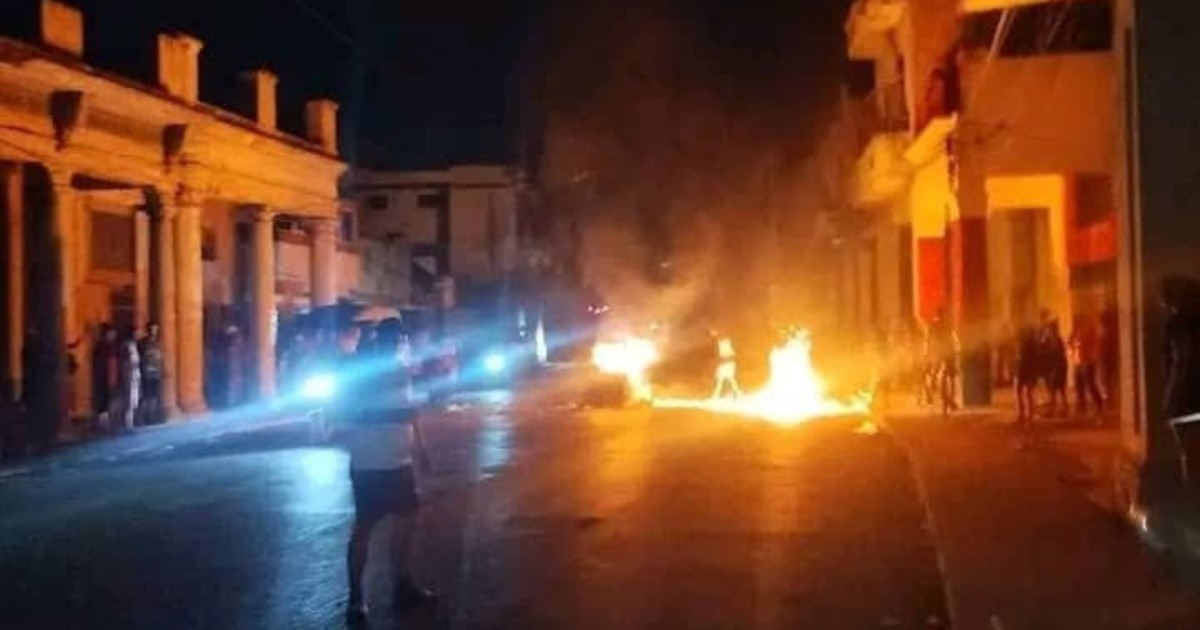
On the night of Wednesday, May 13, scores of residents took to the streets in Santos Suárez and various districts across Havana in the most widespread protests seen in the capital since July 11, 2021. These demonstrations were sparked by power outages lasting up to 22 hours daily.
Journalist José Raúl Gallego shared accounts from Havana that highlighted the scale of the events: "All of Santos Suárez is out on the streets. Protests are erupting on every corner. I haven't seen anything like this since July 11. The internet has been cut. Numerous security motorcycles are patrolling, and I'm told other parts of Diez de Octubre are experiencing the same."
The unrest wasn't confined to Santos Suárez. According to Gallego, protests also erupted in Lawton, Playa, Marianao, Guanabacoa, Boyeros, and Vedado, in addition to Regla, Habana del Este, San Miguel del Padrón, and Nuevo Vedado.
Gallego remarked, "The regime is facing a May 13th reckoning. Protests are occurring in Diez de Octubre, Lawton, Playa, Marianao, Guanabacoa, Boyeros, Vedado. And the 20th is still to come. If all of Cuba rises, they won't last another round."
Protesters employed various methods, including banging pots and pans, blocking streets, burning trash, and lighting bonfires. In San Miguel del Padrón, residents gathered outside the municipal government building chanting "Electricity and food!" Meanwhile, in Reparto Bahía, cries of "Down with the dictatorship!" were heard during a pot-banging protest.
In Nuevo Vedado, Block 1 residents protested after enduring 24 continuous hours without power, and in Arroyo Naranjo, graffiti with "Homeland and Life" and messages against Díaz-Canel appeared on electrical infrastructure.
The energy crisis that ignited these protests reached unprecedented levels: The Union Eléctrica reported a generation shortfall of 2,113 MW at 8:40 PM on Wednesday, with only 1,230 MW available against a demand of 3,250 MW. Minister of Energy and Mines, Vicente de la O Levy, described the situation as a "special case" and acknowledged power cuts ranging from 20 to 22 hours daily in some areas of the capital.
Miguel Díaz-Canel responded on Facebook, denying that Cuba is a "failed state," blaming the United States' "genocidal energy blockade," and admitting that the situation is "particularly tense." He noted that the country requires at least eight fuel shipments monthly, yet only one arrived between January and April 2026.
This Wednesday's event follows a cacerolazo protest by Luyanó residents, who blocked Calzada de Concha the night before, part of an ongoing escalation. The Cuban Observatory of Conflicts recorded 1,133 protests in April 2026, a 29.5% increase from the same month in 2025, and 1,245 in March, the highest monthly figure since July 11.
Social media posts from activists and demonstrators suggested May 20—a significant date marking the proclamation of the Cuban Republic in 1902—as a potential day for another massive mobilization.
Exploring the Recent Protests in Havana
What triggered the recent protests in Havana?
The protests were primarily triggered by severe power outages in Havana, with cuts lasting up to 22 hours a day, severely disrupting daily life for residents.
Which areas in Havana saw significant protest activity?
Significant protest activity was reported in Santos Suárez, Lawton, Playa, Marianao, Guanabacoa, Boyeros, Vedado, Regla, Habana del Este, San Miguel del Padrón, and Nuevo Vedado.
How did the Cuban government respond to these protests?
The Cuban government, through Miguel Díaz-Canel, responded by denying the country is a "failed state," attributing the crisis to the US "energy blockade," and acknowledging the need for more fuel shipments.