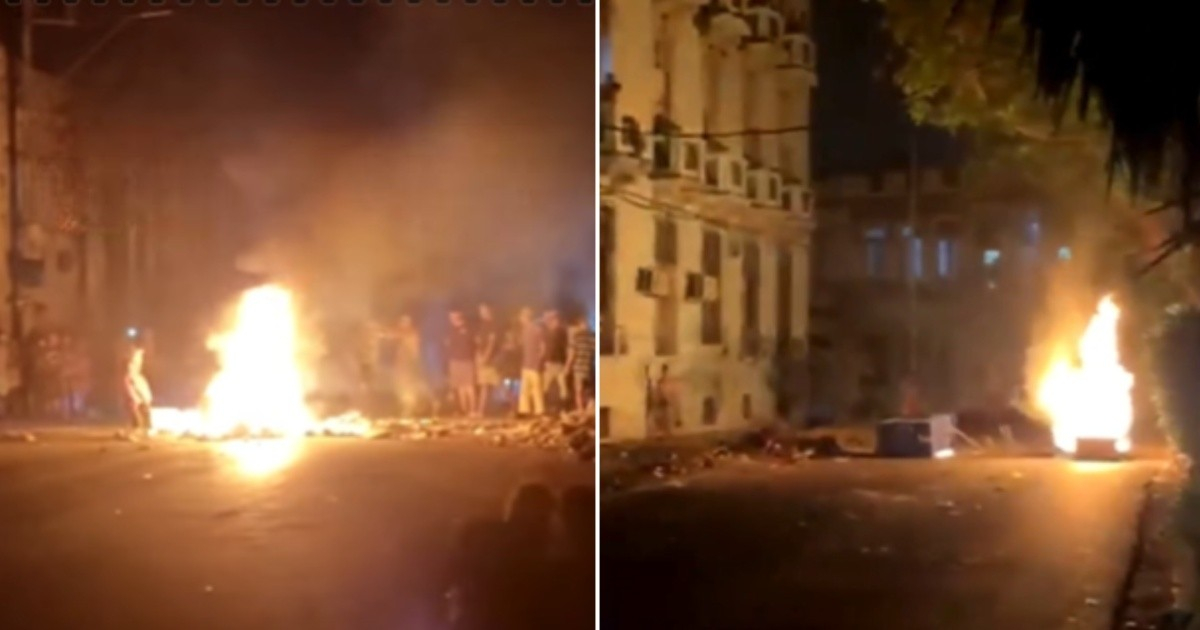
In the early hours of Wednesday, residents of Marianao, a municipality in Havana, took to the streets to protest prolonged power outages exceeding 20 hours. Demonstrators blocked the intersection of 100 and 51 streets, participating in a pots-and-pans protest captured in videos shared on social media.
Journalist Mario J. Pentón reported on these demonstrations, highlighting the frustration after more than 20 hours without electricity, which stretched into the early morning hours. Meanwhile, Mag Jorge Castro described the scene as "Havana takes to the streets tonight... images from the area of 100 and 51, Marianao."
Footage reveals a large group of people gathered in darkness, accompanied by motorcycles and bicycles, in a street devoid of public lighting and surrounded by dilapidated buildings.
Protests Reflect Growing Discontent
According to the independent outlet La Tijera News, residents emerged "in complete darkness to express their indignation over the never-ending blackouts, lack of food, the collapse of basic services, and the total abandonment faced by the Cuban people."
The Marianao protest is not an isolated incident but part of a wave of demonstrations that have been sweeping through Havana since May 12.
Widespread Demonstrations Across Havana
On Wednesday, residents of Reparto Bahía staged a pots-and-pans protest chanting slogans such as "Down with the dictatorship!" Simultaneously, people in San Miguel del Padrón protested outside the municipal government office, demanding "Electricity and food!"
On Tuesday, inhabitants of Luyanó blocked Calzada de Concha in a similar protest, while residents of Nuevo Vedado took to the streets after enduring 24 consecutive hours without electricity.
Previously, in March 2026, Marianao was the site of another protest when residents of El Palmar neighborhood burned garbage for light and sang the national anthem as a form of protest.
Energy Crisis and Government Response
The extent of the energy crisis was laid bare when the Minister of Energy and Mines, Vicente de la O Levy, admitted that Havana experiences power outages lasting between 20 to 22 hours daily, with only two to four hours of electrical service in some areas.
The electrical shortfall hit a record 2,113 MW on Wednesday at 8:40 PM, with availability at a mere 1,230 MW compared to a demand of 3,250 MW.
The minister attributed the dire situation to a fuel shortage; Cuba did not receive any supply shipments from December 2025 to the end of March 2026.
A donation of 100,000 tons of crude from Russia, processed at the Cienfuegos refinery, provided temporary relief in April, but the fuel supply was depleted by early May, coinciding with increased demand due to rising temperatures.
Growing Unrest Among the Cuban Population
Public dissatisfaction has been mounting for months. The Cuban Observatory of Conflicts recorded 1,133 protests in April 2026, marking a 29.5% increase compared to the same month the previous year, with 176 documented acts of repression that month.
Even Miguel Díaz-Canel acknowledged that Cuba's situation is "particularly tense," as the sound of banging pots continues to echo through Havana's neighborhoods night after night.
Understanding the Power Outages in Cuba
What caused the recent power outages in Cuba?
The recent power outages in Cuba are primarily due to a severe fuel shortage, which has led to insufficient electricity generation to meet demand.
How have Cuban residents responded to the power outages?
Cuban residents have responded with widespread protests, including pots-and-pans demonstrations, to express their frustration over the power outages and other socio-economic issues.
What measures has the Cuban government taken to address the energy crisis?
The Cuban government received a donation of crude oil from Russia to temporarily alleviate the crisis, but ongoing shortages and rising demand due to high temperatures have persisted.