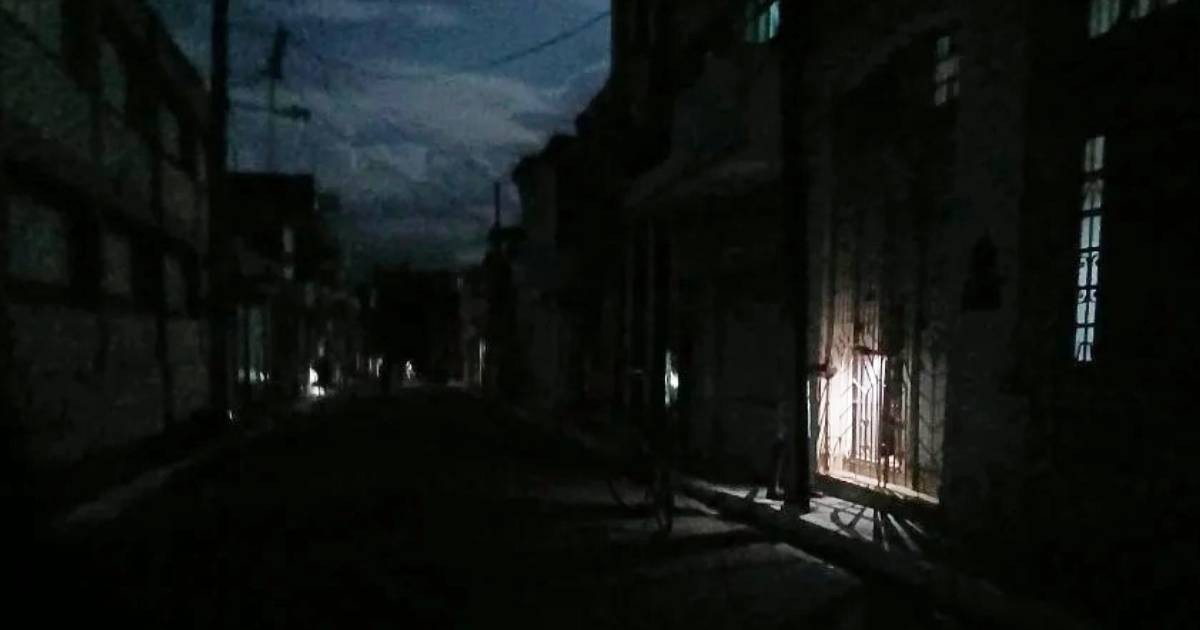
The National Electric System (SEN) in Cuba experienced another collapse on Wednesday night, leaving the entire province of Granma without electricity. This occurred due to a sudden frequency drop in the 110 kV Contramaestre-Bayamo line. Meanwhile, the Ministry of Energy and Mines acknowledged new "unexpected unit outages," further exacerbating the ongoing energy shortfall.
According to a Telegram post from the Granma Electric Company, echoed by CNC TV Granma, the "National Load Dispatch decided to cut power to the province to prevent the National Electric System from collapsing, resulting in Granma currently being without electricity."
Simultaneously, the Ministry of Energy and Mines updated its Facebook page, admitting that "current availability is low, and we are working swiftly and continuously to restore generation capacity," although they noted that the system remains interconnected.
This Thursday's crisis follows the year's worst energy day, with Wednesday's deficit peaking at a record 2,113 MW at 8:40 PM, surpassing the previous high of 2,075 MW set in March.
For Thursday's peak hours, a meager availability of 1,245 MW was projected against a demand of 3,200 MW, estimating a deficit between 1,955 and 2,050 MW.
Energy and Mines Minister Vicente de la O Levy admitted on Wednesday that Cuba is "without fuel" and described the situation as "acute, critical," and "extremely tense."
De la O Levy also confirmed that no fuel shipments arrived in Cuba between December 2025 and the end of March 2026, leading to a recent day where the lack of fuel alone resulted in the loss of 1,100 MW of generation.
President Miguel Díaz-Canel had previously acknowledged on Tuesday that "the National Electric System situation is particularly tense," marking one of the government's most direct admissions regarding the crisis's severity.
The disconnection in Granma is part of an emergency protocol by the National Dispatch to protect the interconnected system's integrity against sudden frequency drops in transmission lines, a measure becoming increasingly common due to the rapid deterioration of Cuba's electrical infrastructure.
Out of the country's 16 thermal units, nine are out of service. Cuba produces only 40% of its consumed oil, heavily relying on imports that have been notably absent in recent months.
The sole exception was a Russian donation of 100,000 tons of crude processed at the Cienfuegos refinery in April 2026, which temporarily improved conditions with several blackout-free days in Havana, but its effects quickly dissipated.
In the past 18 months, Cuba has experienced at least seven total collapses of the SEN, the most severe being on March 16, 2026, when the entire country was left in darkness for 29 hours and 29 minutes.
Cuba's Energy Crisis: Key Questions Answered
What caused the recent blackout in Granma province?
The blackout in Granma was caused by a sudden drop in frequency on the 110 kV Contramaestre-Bayamo line, leading to a decision to cut power to prevent a broader collapse of the National Electric System.
How is the Cuban government responding to the energy shortage?
The Ministry of Energy and Mines has admitted to low availability and is working rapidly to restore generation capacity. However, the government also acknowledges a critical fuel shortage and has not received any fuel shipments for several months.
What measures are being taken to prevent further energy system collapses?
Emergency protocols, such as cutting power to certain areas, are being used to protect the integrity of the interconnected system during sudden frequency drops. However, the rapid deterioration of infrastructure remains a significant challenge.