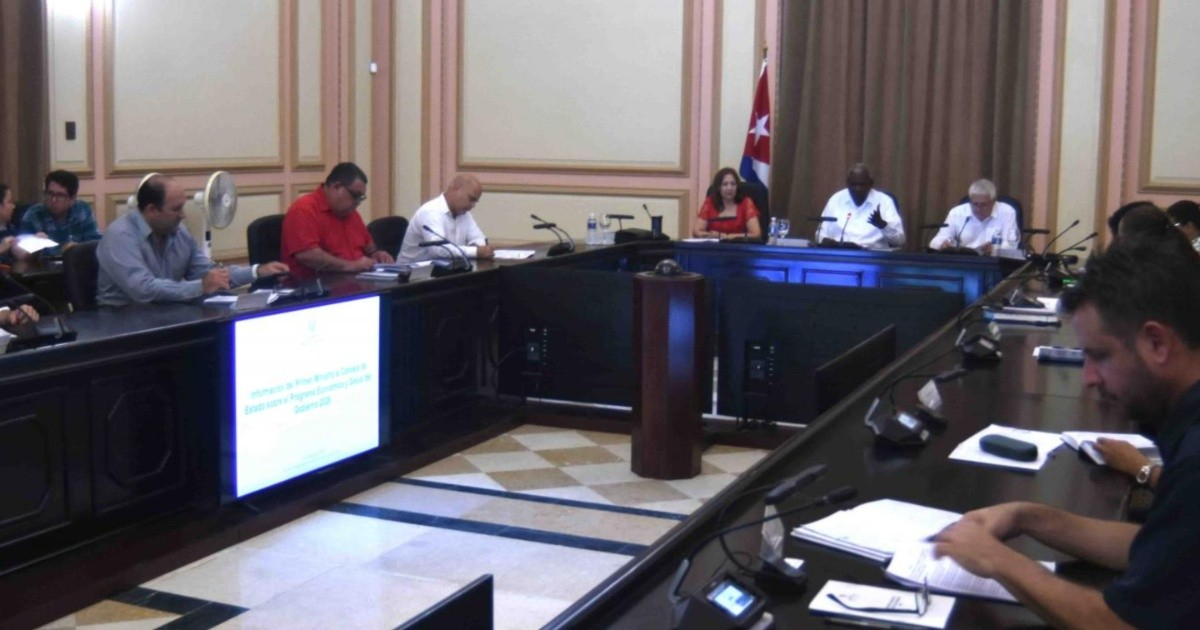
This past Wednesday, the Cuban Council of State assessed the progress of its Economic and Social Program for 2026. The meeting, led by Esteban Lazo Hernández and attended by Miguel Díaz-Canel and Prime Minister Manuel Marrero Cruz, took place as Cubans endure power outages lasting up to 25 hours a day and face a severe food crisis, as described by international organizations.
Initially introduced in April 2026, the program outlines 10 general objectives, 111 specific goals, 505 actions, and 309 indicators and targets. However, official reports reveal only partial success: out of 81 assessed specific goals, just 32 have been attained, with 49 still underway. Moreover, only 65 out of 158 planned actions have been completed.
Looking deeper into the numbers, only 43% of the plan to restore the National Electric System was carried out in the first quarter. Marrero Cruz himself warned of a break in the trend towards controlling the fiscal deficit, which is projected at 74,500 million Cuban pesos for the entire year.
Government Efforts and Public Reality
Confronted with these challenges, the Prime Minister called for increased diligence in implementing the Program and Government Directives, emphasizing innovative solutions and maximizing the use of internal resources and capacities.
During the same session, the popular-participatory movement "Mi Barrio por La Patria" was formally introduced. Structured around three pillars—Safe Neighborhood, Participative Neighborhood, and Productive Neighborhood—this initiative spans more than 12,000 communities nationwide. Independent analysts liken it to a modern version of the Committees for the Defense of the Revolution, focusing more on social control than genuine economic solutions.
The Council of State also approved a decree law on "Oil and Gas," which regulates the exploration, exploitation, refining, transportation, storage, and commercial distribution of hydrocarbons in both terrestrial and marine zones, with a stated goal of ensuring the country's energy sovereignty.
Energy and Food Crisis Worsen
The official narrative starkly contrasts with the harsh reality faced by the Cuban people. On May 11, the Electric Union reported a power supply of only 1,245 MW against a demand of 3,200 MW, resulting in a deficit of 1,955 MW that exacerbated blackouts nationwide.
In terms of food security, surveys from the Food Monitor Program reveal that nearly one in three Cuban households reported at least one family member going to bed hungry in the past 30 days. Furthermore, 79.75% of respondents blame the scarcity on "poor state management" rather than the U.S. embargo.
The non-state market saw inflation rise by 31.9% in the first quarter of 2026, with transportation costs increasing by 17.17% in the first four months. The government, however, continues to attribute the crisis to the embargo and executive orders from the U.S. president.
According to the Economic Commission for Latin America and the Caribbean (ECLAC), Cuba's GDP is expected to shrink by 6.5% in 2026—the steepest decline in Latin America and the Caribbean. Meanwhile, The Economist Intelligence Unit projects a 7.2% contraction, leading to an accumulated drop of about 23% since 2019, marking seven years of decline that no government program has managed to reverse.
FAQs on Cuba's Current Economic Crisis
What is the "Mi Barrio por La Patria" movement?
"Mi Barrio por La Patria" is a popular-participatory movement launched by the Cuban government, focusing on community involvement and structured around three main areas: Safe Neighborhood, Participative Neighborhood, and Productive Neighborhood. Critics view it as an updated form of the Committees for the Defense of the Revolution, emphasizing social control.
How severe is the food crisis in Cuba?
The food crisis in Cuba is described as severe by international organizations, with surveys indicating that nearly one in three households experienced hunger. A significant portion of the population attributes the scarcity to poor state management rather than external factors like the U.S. embargo.