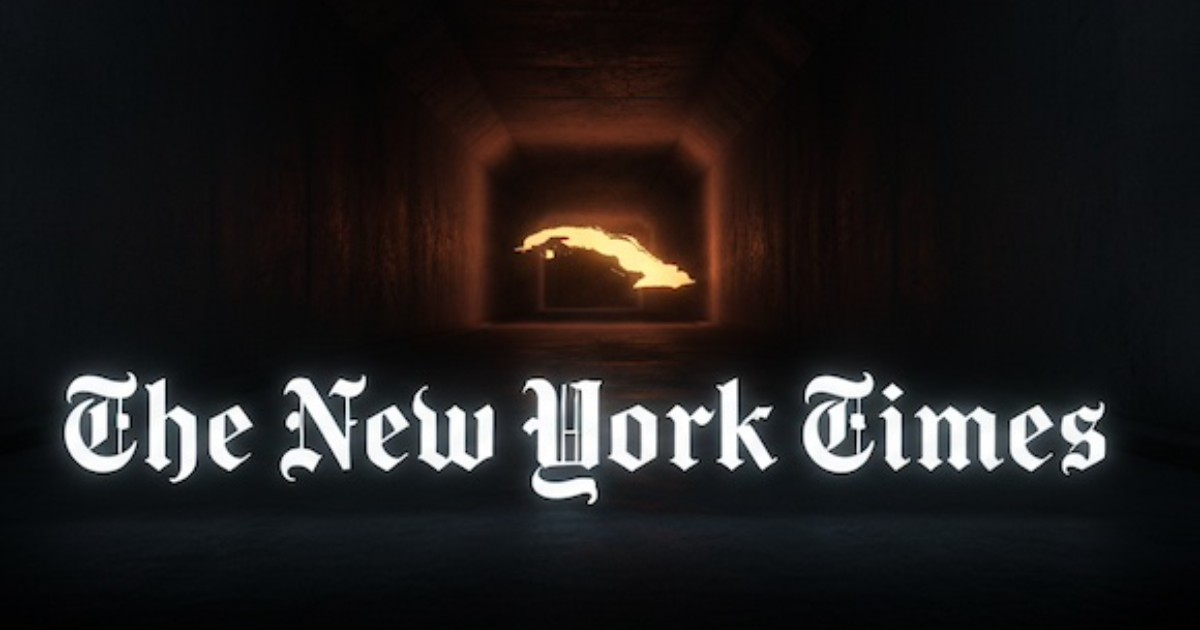
The Media Observatory of Cubadebate, a section dedicated to counter-propaganda within Cuba's primary state-run news portal, has released an in-depth analysis accusing The New York Times of crafting a narrative that portrays Cuba as a "darkened, tense nation on the brink of imminent political upheaval."
The article, titled “Darkness to Naturalize the Threat: Cuba According to The New York Times,” examines the American newspaper's coverage from January to May 2026, identifying 420 mentions of Cuba during this timeframe: 118 in January, 68 in February, 174 in March, 49 in April, and 11 in the early days of May.
Out of these 420 instances, 87 headlines prominently feature Cuba, while 333 references are made within the text, providing context in stories about Venezuela, migration, oil, Guantánamo, or foreign policy.
The Cuban regime's media asserts that this portrayal aligns with Washington's current pressure agenda. Cubadebate claims that the critical coverage did not start with Trump's harsh statements in March but began in January when Cuba was linked to the U.S. operations in Venezuela and the island's energy vulnerabilities.
The analysis highlights three NYT headlines from January as evidence of this pattern: “After Venezuela, Trump Says Cuba Is Ready to Fall” (January 5), “Cuba’s Beleaguered Economy Now in Free Fall” (January 6), and “Can Cuba Survive Without Venezuela’s Oil?” (January 17).
The official outlet describes the headline “Cuba Is Going Dark” as an emotional “major discovery” in that coverage, turning the electrical crisis into a national metaphor: “Darkness ceased to be an issue of the electrical system and began to describe the state of the country.”
The recurring lexicon—blackout, fuel, oil, darkness, crisis—has, according to Cubadebate, constructed “a comprehensive image of the country” that "omits or minimizes" the role of the U.S. embargo as a structural cause of these issues.
This criticism of the NYT is not an isolated incident. On May 9, the state media had previously attacked Axios for disclosing information about Washington's pressure on Havana, including Trump’s suggestion that a carrier could “stand off the coast” to make Cuba “surrender.”
The regime's media counteroffensive comes amid Cuba's most severe energy crisis in decades, as it tries to portray foreign press coverage of the disaster as manipulative: on May 12, there was a recorded deficit of 2,113 MW, the highest of the year, with an electrical system availability of only 1,200 MW against a demand of 2,860 MW.
The reality that the regime prefers not to discuss is that Cuba received just one fuel tanker between December 2025 and April 2026, whereas it needs eight per month, and it produces around 40,000 barrels of oil daily against a requirement of between 90,000 and 110,000.
Cubadebate operates as an official counter-propaganda tool in a country where media is state-owned according to the 2019 Constitution, and where Reporters Without Borders ranked Cuba 165th out of 180 countries in its 2025 World Press Freedom Index, with a score of 26.03 out of 100.
Understanding the Cuban Media Landscape
What does Cubadebate claim about The New York Times' coverage?
Cubadebate accuses The New York Times of creating a narrative that depicts Cuba as a nation in crisis, omitting the impact of the U.S. embargo while highlighting issues like energy shortages.
How does Cubadebate describe the narrative crafted by The New York Times?
Cubadebate suggests that The New York Times uses a lexicon of crisis—such as blackout and darkness—to paint a bleak picture of Cuba, which aligns with political pressure from Washington.
What is the context of Cuba's energy crisis?
Cuba is facing a severe energy crisis, with a significant deficit in power generation and receiving insufficient fuel shipments, which exacerbates the situation.
How does the Cuban government control media narratives?
The Cuban government owns all media outlets, and platforms like Cubadebate function as tools for counter-propaganda, shaping narratives in line with state interests.