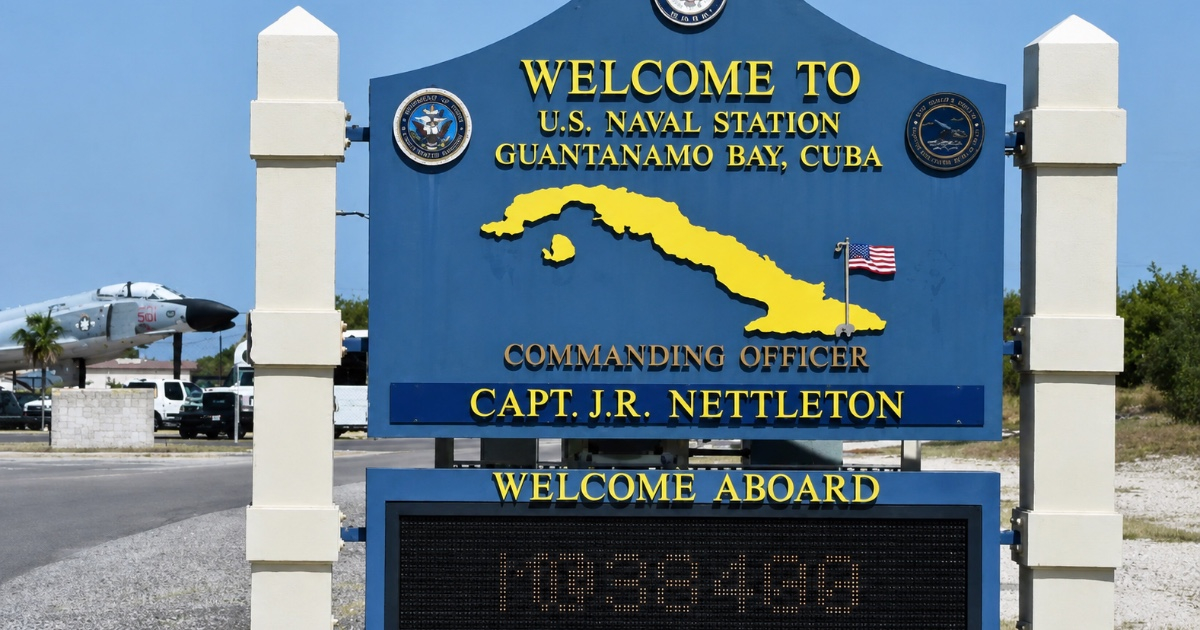
The migrant detention center that former President Donald Trump pledged to construct at the Guantánamo Bay Naval Base, intended to house 30,000 migrants, remains largely vacant over a year after its announcement, according to federal government documents obtained by CBS News.
As of May 11, only six detainees—all Haitian nationals—were held at the site, occupying less than 2% of the approximately 400 available beds, a stark contrast to the promised capacity of 30,000.
While the detainee numbers are minimal, the Department of Defense has stationed 522 military personnel for the operation, along with about 60 Immigration and Customs Enforcement (ICE) employees and additional civilian staff.
This results in a staggering ratio of roughly 100 government personnel for every detainee this week.
The Imbalance in Resources and Detentions
Throughout the past year, 832 immigrant detainees have been transported to Guantánamo via over 100 flights. However, the vast majority were subsequently deported or moved to other facilities.
One notable example involved dozens of Cubans—many without criminal records—who were sent to Guantánamo in late 2025 and early 2026, only to be later returned to detention centers in the U.S. before being deported back to Cuba.
Financial Implications and Criticisms
Despite its low occupancy, the operation has a projected military cost of at least $73 million, as reported by the Department of Defense to Democratic Senator Elizabeth Warren in April. This figure significantly exceeds a prior public estimate of $40 million, a budget that had already faced early criticism.
Senator Warren accused Trump and Defense Secretary Pete Hegseth of "squandering billions of taxpayer dollars on a cruel immigration agenda."
Lee Gelernt, an attorney with the American Civil Liberties Union (ACLU), who filed a lawsuit against the operation, was more blunt: "Not only is the use of Guantánamo by the Trump administration unprecedented and illegal, but it serves no legitimate policy purpose given the financial and logistical burden of using this notorious military base for immigration purposes."
Legal Challenges and Future Prospects
In December 2025, a federal judge in Washington D.C. issued a preliminary ruling stating that the detention of civilian immigrants at Guantánamo was "impermissibly punitive" and likely illegal, although the operation was not halted.
Former Department of Homeland Security official Theresa Cardinal Brown explained the high costs: "Everything has to be shipped there. It's not like we're importing things from Cuba. Everything has to come from a U.S. source to that military facility. It’s going to be much, much more expensive."
Brown emphasized that the real aim of Guantánamo, along with other controversial sites like "Alligator Alcatraz" in Florida, is to deter illegal immigration and pressure undocumented immigrants to self-deport, although the deterrent effect is hard to quantify.
Department of Homeland Security spokeswoman Lauren Bis defended the operation on Wednesday with a stark warning: "If you come to our country illegally and break our laws, you could end up in Guantánamo Bay, CECOT, or a third country. Our message is clear: criminal illegal aliens are not welcome in the U.S."
The legality of the program remains under active litigation, while the base continues to operate with nearly vacant facilities and mounting costs as per the documents.
Questions on Guantánamo's Migrant Detention Facility
Why is the Guantánamo migrant detention facility nearly empty?
The facility is nearly empty because, despite initial plans to house 30,000 migrants, only six detainees remain, and the majority of those brought in have been deported or moved to other locations.
What are the costs associated with the Guantánamo operation?
The military component of the operation is projected to cost at least $73 million, a significant increase from the previous estimate of $40 million, contributing to criticism over fiscal management.
What are the legal challenges facing the Guantánamo detention program?
The program faces ongoing legal challenges, with a federal judge ruling that the detention of civilians at Guantánamo is likely illegal, though the operation continues amid litigation.