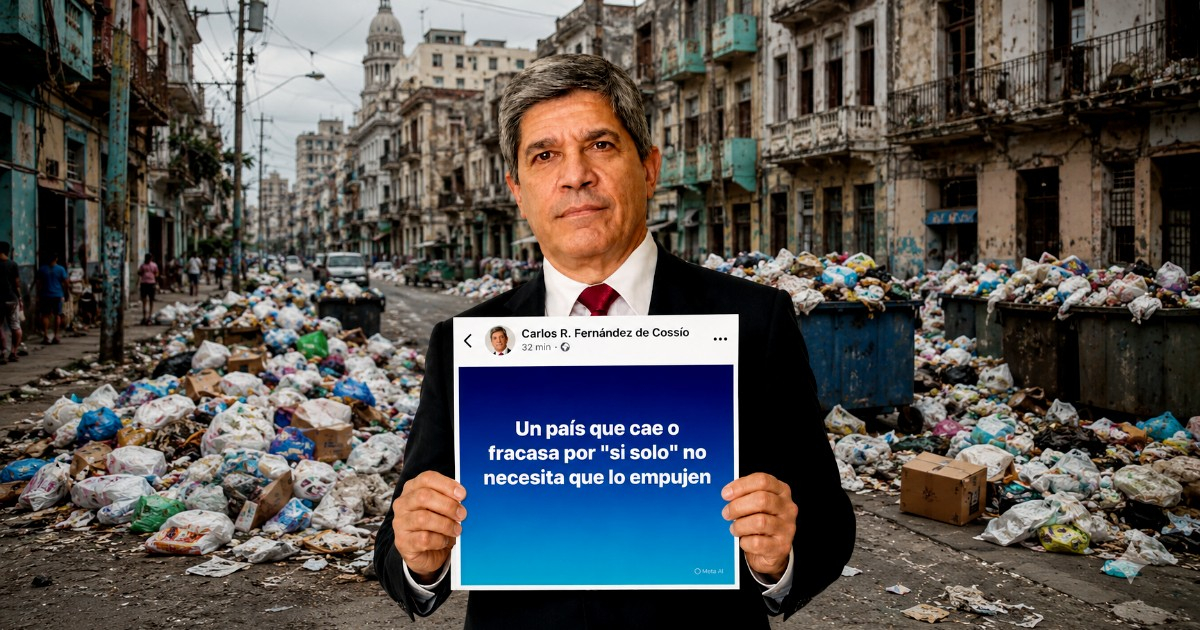
Carlos R. Fernández de Cossío, the Deputy Minister of Foreign Affairs for Cuba, found himself in a diplomatic quagmire after a Facebook post he made on Wednesday. The statement, which he deleted within 30 minutes, inadvertently confirmed the criticisms against the Cuban regime.
“A country that collapses or fails on its 'own' doesn’t need to be pushed,” the diplomat wrote, in a message set against a blue gradient background. Despite its quick removal from his profile, our newsroom captured a screenshot before it could fully circulate.
The statement was intended as a rebuttal to ongoing assertions by Donald Trump and Marco Rubio concerning the imminent downfall of the Cuban government. Ironically, instead of dismissing Washington's claims, Fernández de Cossío inadvertently corroborated them.
The question that arose from his words was inevitable: if Cuba is indeed falling “on its own,” is the regime admitting to its own collapse?
This semantic misstep didn't go unnoticed. The logic of his argument implies acknowledging the nation’s failure as a given, only then debating who is to blame. This inadvertently concedes what Havana has been denying for months—that they have become a failed state.
The backdrop to this publication is one of intense U.S. pressure. On January 27, Trump declared Cuba to be “a nation on the brink of failure,” and reiterated on March 30 that it would “soon collapse.” Additionally, it was reported that Trump pressed his cabinet this Monday for faster results in hastening Cuba’s collapse.
Meanwhile, Rubio has characterized Cuba as a “failed state without a real economy,” plagued by “extreme poverty, chronic energy crises, rampant inflation, and a lack of freedoms,” under the rule of “incompetent communists,” while advocating for new sanctions against GAESA and other regime entities.
In the face of this sustained rhetorical offensive, Fernández de Cossío attempted a clever retort that ultimately imploded upon publication, highlighting the communication breakdown within Miguel Díaz-Canel's government’s so-called "creative resistance."
This isn’t the first instance of the official stumbling in this manner. At the end of April, he defended revolutionary expropriations from the 1960s on Facebook, citing the 1940 Constitution as a legal basis, without acknowledging that the same document guaranteed private property rights and required compensation—precisely what the regime failed to provide.
The pattern is clear: the most active Foreign Affairs Ministry official on social media often resorts to arguments that, upon scrutiny, inadvertently reinforce the critiques he aims to refute.
The deleted post from Wednesday serves as the sharpest expression yet of this rhetorical exhaustion: an attempt to redefine the crisis that ended up confirming its severity, hurriedly erased when someone in Havana spotted the blunder, although it was already too late.
Understanding Cuba's Diplomatic Missteps
What did the Cuban Deputy Minister's post say?
The post suggested that Cuba is collapsing on its own, inadvertently acknowledging the country's struggles rather than refuting them.
Why was the post deleted so quickly?
It was likely removed because it unintentionally supported claims by U.S. officials about the Cuban regime's imminent collapse, contradicting the government's stance.
How does this incident reflect on Cuba's communication strategy?
The incident highlights a communication breakdown within the Cuban government, as attempts to counter criticism often end up reinforcing it.