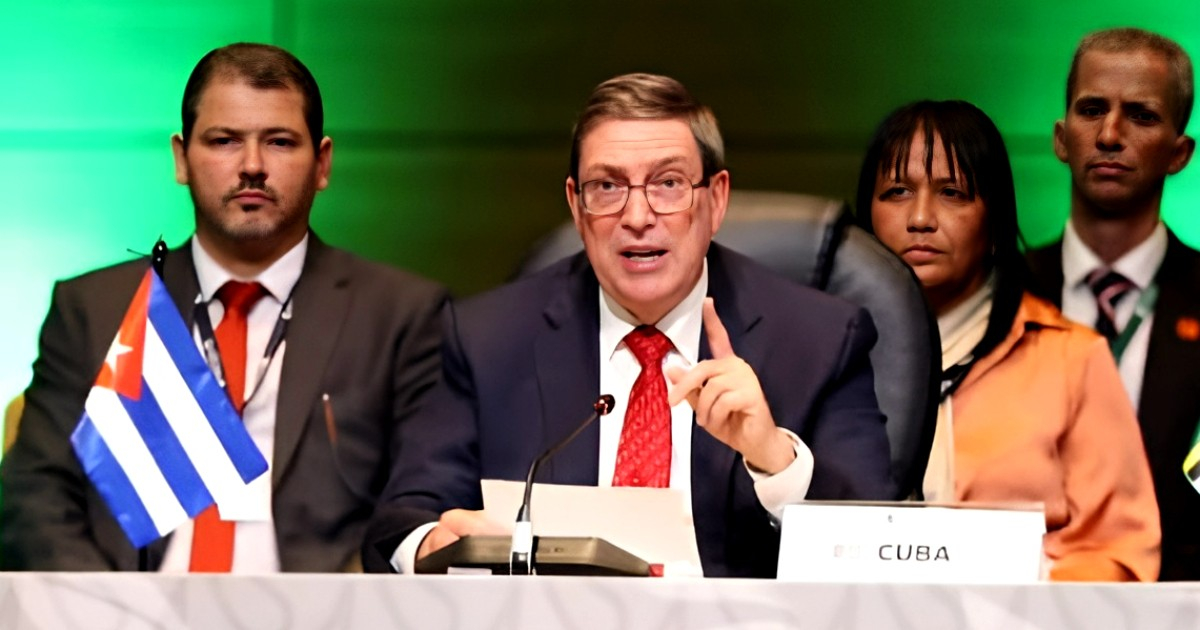
Bruno Rodríguez Parrilla, Cuba's foreign minister, once again sounded the alarm on Wednesday regarding the potential humanitarian disaster that could result from a U.S. military intervention in Cuba. He described such an action as leading to a "bloodbath" in a recent Facebook post, reiterating the stance he has maintained over the past fortnight.
Rodríguez Parrilla emphasized that a military conflict would result in the loss of life for both Cuban and American citizens. He attributed the push for such a scenario to "politicians who do not send their own children or families to war."
He further argued that there is no justifiable reason for a superpower like the United States to launch a military assault on a small island that poses no threat. He suggested that the pressure stems from a desire by a few to alter Cuba's political system or government.
This statement marks Rodríguez's fifth public address on the matter in less than two weeks.
On May 8, during an interview with ABC News from Havana, Rodríguez had already warned that Washington was on a "dangerous path" that could lead to a "humanitarian catastrophe, genocide, and the loss of lives of Cubans and young Americans." He asserted that Cuba would exercise its "right to legitimate defense to the fullest extent."
The pattern of rhetoric began on May 2, when Rodríguez responded to Donald Trump's remarks by declaring, "Cubans will not be intimidated."
The following day, he described the energy restrictions as "an act of war equivalent to a naval blockade, as defined by international law," and reiterated on May 5 during the International Solidarity Meeting with Cuba that there is no justification for military aggression.
The escalation in rhetoric was triggered by Executive Order 14404, signed by Trump on May 1, which expanded the national emergency declared in January and enabled secondary sanctions against entities engaging with the Cuban regime.
On May 7, Secretary of State Marco Rubio announced direct sanctions against GAESA—the military conglomerate controlling between 40% and 70% of Cuba's formal economy—and Moa Nickel S.A., a state-owned mining company that halted operations that day.
Foreign financial institutions have until June 5 to cease operations with GAESA or face secondary sanctions.
Trump, meanwhile, stated at the Forum Club of Palm Beaches that the United States would "take Cuba almost immediately" after military operations against Iran and proposed deploying the USS Abraham Lincoln aircraft carrier off the Cuban coast to force the regime's surrender.
On May 9, Rodríguez also criticized Rubio for allegedly revealing from Rome a purported offer of $100 million in humanitarian aid through the Catholic Church, dismissing it as a "fable" and a "lie." The regime denied receiving such an offer.
This Tuesday, the State Department sought to de-escalate tensions by ruling out imminent military action against Cuba, although Trump's aggressive rhetoric has persisted.
Rodríguez's warnings stand in stark contrast to the severe economic, energy, and migration crisis gripping the island—a crisis that experts attribute to six decades of communist dictatorship and the military asymmetry that would characterize any armed conflict.
Understanding the Tensions Between the U.S. and Cuba
What triggered the recent escalation in rhetoric between the U.S. and Cuba?
The escalation was sparked by Executive Order 14404, signed by Trump, which expanded sanctions and declared a national emergency regarding Cuba.
What are the implications of U.S. sanctions on GAESA and Moa Nickel S.A.?
Sanctions on GAESA, which controls a significant portion of Cuba's economy, and Moa Nickel S.A. could severely impact the island's economic operations, especially if foreign banks comply with the June 5 deadline to cease transactions.
How has the international community reacted to the U.S.-Cuba tensions?
The international community's reaction varies, with some nations criticizing U.S. actions as aggressive, while others support measures aimed at pressuring Cuba to reform its political system.