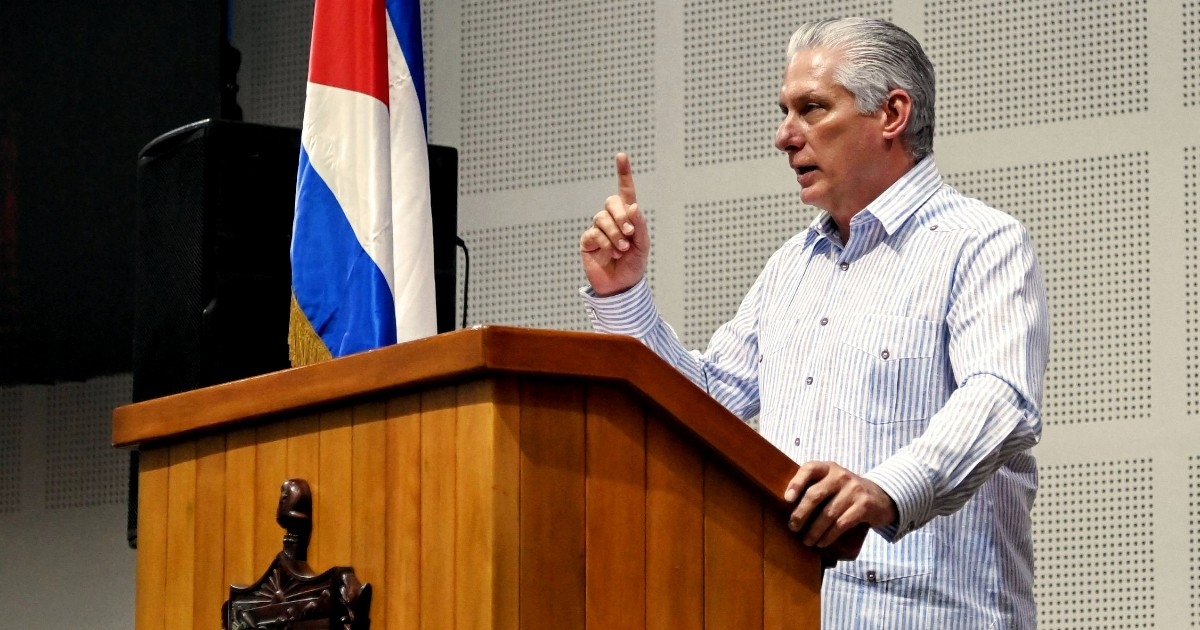
Miguel Díaz-Canel took to Facebook to assert that in over sixty years of socialist revolution, just ninety miles from the United States, Cuba has never initiated any offensive action against the national security of the U.S.
In a post titled "Cuba Does Not Threaten, Cuba is Constantly Threatened," the Cuban leader labeled the U.S. government as "cynical" for portraying Cuba as a "threat to American national security."
His remarks quickly followed statements made this Tuesday by U.S. Defense Secretary Pete Hegseth, who reaffirmed before Congress that the Cuban regime poses a threat to the United States. Hegseth's comments echoed warnings contained in Executive Order 14380, signed by Donald Trump on January 29, 2026.
Historical Context Challenges Díaz-Canel's Narrative
The Cuban government has maintained a hostile posture toward its northern neighbor for decades, with several periods characterized by heightened tension.
One of the most undeniable episodes is the October 1962 Cuban Missile Crisis. During this period, the Soviet Union installed nuclear missiles in Cuba capable of reaching the entire continental U.S., with Fidel Castro’s knowledge and consent.
For 13 tense days—from October 16 to October 28, 1962—the world teetered on the brink of nuclear war, and the U.S. raised its DEFCON alert to level two, the highest before an atomic confrontation.
These missiles, positioned on Cuban soil, were aimed directly at American cities, a fact that no official narrative can erase.
Cuba’s Espionage and Military Activities
In the 1990s, the Wasp Network—a Cuban espionage group dismantled by the FBI in September 1998—actively operated in Miami with specific military objectives.
Their missions included infiltrating the U.S. Southern Command, the Boca Chica base in Key West, and identifying sites on the U.S. southern coast for smuggling weapons and explosives, according to FBI declassified documents.
The leader of this network, Gerardo Hernández Nordelo, was commended by Cuban Intelligence on April 1, 1996, for orchestrating the shootdown of Brothers to the Rescue planes, resulting in four fatalities.
From the 1960s to the 1980s, Cuba trained guerrillas and dispatched military advisors to Latin America and Africa, deploying over 377,000 troops to Angola between 1975 and 1991 during Operation Carlota, which resulted in more than 2,000 confirmed Cuban casualties.
The U.S. perceived this exportation of the Cuban revolution as a direct threat to its hemispheric influence throughout the Cold War.
Cuba’s Current Geopolitical Stance
Moreover, since 1984, Cuba has provided asylum to Assata Shakur, convicted in 1977 for the murder of a New Jersey police officer and wanted by the FBI, with the Cuban regime firmly rejecting extradition.
In the present context, Secretary of State Marco Rubio pointed out on April 28, 2026, that Cuba allows adversaries to operate against U.S. interests, citing the presence of Russian and Chinese military bases on Cuban soil.
Conversely, Díaz-Canel maintains that labeling Cuba as a threat, while imposing additional coercive measures and accusing its government of economic incompetency, is so inconsistent and fanciful that even its proponents cannot support it with solid arguments.
This is not the first instance where the Cuban leader has sent such messages to the U.S. and the global community. Previously in April, Díaz-Canel had issued warnings regarding a potential conflict with Washington, and on May 2, he responded to Trump by emphasizing that Cuba is not an aggressor.
Cuba remains listed as a state sponsor of terrorism. The Trump administration has imposed over 240 sanctions on the island since January 2025.
Understanding Cuba's Alleged Threats to the U.S.
Why does the U.S. consider Cuba a threat?
The U.S. perceives Cuba as a threat due to its historical and ongoing activities, such as hosting Soviet nuclear missiles during the Cuban Missile Crisis, espionage operations like the Wasp Network, and providing asylum to individuals wanted by the FBI. Additionally, the presence of foreign military bases on Cuban soil is seen as a security concern.
What was the Cuban Missile Crisis?
The Cuban Missile Crisis occurred in October 1962 when the Soviet Union placed nuclear missiles in Cuba, capable of striking the U.S. This led to a 13-day confrontation between the U.S. and the Soviet Union, bringing the world to the brink of nuclear war.
Who is Assata Shakur and why is she significant?
Assata Shakur is a former member of the Black Liberation Army, convicted in 1977 for the murder of a New Jersey state trooper. She escaped from prison and fled to Cuba, where she has been granted asylum, making her a contentious figure in U.S.-Cuba relations.