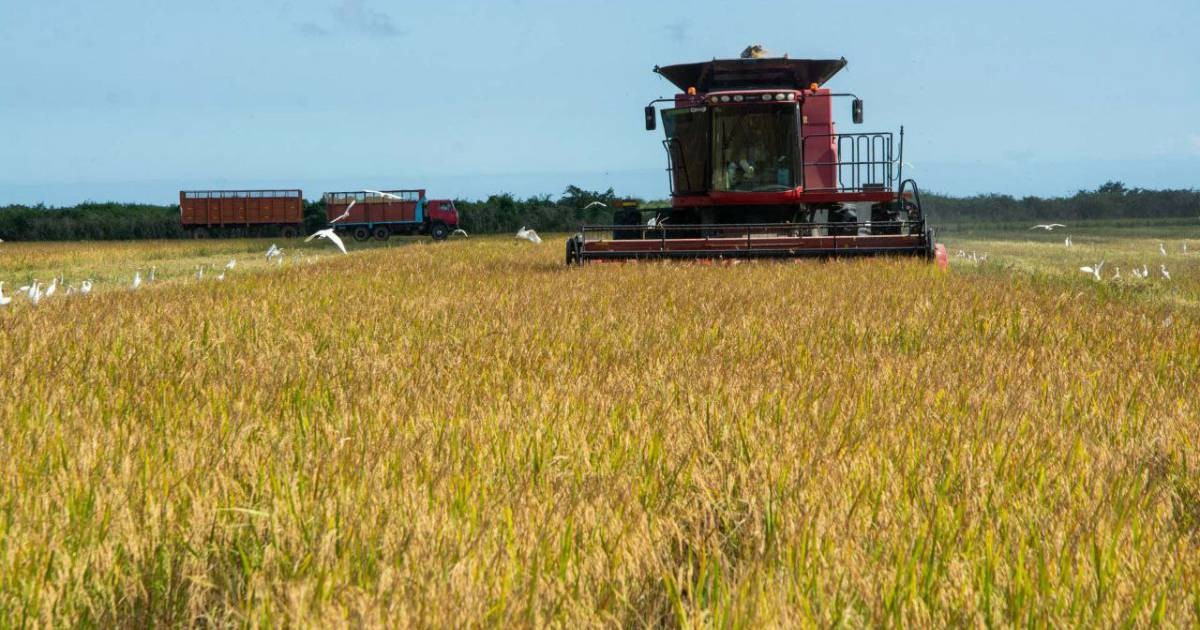
This week, the Chamber of Commerce of the Republic of Cuba issued a public call on social media, seeking foreign investment for the Agroindustrial Grain Company Los Palacios, located in Pinar del Río. The stated aim is to "maximize the productive capacities to support the people's food supply."
The invitation was unveiled during a Business Exchange Day organized by the Chamber of Commerce's agri-food cluster. It is accompanied by an almost twenty-minute institutional video that outlines the company's potential.
As one of the largest rice producers in the country, the Agroindustrial Grain Company Los Palacios (EAIG) was established on December 30, 1986, by resolution 532 of the Ministry of Agriculture. The company manages 47,338 hectares, with 21,577 hectares dedicated specifically to rice cultivation.
The company's infrastructure is equipped to dry 1,177 tons of wet rice daily and store over 15,000 tons of dry rice husks. This capacity is distributed across four agricultural business units, four industrial units, and an agro-industrial unit in Mantua.
Beyond rice, the company diversifies its offerings with marabou charcoal under the brand Marabucubá—exported to Portugal, Spain, Germany, and Saudi Arabia—and pork products under the brand Santa Bárbara, featuring a packing facility with a daily capacity of 1.5 tons.
This model isn't new for the regime. In January 2025, it granted 1,000 hectares in usufruct to the Vietnamese company Agri VMA at the Cubanacán farm of the EAIG. This marked the first time Cuban agricultural lands were allocated to a foreign entity.
The project initially achieved yields between 6.5 and seven tons per hectare, compared to the historical provincial average of one to 2.5 tons. However, it soon encountered the regime's bureaucracy. By July 2025, Agri VMA reported to three Cuban ministers that $300,000 was frozen in the International Financial Bank, reducing their production to 10% due to a lack of resources.
The new call for investors comes amid a food crisis subtly acknowledged in the institutional video: "despite the investments made by the country, the harvester fleet remains insufficient," the material concedes.
Between 2018 and 2023, national rice production plummeted by 59% to 87%, covering less than 6% of national consumption in the latter year. Imports reached 484,222 tons, according to the Cuba Statistical Yearbook 2023.
By 2026, the regime aims to plant 200,000 hectares of rice, with an ambition to meet 85% of the rationed basket's demand by 2030, as stated in the EAIG’s institutional video.
Simultaneously, the regime has been formally opening up to foreign investment in the agricultural sector. In March, it allowed Cubans living abroad to access lands in usufruct, and in April, the Minister of Foreign Trade confirmed they could participate as partners in private companies under the Foreign Investment Law 118.
The case of Agri VMA, however, highlights the main challenges any investor faces when considering Cuban agriculture: a secretive financial system, immobilized funds, and a state bureaucracy capable of stalling operations even when productive outcomes are promising.
Understanding Foreign Investment in Cuban Agriculture
What is the current status of rice production in Cuba?
Rice production in Cuba has dramatically declined between 2018 and 2023, covering less than 6% of national consumption with significant reliance on imports.
How is the Cuban government attempting to attract foreign investment?
The Cuban government is reaching out to foreign investors through public calls and allowing Cubans abroad to participate in partnerships in the agricultural sector under new investment laws.
What challenges do foreign investors face in Cuba's agricultural sector?
Investors face challenges such as a non-transparent financial system, frozen funds, and extensive state bureaucracy that can hinder operational progress despite positive production results.