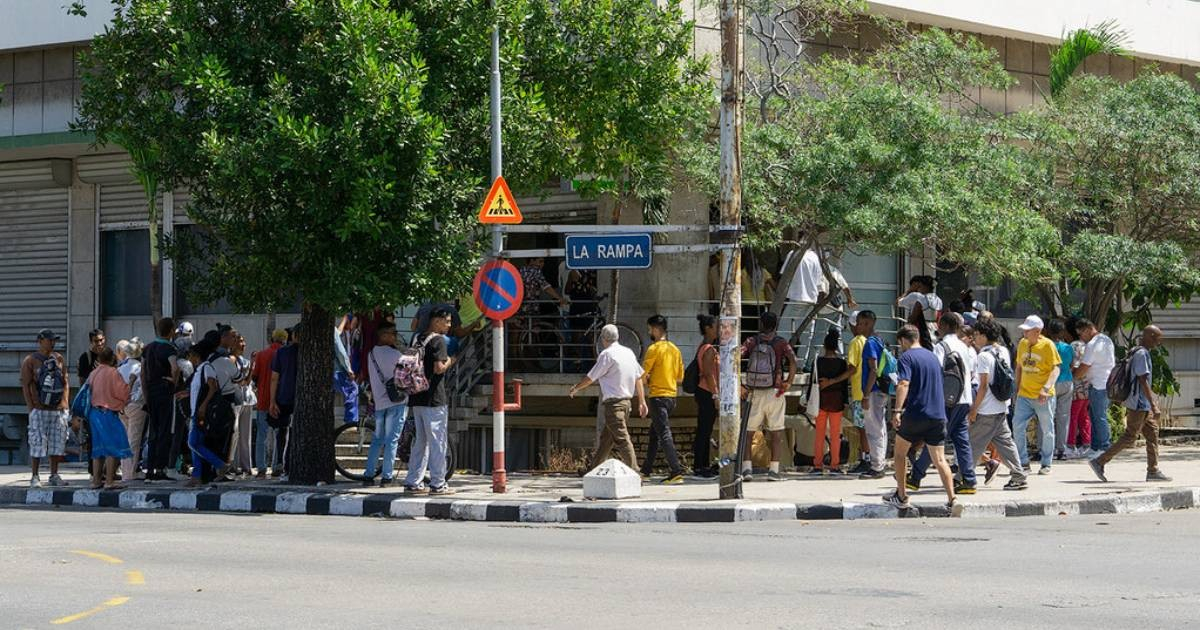
A mother from Havana encapsulated the painful reality facing countless Cuban families today. When asked if she saw a way out of the crisis, she simply replied no, expressing her only hope that her children could leave the country to find peace.
This poignant statement is part of the report "Cuba, the Island Fading Away," aired by the Argentine news program Telenoche (Channel 13) this past Monday. Journalist Carolina Amoroso depicted the current situation in Havana after gaining entry to Cuba under the guise of a tourist visa, circumventing the regime's restrictions on foreign media.
"I don't see any way out. If my children can make it, God willing... because even if they leave, even if they're far away, it doesn't matter, but I know I will have peace of mind," the woman told the cameras.
This sentiment echoes the mindset of many Cuban parents who no longer envision a brighter future on the island but yearn for their children to escape it.
Harsh Realities on the Ground
The report, shot with limited resources by cameraman Juan Pablo Chávez, exposes a Cuba mired in one of its most severe economic and social crises in decades. Testimonies from various Havana neighborhoods reveal power outages at any time of day, a virtually nonexistent public transportation system, and acute shortages of food and medicine.
"Like clowns, we laugh on the outside, but inside we're too sad. Too lifeless," confessed another interviewed resident.
Living on the Edge
One family shared that they only eat once a day, whatever they can find at night: an egg or a bit of minced meat, as chicken is unattainable. According to one account, a package of chicken costs nearly an entire monthly salary. The ration book barely provides a single piece of bread per person each day.
Another former paramedic described quitting his job on ambulances because "I was transporting more deceased people than patients." A neighbor showcased his childhood home, now ruined by leaks and neglect. One interviewee estimated that 80% of Habaneros want to emigrate.
Environmental and Energy Challenges
The lack of fuel has also partially stalled garbage collection, leading to large piles of waste on the streets and corners of the capital.
"It's impossible to live in Cuba now. Look at the streets. Everything is falling apart. They don't collect the garbage, and there are no medicines in the hospitals," another Havana resident complained.
The situation depicted in the report aligns with alarming statistics. The survey "In Cuba There's Hunger 2025," conducted by Food Monitor Program and released on May 4, revealed that 33.9% of Cuban households had at least one member go to bed hungry, an increase of nine points from 2024. Furthermore, 79.4% of respondents reported spending over 80% of their income solely on food.
The energy crisis exacerbates the dire situation. On Monday, May 11, the electrical generation deficit hit 1,955 MW, with only 1,245 MW available against a national demand of 3,200 MW. As of this report, a town in Matanzas had endured seven consecutive days without electricity.
Amid this bleak scenario, the Cuban government announced the deregulation of fuel prices starting May 15, abolishing fixed prices, while gasoline has nearly vanished from state-run stations.
Since 2021, over a million Cubans have left the country, reducing the island's effective population from 11.3 million to between 8.6 and 8.8 million inhabitants.
"Cuba is fading away, and no narrative can mask it. This is the story of a nation crumbling. But it is also the story of a people searching for lost hope and dignity," concludes the Telenoche report's narration.
Understanding Cuba's Current Crisis
What are the main challenges facing Cuban families today?
Cuban families are grappling with severe economic hardships, including food and medicine shortages, frequent power outages, and a lack of public transportation. Many parents hope for their children to leave the country for better opportunities.
How has the energy crisis impacted daily life in Cuba?
The energy crisis has led to extended power outages, affecting households and businesses. It has also contributed to the breakdown of essential services like garbage collection and healthcare.
What measures has the Cuban government taken in response to the crisis?
The government recently announced the deregulation of fuel prices, removing fixed rates. However, this has not addressed the scarcity of gasoline and other critical resources.