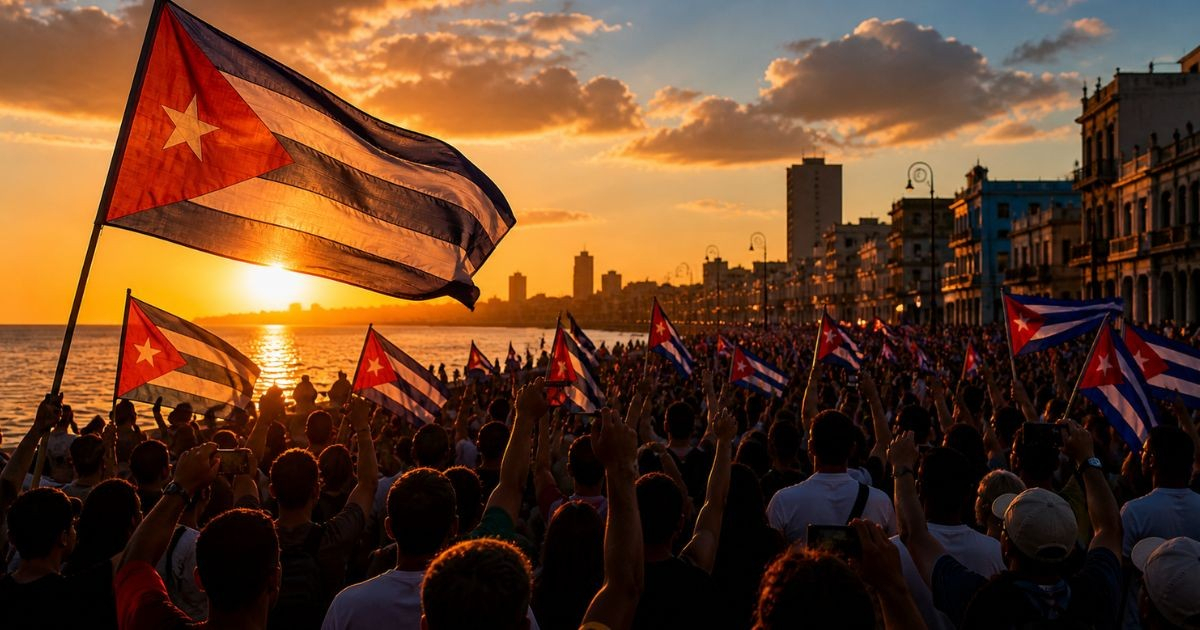
May 20, 1902, marked the formal birth of the Republic of Cuba. At noon, the flag with the lone star was raised over Havana's Morro Castle as General Leonard Wood transferred power to Tomás Estrada Palma, the island's first elected president.
However, as 2026 approaches, this anniversary is imbued with an unusual anticipation that extends far beyond historical debates.
A Complex Independence
According to several accounts, Generalissimo Máximo Gómez, who attended the ceremony, expressed emotionally, “At last, we have arrived!” Yet, this independence was born with conditions.
The Platt Amendment, approved in 1901 and incorporated into the Cuban Constitution, granted Washington the right to military intervention, limited Cuba's ability to sign treaties, and established the groundwork for the cession of Guantánamo.
Wood himself acknowledged in private correspondence: "Cuba has been left with little or no independence due to the Platt Amendment."
This foundational ambiguity explains why the date continues to divide opinions today.
A Divisive Date
For Cuban exiles and opposition sectors, May 20 represents the birth of the modern nation and a symbol of republican sovereignty, despite its historical limitations.
For the regime that emerged in 1959, that republic was "neocolonial" and "mediated" by the United States. Hence, January 1—marking the triumph of the Revolution—became the official founding date, erasing May 20 from the Cuban calendar.
Heightened Expectations in 2026
The 2026 commemoration is marked by extraordinary anticipation, transcending historical discussion.
The Trump administration has imposed over 240 new sanctions against the regime since January, signed Executive Order 14380 declaring the regime an "extraordinary threat," and expanded secondary sanctions on foreign banks on May 1 with Executive Order 14404.
The impact on Cuba's economy has been devastating: energy imports have shrunk by 80% to 90%, blackouts affect more than 55% of the territory with outages lasting up to 25 hours daily, and the economic contraction projected for 2026 is 7.2%, according to The Economist Intelligence Unit.
On Tuesday, Trump was direct when asked about the future of Miguel Díaz-Canel: "Cuba is not doing well. It is a failed nation. And we will be talking about Cuba at the right time."
Earlier, he posted on Truth Social: "Cuba is asking for help, and we are going to talk!" just before departing for a state visit to China from May 13 to 15.
Hope from Exile
Organized exile groups are not sitting idly. On March 2, the Cuban Resistance Assembly and Steps of Change signed the "Liberation Agreement" in Miami, a three-phase transition plan: freeing political prisoners, stabilization, and democratization with free elections.
Miami's mayor confirmed on Monday that the city has a contingency plan with police, firefighters, and paramedics ready to celebrate Cuba's freedom.
Diego Suárez, co-founder of the FNCA, was even more emphatic on May 5: "I am absolutely certain that Cuba will be free in 2026."
Meanwhile, the regime shows no signs of yielding. Díaz-Canel stated on April 24 that "political prisoners are not on the negotiation table," and his ambassador to the UN summarized the official stance on May 4: "Surrender is not in our dictionary."
In this context, May 20, 2026, is not merely an anniversary: for millions of Cubans inside and outside the island, it has become the symbol around which the most intense expectations for change in decades revolve, with the same vigor that Máximo Gómez saluted that flag 124 years ago.
Key Questions About Cuba's Future and May 20
What historical event does May 20 commemorate in Cuba?
May 20 commemorates the formal birth of the Republic of Cuba in 1902, when power was transferred to the island's first elected president, Tomás Estrada Palma.
Why is May 20 significant for Cuban exiles and opposition?
For Cuban exiles and opposition, May 20 represents the birth of the modern Cuban nation and serves as a symbol of republican sovereignty, despite its historical limitations.
What impact have recent U.S. sanctions had on Cuba?
Recent U.S. sanctions have severely impacted Cuba's economy, reducing energy imports by 80% to 90%, causing widespread blackouts, and leading to a projected economic contraction of 7.2% in 2026.