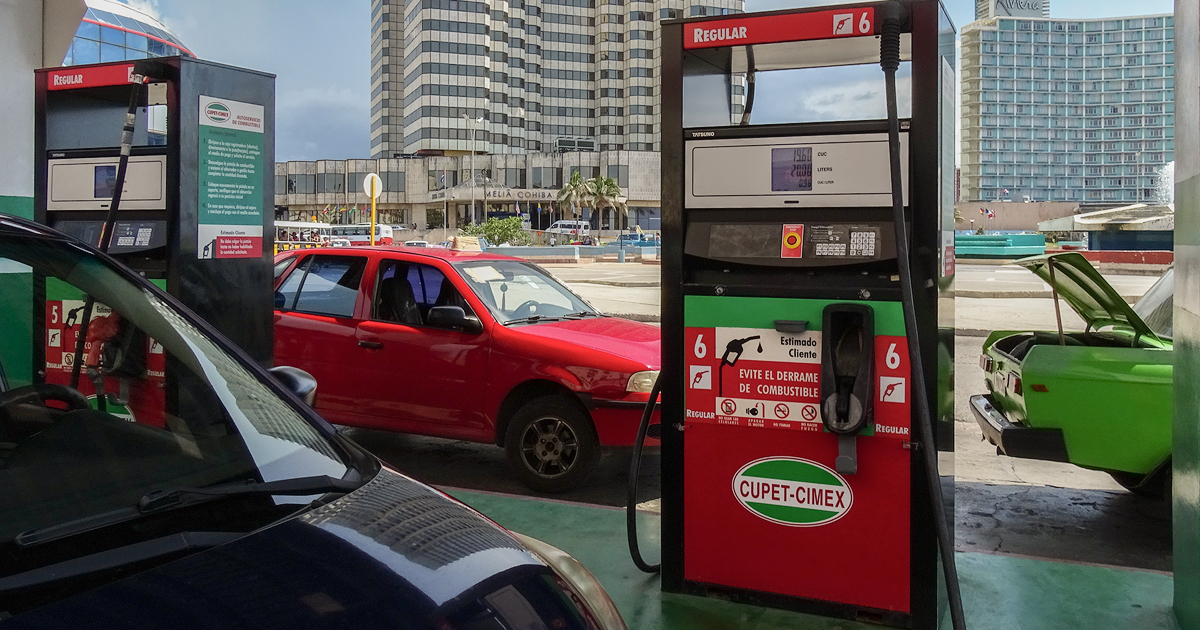
The Ministry of Finance and Prices in Cuba revealed today that starting Friday, May 15, at midnight, the prices of fuel sold in foreign currencies will no longer be fixed and uniform across the nation. This marks a significant shift in the regime's energy policy.
According to the official statement, the prices for fuel in foreign currencies will be adjusted, either increasing or decreasing, based on the actual costs of each specific transaction.
This change means that various retail prices will coexist at different service stations throughout the country. Each authorized economic entity that imports fuel in foreign currency will set their prices.
Factors such as the supplier, freight costs, supply routes, insurance, risks, and international market fluctuations will determine the pricing in each scenario.
The ministry admits that maintaining a single price "is not economically feasible under current conditions," effectively acknowledging that the State can no longer provide regulated prices and is transferring the real scarcity costs directly to consumers who pay in dollars.
The regime blames this measure on sanctions from the Trump administration, particularly the executive orders from January 29 and May 1 of 2026, which imposed secondary tariffs on any country or company that sold oil to Cuba.
Nevertheless, the fuel crisis stems from a combination of structural factors that extend far beyond the U.S. embargo.
The capture of Nicolás Maduro on January 3, 2026, cut off between 25,000 and 35,000 barrels per day that Venezuela supplied to the island. Meanwhile, Mexico halted Pemex shipments on January 9 of the same year under pressure from Washington, when the Mexican company covered 44% of Cuba's fuel imports.
Cuba's domestic production only covers about 40,000 of the 110,000 barrels needed daily, according to Jorge Piñón, an expert from the University of Texas.
The result was that Cuba, which requires eight fuel tankers per month, received only one between December 2025 and the end of April 2026. Even Miguel Díaz-Canel admitted in April that Cuba "absolutely lacks fuel for almost everything."
In the informal market, the price of gasoline soared to between 4,000 and 6,000 Cuban pesos per liter in April 2026, equivalent to between seven and 11 dollars at the informal exchange rate.
The announced price liberalization is the next step in a process that began in January 2024, when nearly 30 gas stations started selling fuel exclusively in dollars. This accelerated in February 2026 when CIMEX halted sales in Cuban pesos and limited gasoline purchases in dollars to 20 liters per person through a digital queue system.
More than 1,700 international flights have been canceled since February 2026 due to the supply crisis, highlighting the extent of the energy collapse facing the island.
Understanding Cuba's Fuel Price Policy
Why is Cuba changing its fuel pricing policy?
Cuba is adjusting its fuel pricing policy to reflect the actual costs of each transaction, as maintaining a single price is economically unsustainable under current conditions.
What factors will influence the new fuel prices in Cuba?
The new fuel prices will be influenced by factors such as the supplier, freight costs, supply routes, insurance, risks, and international market fluctuations.
How has the fuel crisis affected Cuba's international flights?
The fuel crisis has led to the cancellation of over 1,700 international flights since February 2026, demonstrating the severe impact of the energy collapse on the island.