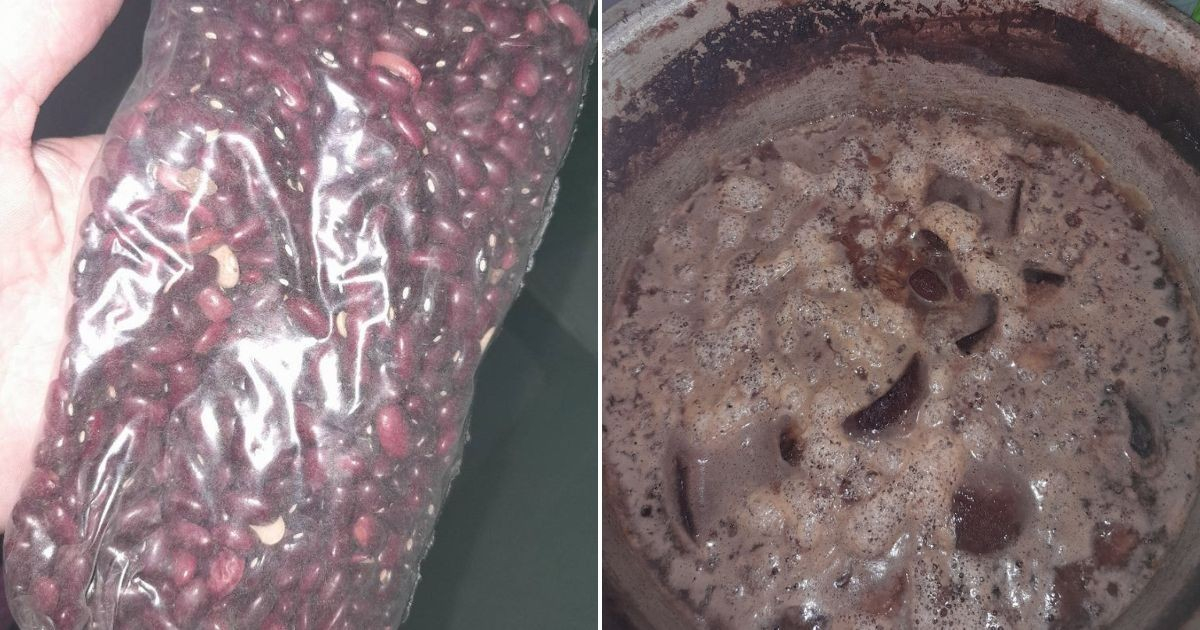
Deimi Mederos Ramírez, a Cuban resident, expressed her frustration in the Facebook group "Cuban Mothers Fighting Back" by sharing a heart-wrenching account of how frequent power outages ruined a pot of red beans she had painstakingly prepared for her son.
She explained that her son had requested "a lot of stew," so she decided to buy a package of beans for 500 pesos, fully aware that in today's Cuba, "a pot of beans is an investment."
The cost breakdown included a head of garlic at 70 pesos, a small pork leg at 250 pesos, a bundle of cilantro at 50 pesos, and a packet of tropical seasoning at 70 pesos, along with peppers and onions.
"I don't even want to add it all up to avoid tears," she admitted, choosing not to calculate the total expenditure.
Unfortunately, when she went to reheat the stew, the beans had spoiled due to the power cuts.
"An entire pot gone to waste, just like so many other things I've had to throw away," she lamented.
Mederos didn't hide her frustration: "The power outages are endless; this is abusive."
Her testimony also subtly criticized those who participated in the May Day parade supporting the government: "I sometimes wonder if those people marching on May 1st and defending this don't experience these issues too."
With sarcasm, she added, "Surely the Americans are also to blame for the beans going bad."
The most painful scene comes at the end: calling her son to eat and imagining "his disappointed little face when he finds out what happened to his cherished beans."
Such losses are not isolated incidents. According to the 2025 Food Security Survey, which gathered 2,513 valid responses across Cuba's 16 provinces, 47.59% of respondents nationwide reported that their refrigerated food spoiled due to prolonged blackouts.
In four provinces, that figure exceeds 80% of households.
Moreover, 80.39% of those surveyed said power cuts hindered their ability to cook, nearly 10 percentage points higher than the previous year.
The organization behind the study warned that the situation in 2026 is "far more alarming" than in 2025.
The projected power generation deficit for Monday night's peak was 1,985 MW, with morning availability at just 1,430 MW against a demand of 2,750 MW, according to the Electric Union.
The energy crisis has worsened since the cessation of Venezuelan crude in November 2025 and the suspension of supplies from Mexico, leaving Cuba's electrical system on the brink of permanent collapse.
So far in 2026, Cuba has endured at least five total collapses of the National Electric System, including a nationwide blackout on March 16th, the longest of the year.
Official maximum prices for common beans, set by the Council of Ministers in March 2025, already reached 285 pesos per pound in retail, although informal prices often exceed these.
This is not the first time Cuban women have documented this ordeal: other mothers have shown defrosted refrigerators, spoiled food, and even baby puree gone bad after entire nights without electricity.
"No one knows what we suffer day by day," concluded the author of the testimony, a phrase that encapsulates the reality faced by millions of Cubans caught between relentless power outages and an unyielding food crisis.
Impact of Power Outages on Cuban Households
How have power outages affected Cuban households?
Power outages have caused significant food spoilage and disrupted cooking capabilities, impacting nearly 48% of households nationwide and over 80% in some provinces.
What is the current state of Cuba's electrical system?
Cuba's electrical system is on the verge of collapse due to halted oil supplies from Venezuela and Mexico, leading to frequent blackouts and power generation deficits.
How have rising food prices impacted Cuban families?
Rising food prices, such as beans reaching 285 pesos per pound, have strained Cuban families' budgets, making it difficult to afford basic necessities.