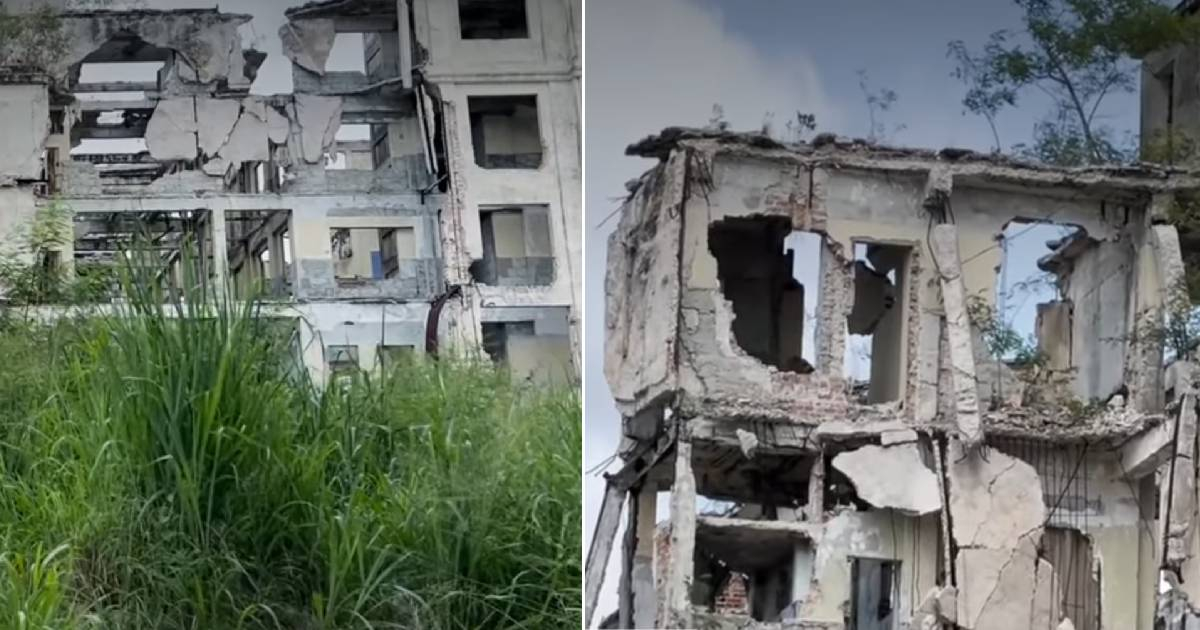
The remains of the once-renowned Joaquín García Lebredo Hospital, located in the Havana municipality of Arroyo Naranjo, have transformed into an open-air landfill enveloped by wild vegetation, debris, and revolutionary slogans. Once hailed as Cuba's premier maternity hospital, it fell into disrepair not because of bombs or warfare, but due to state neglect and decades of apathy, as digital creator Aldo Ruiz highlighted on his social media platforms.
Originally inaugurated in 1936 as a tuberculosis sanatorium, the facility was established by the Cuban Anti-Tuberculosis League and designed by architect Luis Echevarría. It was equipped to accommodate 400 patients, featuring an operating room, X-ray and fluoroscopy facilities, a pharmacy, clinical laboratory, and a morgue with a capacity for twelve bodies, among other amenities. Its advanced facilities impressed visiting foreign medical delegations and were featured in the November 1937 issue of the magazine Arquitectura.
After the 1959 revolution, the government added two extra floors to the original three-story structure, converting it into a gynecological and obstetric hospital. Residents recall that Fidel Castro himself dubbed it "the best maternity hospital in Cuba."
The Decline and Abandonment
The decline of the hospital accelerated during the Special Period. Dr. Agustín Figueroa, who worked there during that time, reported that between 1991 and 1996, the hospital was nearly entirely destroyed. This downfall was hastened by the exodus of doctors, systemic theft of materials, and authorities' indifference, as detailed in a report by 14ymedio.
By 2000, the Ministry of Public Health had completely abandoned the premises. All equipment and machinery were relocated to the nearby Julio Trigo López Hospital. Since then, doors, pipes, and any salvageable materials have been stolen by thieves or even by local residents.
A Failed Attempt at Demolition
"A few years ago, the government brought a crane to demolish it, but despite their efforts, the building wouldn't budge. Eventually, they gave up," recounts Tomás, a 67-year-old resident, to 14ymedio. His son Julián, 42, added, "The plan was to demolish the hospital and build a rest villa for the military."
Today, the building's perimeter is littered with debris and trash. "It's Havana's dump," Tomás describes, cautioning that the Lebredo remains a "collapse zone." On its walls, someone has painted in large letters: "There is no aggression Cuba cannot withstand," a slogan that residents themselves find ironic.
Not an Isolated Case
The fate of the Lebredo is not unique in Cuba; numerous historic sites have suffered similar neglect, from the Lidia Doce Nursing Home to architectural gems in Old Havana and other historical structures left to decay. Havana experiences approximately 1,000 building collapses annually, and Cuba's housing deficit exceeds 805,000 homes, with independent estimates suggesting it could reach 929,000 this year.
"Imagine, Fidel Castro once claimed this was the best maternity hospital in Cuba," Tomás concludes, observing what Dr. Figueroa described as a scene "straight out of a horror movie."
The State of Cuban Hospitals and Infrastructure
What led to the decline of Hospital Lebredo?
The decline of Hospital Lebredo was caused by state neglect, theft of materials, and the exodus of medical professionals, further exacerbated during the Special Period.
What was the original purpose of Hospital Lebredo?
Hospital Lebredo was originally designed as a tuberculosis sanatorium in 1936, equipped to treat 400 patients with advanced medical facilities for its time.
Is Hospital Lebredo's situation common in Cuba?
Yes, the situation at Hospital Lebredo is not unique. Many historical buildings in Cuba have suffered similar neglect, contributing to widespread infrastructure deterioration.